Yurei are perhaps the most terrifying Japanese creatures. These are the ghosts of the deceased and have been introduced to Western culture through horror films such as Ring (The Ring) and Ju-On (The Grudge). Yurei have long, disheveled hair and appear to be wearing the clothes they died or were buried in, such as a white burial kimono.
In some cases, they may have a specific person, but they are usually linked to the place where they died. Yurei are trapped between life and death and can only move on when their unfinished business is resolved, like ghosts in Western mythology.
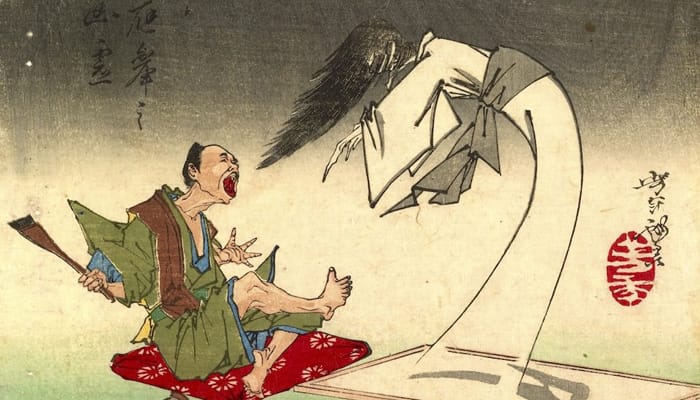
Like their Chinese and Western counterparts, they are believed to be spirits who are kept from a peaceful afterlife.
1. Etymology
Yurei are figures from Japanese folklore, analogous to Western legends of ghosts. The name consists of two kanji, (yu), meaning “weak” or “tenuous,” and (rei), meaning “soul” or “spirit.” Alternative names include (Borei), meaning ruined spirit or deceased, (Shiryo) meaning dead spirit, or the broader (Yokai) or (Obake).
2. Life after death for Japanese people
According to common Japanese beliefs, all living beings have a soul or spirit called reikon. When a person dies, the reikon leaves the body and enters a form of purgatory, where it waits for the appropriate funeral and post-funeral rites to be performed so that it can join its ancestors.
Buraq: Islamic Creature. Horse With a Woman’s FaceIf this is done correctly, the reikon is believed to be a protector of the living family and returns annually in August during the Obon Festival to receive thanks.
The emotion or thought does not need to be particularly strong or driving, and even harmless thoughts can cause a death to be disturbed. Once a thought enters the mind of a dying person, their Yurei will return to complete the action of the last thought before returning to the cycle of reincarnation.
The Yurei thenexists on Earth until it can be laid to rest, either by performing the missing rituals or by resolving the emotional conflict that still binds it to the physical plane. If the rites are not perfected or the problem is not solved, the Yurei will remain in its limbo.
Often, the lower the social status of the person who died violently or was treated harshly during their life, the more powerful their return will be. This is illustrated in the fate of Oiwa in the story Yotsuya Kaidan, or the servant Okiku in Bancho Sarayashiki.
3. Appearance
The Zensho-an in Tokyo houses the largest collection of Yurei paintings, which are only displayed in August, the traditional month of spirits.
White clothing: Yurei are usually dressed in white, which refers to the white burial kimono used in funeral rituals during the Edo period. In Shintoism, white is a color that signifies purity within the ritual, proverbially reserved only for clergy and the deceased.
They sometimes have a hitaikakushi (“forehead cover”), which is a small triangular piece of white cloth tied around the head.
A Yurei’s hair is often long, black, and unkempt, which some believe is a trademark of kabuki theater, where wigs are worn by all actors: Japanese women traditionally grew their hair long and wore it pinned up, and left it down for funerals and burials.
Byakko: White Tiger of the Western SkyHitodama: Yurei are often depicted as being accompanied by a pair of floating flames or wisps (hitodama in Japanese) in eerie colors such as blue, green, or purple. These ghostly flames are isolated parts of the spectrum rather than free energies.
4. Classifications
These ghosts come in categories. They depend on the degree of violent death. All Japanese spirits are called Yurei, and there are categories and classifications where there are several specific examples of apparitions, catalogued primarily by the way they died or the reason for returning from the afterlife, named as: Rancorous specters.
- Ubume: A ghostly mother who died in childbirth or died leaving behind young children. This Yurei returns to care for her children, often bringing them sweets.
- Goryo: These are malevolent spirits of the distinguished variety, mainly those who died as martyrs.
- FunaYurei: The souls of those who died at sea. These apparitions are personified as humanoids covered in fish-like scales, and others may also have a form equivalent to that of a mermaid or merman.
- Zashiki-warashi: Infant spirits; these spirits are not dangerous and often just like to play pranks.
- Floating spirits (FuYurei): These spirits do not seek to fulfill a specific purpose and wander aimlessly. In ancient times, it was believed that the illness of the Emperor of Japan arose as a result of these spirits floating in the air.
- Earthbound spirits (Hepburn Jibakurei): Similar to a FuYurei and rare, these spirits do not seek to fulfill a specific purpose and are bound to a specific place or situation. Famous examples of this include the famous story of Okiku in the well of Himeji Castle, and the obsession in Ju-On: The Grudge.
5. Buddhist ghosts
There are two specific types of apparitions in Buddhism, both of which are models of insatiable earthly hunger that occur after death. In Japanese customs, it is not only the dead who are skilled at using their reikon in possession. People or living beings possessed by enormous resentment or anger can release their souls as an Ikiryo, a living spirit that can do its own will.
An example of these spirits can be found in a famous novel about an ikiryo known as The Tale of Genji (Rokujo no Miyasundokoro). Lady Rokujo, the mistress of the titular Genji, falls deeply in love with him. She is an ambitious woman whose ambition is denied after the death of her husband.
The jealousy she harbored toward Genji slowly transformed her into a demon, and she took the form of an Ikiryo upon discovering that Genji’s wife was pregnant. This Ikiryo possessed Genji’s wife, ultimately leading to her death. Realizing that her jealousy had caused this misfortune, she locked herself away and became a nun until her death, after which her spirit continued to haunt Genji until his daughter performed the proper spiritual rites.
6. Hauntings
Yurei differ from traditional bakemono in their temporal specificity. The Yurei is one of the few creatures in Japanese mythology that has a preferred time of haunting (in the middle of the Ox hours, around 2:00-2:30 a.m.), when the veils between the world of the dead and the world of the living are at their thinnest.
In comparison, normal obake can strike at any time, often darkening or changing their surroundings if necessary. Similarly, Yurei are more tied to specific hunting grounds than the average bakemono, who are free to frequent any location without being bound to it.
Yanagita Kunio generally distinguishes between Yurei and Obake by pointing out that Yurei tend to have a specific purpose for their obsession, such as revenge or the completion of unfinished business. While for many Yurei this business is concluded, some Yurei such as the famous Okiku remain on earth due to the fact that their business cannot be completed.
Asmodeus: Demon King of the Nine Hells. Lust IncarnateIn Okiku’s case, this business is counting plates in the hope of finding a complete set, but the last plate is invariably missing or broken according to different versions of the story. This means that her spirit can never find peace, and she will therefore remain a Jibakurei.
7. Famous characters
Okiku, Oiwa, and the lovesick Otsuya together form the San O-Yurei (“three great Yurei”) of Japanese culture. These are Yurei whose stories have been passed down and retold over the centuries, and whose characteristics, along with their circumstances and fates, have formed a large part of Japanese art and society.
Some very famous tourist sites that are said to be haunted by Yurei ghosts are:
- The well at Himeji Castle haunted by the spirits of Okiku and Aokigahara,
- The forest located deep in Mount Fuji, a public territory for people to commit suicide. It is said that a peculiar and powerful Onryo, Oiwa, is capable of punishing any artist who portrays her role in a theater or film.
8. Exorcism
Traditionally, this is achieved through the revenge of family members against the Yurei’s murderer, or when the ghost consumes its passion and love with its lover, or when its remains are discovered and given a proper burial with all the rites performed.
The emotions of Onryo are particularly strong, and they are the least likely to be appeased by these methods. On occasion, Buddhist priests and mountain ascetics were hired to perform services for those whose unusual or unfortunate deaths could result in their transition to a vengeful ghost, a practice similar to exorcism.

