Let’s meet the mythical demon Asmodeus, a being that appears in countless legends and traditions from many cultures.
Asmodeus is one of the “Seven Princes of Hell,” a demon whose evil is matched only by his talent. He specializes in spreading lust, and he doesn’t just take advantage of ordinary people. Kings, queens, and even divine beings have been affected by his touch.

Who is Asmodeus?
Asmodeus is a prince of demons, or in the Judeo-Islamic tradition, the king of earthly spirits (shedim/jinn), best known from the deuterocanonical Book of Tobit, in which he is the main antagonist. In Binsfeld’s classification of demons, Asmodeus represents lust. The demon is also named in several Talmudic fables, one of which is the story of King Solomon building the Temple of Jerusalem.
Certain Renaissance Christians suspected that Asmodeus was the Prince of the Nine Hells. Asmodeus is also presented as one of the seven rulers of hell. In the symbolization of demons, each of these characters personifies one of the seven deadly sins: lust, gluttony, greed, sloth, wrath, envy, and pride.
Asmodeus is rooted in ancient Persia, identified as the demon Aeshma Daeva, one of the seven archangels of Persian mythology. He is said to be a demon of passion, jealousy, and rage. The meaning of his name may also come from the Hebrew word shamad, which means “to destroy.” He is also known as the destroyer of men and the demon of lust.
Representations of Asmodeus
In Jewish tradition, Asmodeus is described as the “king of demons.” Tradition says that Asmodeus fell in love with Sarah, the beautiful daughter of Raguel. He wanted Sarah for himself and did not want her to marry a human man. But Sarah married, and every time Asmodeus came to the marriage bed, he killed her new husband. This happened seven times.
It was then that Tobias, the eponymous author of the book, was visited by the angel who told him how to deal with the demonic lover. Tobias married Sarah and drove Asmodeus away. The demon fled to the farthest regions of Egypt where the angel Raphael bound him.
In the Testament of Solomon, Asmodeus plays a very important role. When King Solomon asks the demon about his duties, Asmodeus describes them as causing the destruction of fidelity between husband and wife, either through calamities or by leading men astray. He also attacks the beauty of virgins, causing them to waste away.
In a passage reminiscent of the Book of Tobit, Asmodeus admits that the angel Raphael has power over him. He could also be put to flight by burning the gall of a specific fish.
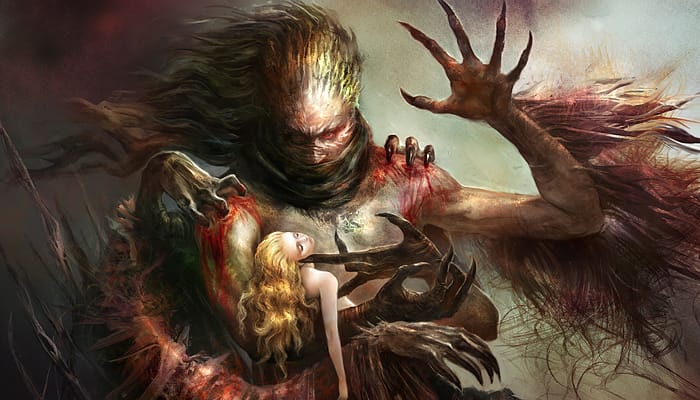
Origins and beginnings of Asmodeus
It is also stated in the Testament of Solomon thathe was“born of the seed of an angel by a daughter of a man.” If this were true, he would be among the Watchers. He was included among the Seraphim, the highest angelic order, but fell from grace and is mentioned in the Jewish Haggadah with regard to Noah.
It is said that Asmodeus came from a union between the fallen angel Shamdon and a lustful maiden named Naamah. King Solomon bound him with iron, a metal frequently used as an anathema for demons. Furthermore, in the fairy tradition of the British Isles, iron is used to harm or ward off the fae.
Also, according to Hebrew tradition, Asmodeus is the husband of Lilith, the queen of lust and mother of succubi and incubi, or is associated with her. Being Lilith’s companion is very likely since he is characterized as a demon of lust, sensuality, and luxury.
A conjunction of Asmodeus and Leviathan is mentioned in the Grimoire of Armadel. The two demons can teach about the malice of other demons. However, the operator is warned against using this technique because these two demons lie. In Francis Barrett’s The Magician, Asmodeus is associated with the sin of wrath.
Arthur Edward Waite’s 1910 edition of The Book of Black Magic and Pacts mentions Asmodeus as the superintendent of Hell’s casinos, the mention of a demonic hierarchy coming from 19th-century demonologist Charles Berbiguier.
Demonization in history
Of course, Christianity continued to demonize him. He was a major target in witch trials during the Middle Ages. Ascribed with a sexual nature, he would naturally be among the main demons with whom witches were accused of having sexual relations.
He also continued to be accused because of his relationship with Lilith. He was a patron of sorcerers and magicians who invoked him to strike their enemies. He also ruled gambling houses and was invoked with his head uncovered. He was one of the infernal agents accused of sexually possessing the nuns of Louviers in France (see Black Mass).
Etymology of Asmodeus
The name Asmodeus is also believed to have roots in the Avestan language, meaning “anger” and “demon.” However, it is likely that such a form existed, and that the Book of Tobit’s “Asmodeus” and the Talmud’s “Ashmedai” reflect this. In the study of Zoroastrian and Middle Persian demonology, the form khashm-dev did coexist, where the term dev was the same as daeva.
However, the encyclopedia proposes that the “Asmodeus” of the Apocrypha and the Testament of Solomon are not only related in some way to Esma, but have similar behavior, appearance, and roles, concluding in another article under the heading “Aeshma,” in the paragraph “Influence of Persian beliefs on Judaism,” that Persian Zoroastrian beliefs may have strongly influenced Jewish theology in the long term.
Origin of Asmodeus
Most scholars agree that Asmodeus is derived from Aeshma-daeva, an angry demon who appeared in Persian Zoroastrianism around the 9th century BCE. Later, the Jewish and Christian religions built upon the infamy of Aeshma-daeva, creating a new demon called Asmodeus.
In the Talmud and the Testament of Solomon (3rd century BCE), Asmodeus appears as one of the demons who was forced to help build Solomon’s temple. Unfortunately, Asmodeus proved too powerful for this slavery, and when he fell upon Solomon’s beautiful wives, he decided that enough was enough. He threw Solomon 400 miles into the desert, then disguised himself as the king and took over his palace, as well as his wives. Eventually, Solomon returned and expelled the demon.
In the Book of Tobit (400 AD), Asmodeus appears again as an evil demon who kills several of Sarah’s husbands, only to be expelled by the angel Raphael.
Later, Jewish and Christian theologians included Asmodeus in their categorization of demons. He appeared in important books, including the Dictionnaire Infernal, where he was given his high rank among the demons of hell.
Characteristics of Asmodeus
Asmodeus may be the “prince of lust,” but his appearance isn’t exactly tempting! He is a monstrous creature with three heads: one like a sheep, one like a bull, and one like a man. The man’s face may sound like the most normal, but with pointed ears, a hook-shaped noise, irregular teeth, and a mouth that breathes fire, this “human” feature is perhaps the most macabre of all.
All of Asmodeus’ heads are piled on a chest, which resembles a man. At the waist, his body undergoes another strange transformation, giving him the shiny feathered legs of a rooster and the scaly tail of a snake. As if Asmodeus were not strange and disturbing enough, the demon rides an equally strange steed: a lion with the wings and neck of a dragon.
Some later myths have toned down the horror of Asmodeus’ physical features. They describe him as a young man with an attractive face. He can be picked out from the crowd by his pronounced limp, and if you catch him without his clothes (not hard to do, considering that’s his specialty), you’ll find he has a rooster’s foot.
Asmodeus’ personality
Asmodeus is a powerful demon. He is considered one of the “seven princes of hell,” a position that requires great cunning and cruelty to obtain.
Each of the “seven princes of hell” is responsible for spreading one of the “seven deadly sins.” Asmodeus specializes in lust. In some cases, he has fanned the flames of lust. For example, he has connected with Solomon’s wife, Bathsheba, and may have been responsible for amplifying her infamous sexual appeal.
He is also the husband (or son) of Lilith, the “mother of all succubi.” In other cases, Asmodeus preys on people who succumb to lust. For example, I plagued the beautiful virgin named Sarah, killing seven consecutive suitors who wanted to marry Sarah and enjoy her body.
Although lust is Asmodeus’ bread and butter, I also have other sins. He is said to be the lord of numerous gambling houses. And he revels in revenge. I will never pass up an opportunity to fuel a grudge or help with violent plans for revenge.
Later, Asmodeus developed a more cheerful and playful personality. True, he was promiscuous and fond of a game of dice, but he did not have the evil intentions one would expect from one of the seven princes of hell.
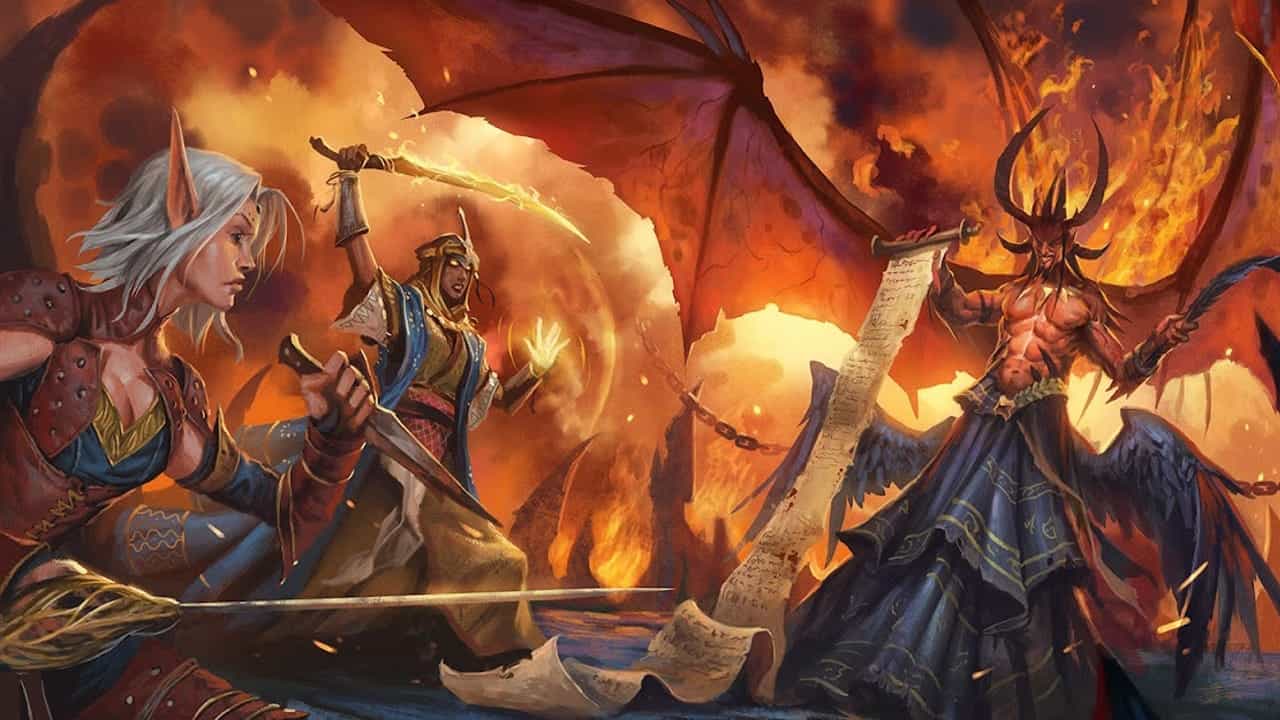
Other appearances of Asmodeus
- While the good gods dislike this demon, the legal deities accept him as a necessary evil that plays a role in the great cycle of creation. Asmodeus is always depicted wielding his Ruby Staff, a powerful artifact of the government. His secret goal is to defeat or subjugate the demons of the Abyss and then conquer the Higher Planes.
- The demon Asmodeus is also present in the Explorer’s Roleplaying Game in a role similar to his D&D counterpart. The main difference is that his church is widespread in Golarion, and this has elevated him to true divinity.
- The character of Asmodeus appears as the father of Magnus Bane and Prince of Hell, also known as Edom, in the third season of the Freeform television series Shadowhunters, based on Cassandra Clare’s popular book series The Mortal Instruments. He is portrayed by Jack J. Yang.
- This devil appears in the book Asmodeus: a Forkful of Tales from Devil’s Peak by Alex D’Angelo (author), Tony Grogan (illustrator) Tafelberg Publishers Ltd 1997. A story “Asmodeus and the Bottler of Djinns” is included in the anthology Favorite African Folktales edited by Nelson Mandela, published by Norton and available as an audiobook.

