Tonatiuh, in Mesoamerican religion, is the Nahua sun deity of the fifth and final era (the fifth sun). In most Mesoamerican Nahua myths, including those of the Aztecs, four eras preceded the era of Tonatiuh, each ending in cataclysmic destruction. Tonatiuh, or Ollin Tonatiuh, was associated with the eagle (at dawn and dusk) and, in Aztec versions, with the deity Huitzilopochtli.
The Aztecs saw Tonatiuh as a god constantly threatened by the incredible tasks of his daily birth at dawn, his death each sunset, and the immense effort of making his journey across the sky each day. According to Aztec traditions, it was believed that the gods themselves practiced voluntary sacrifice, first to create Tonatiuh and then to feed and encourage him on his journey across the sky.
The worship of Tonatiuh, whose sustenance required human blood and hearts, involved militaristic cults and the practice of frequent human sacrifice to ensure the perpetuation of the world. Tonatiuh is usually represented by a colorful disc. He is best known because he is depicted in the center of the Aztec calendar, with his eagle’s clawed hands grasping human hearts.
1. Etymology
Tonatiuh (pronounced Toh nah tee uh and meaning something like “He who comes forth shining”) was the name of the Aztec sun god, and he was the patron of all Aztec warriors, especially the important orders of the jaguar and the eagle.
In terms of etymology, the name Tonatiuh comes from the Aztec verb “tona,” which means to shine, sparkle, or emit rays. The Aztec word for gold (“cuztic teocuitlatl”) means “divine yellow excretions,” taken by scholars as a direct reference to the excretions of the sun deity.
2. Physical appearance
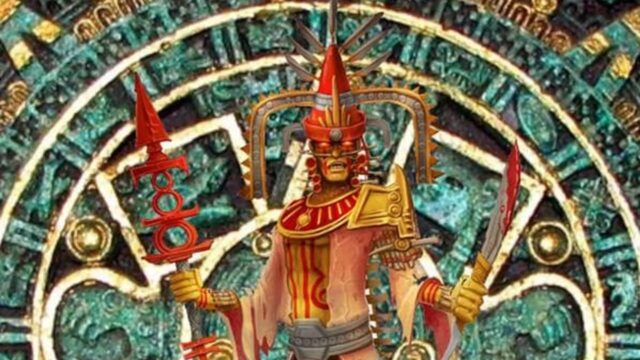
In certain representations, Tonatiuh is painted red and seen wearing an eagle feather headdress, holding a shield that could be a solar disc. This particular form of symbolism points to the ritual of human sacrifice, which was associated with Tonatiuh and his devouring of the hearts of his victims.
3.
The Aztec sun deity had both positive and negative aspects. As a benevolent god, Tonatiuh provided the Aztec people (Mexico) and other living beings with warmth and fertility. To do so, however, he needed sacrificial victims.
In some sources, Tonatiuh shared the role of supreme creator god with Ometeotl; but while Ometeotl represented the benign and fertility-related aspects of the creator, Tonatiuh had the militaristic and sacrificial aspects. He was the patron god of warriors, who fulfilled their duty to the god by capturing prisoners to be sacrificed in one of several shrines throughout his empire.
4. The image of Tonatiuh
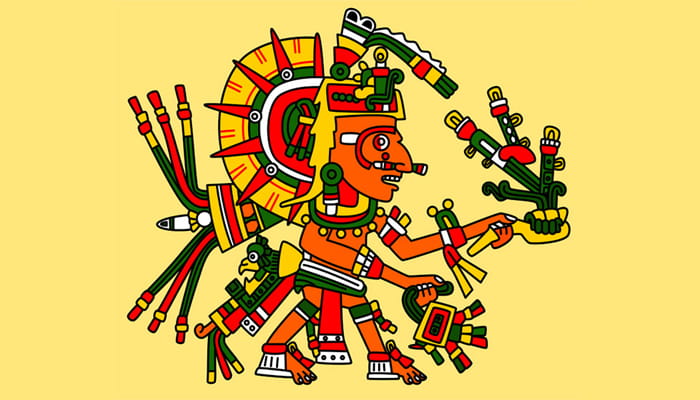
In the few surviving Aztec books known as codices, Tonatiuh is illustrated with circular earrings, a jeweled nose bar, and a blond wig. He wears a yellow headband decorated with jade rings and is often associated with an eagle, sometimes depicted in the codices alongside Tonatiuh in the act of grabbing human hearts with its talons.
Tonatiuh is frequently depicted in the company of the solar disc: sometimes his head is placed directly in the center of that disc. In the Codex Borgia, Tonatiuh’s face is painted in vertical bars in two different shades of red.
One of the most famous images of Tonatiuh is depicted on the face of the Axayacatl stone, the famous Aztec calendar stone, or rather the Sun Stone. In the center of the stone, Tonatiuh’s face represents the current Aztec world, the Fifth Sun, while the surrounding symbols represent the calendar signs of the last four eras.
On the stone, Tonatiuh’s tongue is a sacrificial flint or an obsidian knife protruding outward.
5. Tonatiuh in the Codex Borgia
In Mesoamerican culture, Tonatiuh (“Movement of the Sun”) was like an Aztec deity of the daytime sky and ruled the cardinal direction of the east. According to Aztec mythology, Tonatiuh was known as “The Fifth Sun” and was given a calendar name of naui olin, meaning “Movement 4.” Depicted as a fierce warrior god, he is first seen in the Early Postclassic art of the pre-Columbian civilization known as the Toltec.
Tonatiuh’s symbolic association with the eagle alludes to the Aztec belief in his journey as the present sun, traveling across the sky each day, where he descended in the west and ascended in the east. His journey was thought to be sustained by the daily sacrifice of humans. His Nahuatl name can also be translated to “He who goes beyond” or “He who makes the day.”
However, Tonatiuh was the central deity in the Aztec Calendar Stone, but is no longer identified as such. In Toltec culture, Tonatiuh is often associated with Quetzalcoatl in his manifestation as the morning star aspect of the planet Venus.
6. Creation myths
There are several versions of Tonatiuh’s birth as a sun deity in the Aztec creation myth. The Aztecs (also known as the Mexicas) believed in several sun gods. According to their mythology, the Earth and its beings had been created five times in five cosmic ages and were ruled by five different sun gods. When each age or eon had ended and the sun god and his beings had been destroyed, the gods had to choose a new sun god.
The four suns that preceded Tonatiuh were called “4 Tiger,” “4 Wind,” “4 Water,” and “4 Rain.” Each of the four eras and its beings had been destroyed by an element named after its sun. God: the beings in 4 Tigers (giants) were consumed by tigers; the beings in 4 Wind (monkeys) were destroyed by great winds; the beings in 4 Water were consumed by water; the being in 4 Rain (turkeys) was killed by rains of fire. The first two ages lasted 676 years, while the third age lasted 364 years.
The era of Tonatiuh was known as “the fifth age.” In a myth called “The Myth of the Primordial Sun,” the appearance of Tonatiuh as the fifth and final sun took place in the pre-Columbian Mesoamerican city of Teotihuacan. According to the myth, in order for Tonatiuh to rise, a substantial sacrifice had to be made. Despite the voluntary self-sacrifices of the Aztec gods Nanahuatl (or Nanahuatzin), a deformed and granular deity, and Teucciztecatl, Tonatiuh refused to ascend and did not ascend until the canine god Xolotl sacrificed himself.
In this particular account, it is said that it was Nanahuatl’s bravery that resulted in Tonatiuh’s ascension and that Teucciztecatl became the moon due to his hesitation before sacrificing himself. Several accounts of the creation myth depict different narratives.
According to an account by Franciscan missionary Bernardino de Sahagún, after the sacrifices of Nanahuatl and Teucciztecatl in a great fire, Tonatiuh rose weakly and did not move until the wind god Ehecatl (also known as Quetzalcoatl or Ehecatl-Quetzalcoatl) executed Xolotl and his name. Tonatiuh in motion. The account of this version of the creation of the fifth sun was captured in a text that read:
And they say that, although all the gods died, in truth, he still did not move. (It was not possible) for the Sun, Tonatiuh, to continue on his way. In this way, Ehecatl did his work. Ehecatl stood up. He grew extremely strong. He ran and blew lightly. Instantly, it moved (the sun). As such, it continues on its way.
It is also suggested that Tonatiuh is the transfigured version of Nanahuatl. In his writings on the creation of the fifth sun, Bernardino de Sahagún mentions that the gods were waiting for Nanahuatl to appear as the sun:
When both had been consumed by this great fire, the gods sat down to wait for Nanahuatzin to reappear; where, they wondered, would he appear? Their wait was long. Suddenly the sky turned red; everywhere the light of dawn appeared. It is said that the gods knelt down to wait for Nanahuatzin’s ascent as the Sun. Everyone around them looked, but they could not guess where he would appear.
7. Iconographic representations and symbols.
The iconographic representations of Tonatiuh have many personifications discovered in Aztec archaeology.
The Aztec stone calendar
Early pre-Columbian scholars have identified Tonatiuh as the central deity of the Aztec Calendar Stone. However, several scholars believe that the face in the center of the stone is that of the earth monster Tlaltecuhtli. This representation of Tlaltecuhtli is often personified in Aztec art with an open mouth and a sacrificial knife known as a “flint” representing a tongue.
While the inner ring of the stone contains the glyph “Movement 4,” it is flanked by four square compartments. These compartments and their glyphs are believed to represent the four cosmic ages preceding Tonatiuh as the fifth sun and the documentation of when each age was destroyed.
Some scholars maintain the view that Tlaltechutli means the destruction of the current or fifth era by earthquakes, a view relevant to the Aztec belief itself.
8. Belief in Alvarado as Tonatiuh.
During the Spanish conquest in the 16th century, the Aztecs believed that the Spanish explorer and conquistador Pedro de Alvarado was Tonatiuh and referred to him as such. Alvarado was said to be violent and aggressive and also had red hair, aspects that led the Aztecs to call him Tonatiuh or “the Sun.”
In a translation of his writings, Spanish conquistador Bernal Díaz del Castillo talks about the Aztecs’ reference to Alvarado as “the Sun.” Castillo describes Alvarado and Hernán Cortés meeting with Aztec ruler Moctezuma II and accompanied by their men, an encounter that includes a description of Alvarado’s characteristics:
The ambassadors who traveled with them reported their activities to Moctezuma, and he asked them what kind of faces and general appearance these two Teules who had come to Mexico had, whether they were captains, and it seems that they replied that Pedro de Alvarado was very pleasing, both in face and person, that he resembled the Sun and that he was a Captain, and in addition to this they brought a photo of him with his face very naturally portrayed and from there some time later they gave him the name Tonatio, which means the Sun or the Son of the Sun, and so they called him forever.
9. Aztec creation myths
The myth says that after the world was dark for many years, the sun appeared in the sky for the first time, but refused to move. The inhabitants had to sacrifice themselves and feed the sun with their hearts to propel the sun on its daily course.
Tonatiuh ruled the era in which the Aztecs lived, the era of the Fifth Sun. According to Aztec mythology, the world had gone through four eras, called suns. The first era, or Sun, was ruled by the god Tezcatlipoca, the second by Quetzalcoatl, the third by the rain god Tlaloc, and the fourth by the goddess Chalchiuhtlicue. The current era, or fifth sun, was ruled by Tonatiuh. According to legend, during this era, the world was characterized by corn eaters, and no matter what happened, the world would come to an end violently, through an earthquake.
10. The Flower War
The sacrifice of the heart, ritual immolation by cutting out the heart or Huey Teocalli in Aztec, was a ritual sacrifice to the celestial fire, in which hearts were torn from the chest of a prisoner of war. The sacrifice of the heart also initiated the alternation of night and day and of the rainy and dry seasons. In order for the world to continue, the Aztecs waged war to capture sacrificial victims, particularly against Tlaxcallan.
The war to win sacrifices was called “fields burned by water” (atl tlachinolli), the “sacred war,” or “flower war.” This conflict involved simulated battles between the Aztecs and Tlaxcallan, in which the combatants were not killed in battle but were taken prisoner and destined for blood sacrifice. The warriors were members of the Quauhcalli or “House of Eagles” and their patron was Tonatiuh; participants in these wars were known as the Tonatiuh Itlatocan or “men of the sun.”