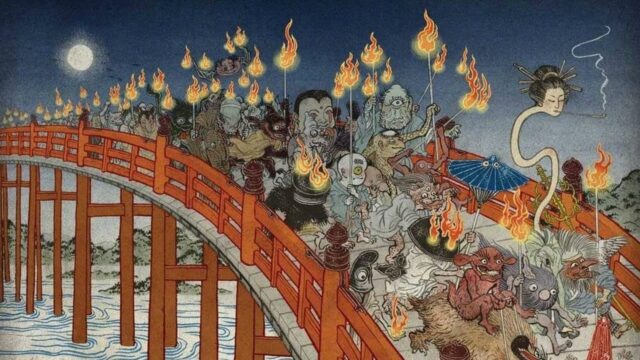
From animated umbrellas to polite but violent turtles, Japanese folklore contains some extremely creative Japanese myths featuring monsters. Compared to Japan’s collection of creatures, Western folklore can feel a bit monotonous.
The collection in Japanese mythology ranges from fantastic yokai to giant beasts and multiple supernatural spirits. Like any culture, Japan has its fair share of folkloric creatures within Japanese myths. But for Westerners, whose folklore tends to recycle the same variations on witches, goblins, orcs, and dragons, Japan’s bestiary of creatures can be surprisingly varied.

1. Yama-uba (mountain oyster)
Also originating in the medieval period within Japanese mythology, yama-uba are generally considered to be elderly women who were marginalized by society and forced to live in the mountains, who also have a penchant for eating human flesh.
Among many Japanese myths, there is one of a yama-uba offering shelter to a young woman who is about to give birth while secretly planning to eat her baby, and another of a yama-uba going to village houses to eat children while their mothers are away.
But they are not picky; they will eat anyone who passes by. Yamabuas also have their mouths under their hair.
2. Uji no Hashihime (Woman on the Uji Bridge)
In another Japanese myth about a woman who was scorned, Uji no Hashihime prayed to a deity to turn her into an oni so that she could kill her husband, the woman he had fallen in love with, and all of her relatives.

To achieve this, she bathed in the Uji River for 21 days, divided her hair into five horns, painted her body red with vermilion, and went on a legendary killing spree. In addition to her intended victims, anyone who saw her instantly died of fear.
3. Tengu
Tengu are mischievous mountain goblins who play tricks on people. They appear in countless folk tales within Japanese mythology and were considered purely evil until around the 14th century. They were originally depicted as birds with wings and beaks, although now the beak is often replaced by a comically large nose.

They are known to lead people away from Buddhism, tie priests to tall trees and towers, set fires in temples, and kidnap children.
4. Demon on the Agi Bridge
This Japanese myth begins as so many horror stories do: with an overconfident man who boasted to his friends that he was not afraid to cross the Agi Bridge, which was rumored to be haunted by a demon. As oni are known for their ability to change shape, the demon of Agi Bridge appeared to the man as an abandoned woman.

As soon as she caught the young man’s attention, she transformed back into a 9-foot green-skinned monster and chased him. Unable to catch the man, the demon then changed into the form of the man’s brother and knocked on his door late at night.
The demon was allowed into the house and, after a struggle, ripped off the man’s head, held it up, and danced with it in front of his family before disappearing.
Discover the 4 most popular Japanese myths in this video
5. Aka Manto (Red Cloak)
Japanese myths feature a demon for almost everything in their legends, and Aka Manto was one of the most popular demons, hiding in women’s bathrooms. In one version of the story, Aka Manto asks women if they would like a red cloak or a blue cloak. If the woman answers “red,” Aka Manto rips the flesh from his back to make it look like he is wearing a red cloak.
If she answers “blue,” he strangles her to death. Unfortunately, if you encounter Aka Manto, there may be no escape: some versions of the story say that if you don’t answer or if you choose a different color, he will immediately drag you to hell.
6. Tanuki
Starting the list with Japanese mythology are the powerful tanuki, or raccoon dogs. Tanuki are real animals native to Japan that look, as their name suggests, like a cross between a raccoon and a dog. But the folkloric version of tanuki, bake-danuki, is much more mischievous and powerful.
If you have ever been to Japan, you will undoubtedly have come across statues of chubby, friendly-looking creatures with large eyes. These are tanuki, but they are a much more modern and friendly reincarnation.
In the past, tanuki were tricksters who had the ability to change shape and stretch their massive scrotums. Depictions of tanuki show them using their scrotums for everything from makeshift jet skis to giant, comical faces.
7. Jorogumo
A decidedly uncharming yokai from Japanese mythology is the Jorogumo. When an orb-weaving spider reaches 400 years of age, it grows tremendously large and is able to transform into a beautiful woman to lure men to eat them later.
Since the origin story of the Jorogumo involves real spiders, the word is also used to refer to several species of spiders that, if they could live to be 400 years old, would ostensibly turn into this unpleasant creature.
8. Kappa
In Japanese mythology, humanoid reptiles called Kappa are said to inhabit the ponds and rivers of Japan. They are short and scaly, have beaks for mouths, and have a bowl on top of their heads that contains water. If a kappa’s bowl is emptied onto dry land in some way, it is said that they lose their magical powers. Although they are generally malevolent, kappa are supposed to be very polite. If a passerby bows to them, they will have to bow back, losing the water in their bowls. If that passerby refills the bowl, they will have made friends and allies for life.
Kappa drown children, drink the blood of their victims, or sexually assault women, but they also have three obsessions. The first is cucumbers, which they apparently cannot resist. The second is sumo wrestling. And the third is obtaining shirikodama, jewels containing the soul, located in people’s anuses.
9. Kamaitachi
In Japanese mythology, Kamaitachi are weasels with sickle-shaped claws on their feet. When they attack people, they travel in whirlwinds, knocking their victims down before slashing their ankles or calves.

According to Japanese mythology, the creatures’ sickles contain a type of medicine that prevents the wound from bleeding or hurting, which is considered polite after knocking someone down and cutting them. The pain is said to come later, however, after the anesthetic medicine has worn off. For some unknown reason, only men are attacked by Kamaitachi.
10. Nuribotoke
The word Nuribotoke means “lacquered Buddha” or “painted Buddha” due to the creature’s black skin and its slight resemblance to the Buddha, mainly due to its large stomach. According to Japanese mythology, its eyeballs hang out of their sockets, and it has a long tail that resembles a catfish’s tail. It also stinks.

Japanese homes and temples often contain a Buddhist shrine called a butsudan, a kind of ornate cabinet containing a small inner shrine. Bhutanese citizens keep them open during the day but close them at night, as it is believed that spirits can use them to enter the material world.
When a butsudan is poorly maintained or left open at night, Nuribotokes can enter homes, sometimes appearing as Buddhas who give false prophecies or dance at night.
You can read this article in Spanish here: Los 10 mitos japoneses más populares y aterradores