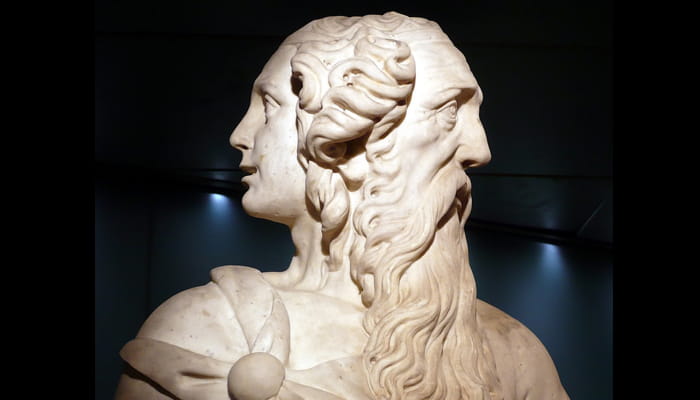
Janus was the god of beginnings and transitions in Roman mythology, presiding over passages, doors, gateways, and endings, as well as periods of transition, such as from war to peace. He was usually depicted with two faces looking in opposite directions, one toward the past and the other toward the future.
As the god of beginnings and transitions, both literal and abstract, he was also responsible for movement, change, and time. He was present at the beginning of the world, guarding the gates of Heaven, and also presided over the creation of religion, life, and even the gods. He was probably considered the most important Roman god, and his name was the first to be mentioned in prayers, regardless of which god the devotee wanted to pray to.
In one of the myths in which Janus played an important role, Romulus, one of the founders of Rome, kidnapped the Sabine women, aided by his men. Janus saved the women by creating a volcanic hot spring that erupted and buried the kidnappers in a mixture of boiling water and volcanic ash.
1. Janus and Jana
Janus and Jana, a pair of ancient Latin deities, were worshipped as the sun and moon, from which they were considered the highest of the gods, and received sacrifices before all others. The name Janus is just another form of Dianus, and Jana of Diana; but the ancients also related it to janua (door), as it was also applied to a passage covered with two entrances, such as the Janus medius.
The fact that Jana is identical in importance to Luna and Diana is attested without doubt by Varro. We explained earlier that Janus was considered identical to Sol, but this does not seem to have been the case originally, for it is said that the cult of Janus was introduced into Rome by Romulus, while that of Sol was instituted by Titus Tatius, and the priority of the cult of Janus is also implied in the story related by Macrobius.
We must therefore infer that the two deities were identified at a later period, and that in such a way that the separate idea of Sol was lost in that of Janus, since we find few traces of the worship of Sol, while that of Janus acquired the highest importance in the religion of the Romans.
2. Worship
In his regulation of the Roman year, Numa called the first month Januarius, after Janus, the highest deity, presiding over the beginning of all things: the king himself dedicated to Janus the passage called Janus, which was opened in times of war and closed when the Roman arms rested. This passage (commonly but erroneously called a temple), with two entrances, was generally called Janus Geminus, Janus Bifrons, Janus Quirinus, or Portae Belli, and was ad infimum Argiletum.
The objects of the first Janus (and those of the others in a similar manner) were as follows: “When the two cities (that of the Romans on the Palatine and that of the Sabines on the Quirinal) were united on equal terms, they built the double Janus, on the road leading from the Quirinal to the Palace, with a gate facing each of the cities, as the gate of the double barrier that separated their liberties.
It was opened in times of war, so that relief could pass from one to the other, and closed during times of peace, either to prevent unrestricted sexual relations, from which disputes might arise, or as a sign that, although united, they were distinct.”
This covered gate is often referred to in later times as a temple, but probably in a broader sense of the word, that is, as a sacred place containing the statue of Janus. A bronze statue of the god, five cubits high, existed until the time of Procopius.
3. Representations
In some representations, he held a staff or scepter in his right hand and a key in his left, symbolically describing him as the god who had power over the entrance to heaven; hence he had the surnames Patullus or Patullus, and Clusius or Clusiviuns.
Although in classical times the Romans themselves declared that Janus was peculiar to them, nevertheless, in a later period, when Janus was regarded as the god of all entrances and doors, we find that he was identified with Apollo.
We will pass over a series of arbitrary etymological and philosophical speculations, and simply observe that no nation in ancient times attached so much importance to the beginning of a work or undertaking as the Romans, who believed that the progress and success of a thing had some magical connection with its beginning.
Janus was the god of the beginning of everything: he protected the beginning of all occupations and actions, as well as human life, hence he was called Consevius (conserendo, or consationibus). Therefore, whenever a civil or military enterprise was unsuccessful, some fault was attributed to the way it was begun, and it was often started again.
Indeed, it was Jupiter who sanctioned all undertakings by augury, but their beginning depended on Janus’ blessing; therefore, these two deities were invoked first in all undertakings, and their names were mentioned first in all prayers.
The fact that Janus’ name was pronounced even before Jupiter’s, and that according to tradition Janus was in Italy before any of the other gods, and that temples were dedicated to him, is perfectly in accordance with the idea of the god, he being the beginning of all things; but it does not follow that he was therefore considered superior or more powerful than all the other gods.
4. Iconography
Janus is depicted on double-sided coins, initially with one bearded face, symbolizing the sun and the moon. Later, both faces were bearded. In his right hand he holds a key. After the 2nd century AD, he was also depicted with four faces.
In ancient Roman religion and mythology, Janus is the god of beginnings and transitions, hence also of doors, gates, portals, endings, and time. The Romans dedicated the month of January to Janus. His most apparent remnant in modern culture is his namesake, the month of January.
Although he was usually depicted with two faces looking in opposite directions (Janus Geminus (the twin Janus) or Bifrons), in some places he was Janus Quadrifrons (the four-faced one). The Romans associated Janus with the Etruscan deity Ani.
5. Theology and functions
While the fundamental nature of Janus is debated, in the opinion of most modern scholars, the entirety of God’s functions can be considered to be organized around a simple principle: that of presiding over all beginnings and transitions, whether abstract or concrete, sacred or profane. As the god of movement, he watches over passages, causes actions to begin, and presides over all beginnings, and since movement and change are two-sided, he has a dual nature, symbolized by his image with two heads.
He has under his protection the entrance and exit of the door of homes, the ianua, which gave him his name, and not the other way around. He has an altar, later a temple near the Porta Carmentalis, where the road leading to Veii ends, as well as being present at the Janiculum, a gateway from Rome to Etruria.
In one of his temples, probably the one in the Forum Holitorium, the hands of his statue were placed to signify the number 355 (the number of days in the year), later 365, symbolically expressing his mastery over time. He presides over the concrete and abstract beginnings of the world, such as religion and the gods themselves, and also has access to Heaven and other gods: this is why men must invoke him first, regardless of the god they wish to pray to or appease.
6. Rites
Cases can be found in the Carmen Saliare, the formula of devotion, the lutricion of the fields and the sacrifice of the porca praecidanea, the Act of the Arval Brothers.
Although Janus had no flame, he was closely related to the rex sacrorum who performed his sacrifices and participated in most of his rites: the rex was first in the priestly hierarchy of the ordo sacerdotum; the flamen of Portunus performed the ritual greasing of the spear of the god Quirinus on August 17, the day of the Portunalia, on the same date that the temple of Janus was consecrated in the Forum Holitorium (by the consul Gaius Gaius Duilius in 260 BC).
Portunus seems to be a god closely related to Janus, although with a specifically restricted area of competence, in the sense that he presides over doors and ports and shares with Janus his two symbols, the key and the stick.
7. Association with non-Roman gods
The two-faced god appeared repeatedly in Babylonian art. Reproductions of the image of such a god, called Usmu, on cylinders in Akkadian Sumerian art. In Greece, heads of gods related to Hermes similar to those of Janus have been found, perhaps suggesting a composite god.