A harpy was a creature that was part woman and part vulture in Roman and Greek mythology. Harpies were said to be spirits of the wind originally. Some descriptions defined a harpy as a woman with the body of a vulture, while others defined it as a woman’s body with a vulture’s head.

Origin
The word “harpy” derives from “harpyia” in Greek, which can be interpreted as “thief” or “one who steals.” They acted with sharpness and speed in their actions. Stories about them describe harpies as cunning creatures that steal food from their victims, which is why these mythical creatures were given the name “harpy.”
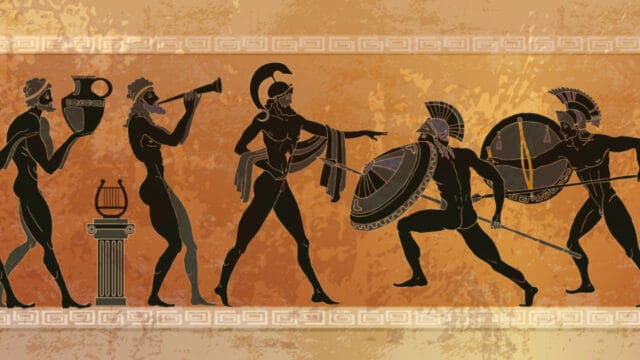
Both Hesiod and Homer mentioned harpies in their writings, but their existence was not limited to Greek literature. These creatures were also mentioned in Roman and Byzantine literature as furtive and ugly beings, while they were mostly depicted as beautiful women in pottery.
Harpies served Zeus whenever he wanted them to steal something from humans or take humans from the earth to punish them. That is why sudden disappearances of people and things were attributed to harpies in ancient times.
The King of Thrace, Phineus, was one of those humans punished by Zeus through harpies. Since he revealed some secrets of the gods using his talent for prophecy, Zeus punished him by ordering the harpies to steal any food placed on his plate right in front of his eyes.
These creatures are also said to have captured and taken evil people to the Erinyes, chronic deities of vengeance. In modern culture, the word “harpy” is used to describe a woman of an irritating and deviant nature.
Descriptions
They were generally depicted as birds with maidens’ heads, pale faces from starvation, and long claws on their hands. Roman and Byzantine writers detailed their ugliness. Pottery art depicting harpies featured beautiful women with wings. Ovid described them as human vultures.
Hesiod
For Hesiod, they were imagined as winged maidens, surpassing the winds and birds in the swiftness of their flight. “…the Harpyiai (harpies) with beautiful hair, Okypete (Ocypete) and Aello, and these two, with the speed of their wings, follow the rhythm of the winds, or of birds in flight, as they rise and swoop down, high above.”
Aeschylus
But even in Aeschylus’ time, they were described as ugly creatures with wings, and later writers took their notions of harpies to the point of representing them as the most repulsive monsters. The Pythian priestess of Apollo recounted the appearance of the harpies in the following lines:
“Before this man slept an extraordinary band of women (that is, harpies), seated on thrones. No! Not women, but rather Gorgons, whom I call; and yet I cannot compare them to the forms of Gorgons.
I once saw in a painting some creatures who were carrying off the feast of Phineus; but these are wingless, black, utterly repulsive; they snore with foul breath, and hateful drops drip from their eyes.
Their attire is not fit to be worn before the statues of the gods or in the houses of men. I have never seen the tribe that produced this company, nor the land that boasts of raising this brood with impunity and does not grieve for its labor afterward.
Functions and dwelling
They seem to have originally been spirits of the wind (personifications of the destructive nature of the wind). Their name means “thieves” or “swift thieves,” and they steal food from their victims while they eat and carry wrongdoers (especially those who have killed their family) to the Erinyes.
When a person suddenly disappears from the earth, it is said that they have been kidnapped by the harpies, who take the daughters of King Pandareus and deliver them as handmaids to the Erinyes. In this form, they are agents of punishment who kidnap people and torture them on their way to Tartarus. They were vicious, cruel, and violent.
The harpies were called “the hounds of mighty Zeus” and thus “ministers of the Thunderer (Zeus).” Later writers included them among the guardians of the underworld alongside other monstrosities, including the Centaurs, Scylla, Priam, the Lernaean Hydra, the Chimera, the Gorgons, and Geryon. Their home is the islands called the Strophades, a place at the entrance to Orcus, or a cave in Crete.
Names and family

However, Hyginus cited a certain Ozomene as the mother of the harpies, but also reported that Electra was also the mother of these beings in the same source. This can be explained by the fact that Ozomene was another name for Electra.
The harpies were possibly siblings of the river god Hydaspes and Arke, as they were called sisters of Iris and children of Thaumas. According to Valerius, Typhon was the father of these monsters, while another version by Servius said that the harpies were daughters of Pontus and Gaia or of Poseidon.
They are called Aello (“storm swift”) and Ocypete (“the swift wing”), and Virgil added Celaeno (“the dark one”) as the third. Homer knew of a harpy named Podarge (“winged foot”). Aello is sometimes also spelled Atropellus or Nicothoe; Ocypete is sometimes also spelled Ocythoe or Ocypode.
Homer called the harpy Podarge the mother of Achilles’two horses (Balius and Xanthus), sired by the west wind Zephyrus, while according to Nonnus, Xanthus and Podarkes, horses belonging to the Athenian king Erechtheus, were born of Aello and the north wind Boreas.
Other offspring of Podarge were Phlogeus and Harpagos, horses given by Hermes to the Dioscuri, who competed in the chariot race at the funeral games of Pelias. It was also said that the swift horse Arion was born of a harpy (probably Podarge), as attested by Quintus Smyrnaeus.
Modern reception
Harpies in the Infernal Forest, from Inferno XIII, by Gustave Doré, 1861
Dante
Harpies remained alive in the Middle Ages. In Canto XIII of his Inferno, Dante Alighieri contemplates the tortured wood infested with harpies, where suicides are punished in the seventh ring of Hell:
Here the repulsive harpies make their nests,
Who drove the Trojans from the Strophades?
With terrible announcements of the affliction to come. They have broad wings, sharp claws, and a human neck and face. Their feet are clawed, their bellies swollen and feathered; they squawk. Their lamentations echo in the terrifying trees.
William Blake was inspired by Dante’s description in his pencil, ink, and watercolor “The Wood of the Self-Murderers: The Harpies and the Suicides” (Tate Gallery, London). Greater coat of arms of the city of Nuremberg
Linguistic use and application

The harpy eagle is a real bird that owes its name to the mythological animal. The term is often used metaphorically to refer to an unpleasant or annoying woman. In Shakespeare’s Much Ado About Nothing, Benedick sees the sharp-tongued Beatrice approaching and exclaims to Prince Don Pedro that he would do a variety of arduous tasks for him “rather than have a three-word conference with this harpy.”
Heraldry
In the Middle Ages, the harpy, often called Jungfrauenadler or “maiden eagle” (although it may not have been modeled after the original harpy of Greek mythology), became a popular charge in heraldry, particularly in East Frisia, seen, among others, on the coats of arms of Rietberg, Liechtenstein, and the Cirksena.