Dagon, also known as Dagan, was a fertility deity who eventually became an important Semitic god. The Philistines, a community of Canaanites, were an Aegean people who settled on the southern coast of what is now Israel during the 12th century BC. Their pagan god

Dagon was represented by both grain and fish, symbols of fertility and multiplication. Often depicted with the torso of a man and the tail of a fish, he may be the first man, even before the mermaids (mermaids and men) of Greek mythological legends.
In the Hebrew Semitic dialect, the root of Dag, dag, means fish, and Dagan or Dagon is an endearing term meaning little fish. Some linguists interpret the name to mean grain in the ancient language of the Canaanites.
Origin
The first known appearance of Dagon is found in the records of Mari, Syria, in ancient Mesopotamia from 2500 BC. Later, he was mentioned in Assyrian and Babylonian inscriptions as a protective and warrior god, and in texts from the port city of Ugarit in ancient Syria.
A temple in his honor stood at this ancient site. At that time, he had risen to become the third god in the pantheon alongside El and Baal. Archaeological expeditions also discovered a temple to Baal in the city of Ugarit.
The Philistines were originally from the Aegean area near Greece, but they sailed to the coast of Palestine at about the same time that the Israelites entered the Promised Land from the east, around 1100 BC. Philistine culture and the skills of the Philistine people were relatively sophisticated.
They produced olive oil, worked with iron, and developed cities. Due to their strategic location, they were the dominant commercial force with other nations. The five main cities along the main trade route were Ashdod, Ashkelon, Gaza, Ekron, and Gath.
Family
In earlier mythology, Dagon’s companion was known as Belatu, meaning lady. Other mythologists associate him with the goddess Nanshe, who was a deity of fertility and fishing, and the son of Enki. She is the legendary sister of Astarte (Asherah).
Historical influence
Ark of the Covenant
The Ark of the Covenant contained the sacred tablets on which the Ten Commandments were written. The Israelites carried the ark with them during their 40 years in the desert. There are many miracles associated with the ark, including the parting of the waters of the Jordan River, which allowed them to cross into the land of Canaan.
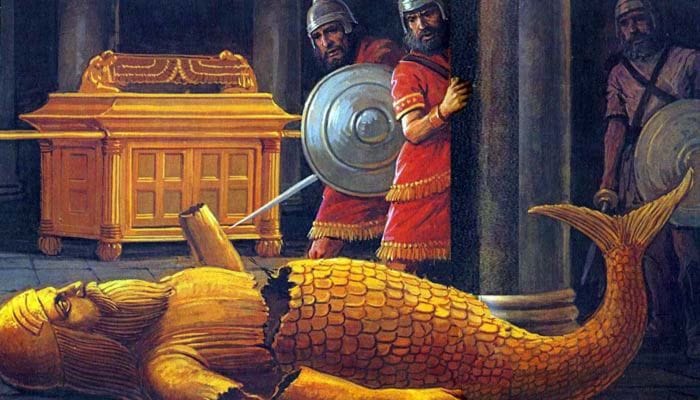
According to biblical legend, the Philistines captured the ark and took it to their capital, Ashdod, to place it in the temple of Dagon. The next day they found that Dagon’s idol had fallen face down. Thinking it was an accident, they replaced the statue.
They returned the next day and found the statue decapitated. Shortly thereafter, the city was struck by a plague of mice, and the people got hemorrhoids!
So the Philistines moved the ark to another city called Gath, and then moved it again to Ekron. Each of those cities has plagues too. The ark became a pain, not to mention the mice and vermin that accompanied it. Finally, after seven months, the Philistines sent it back to the Israelites along with the gifts.
Ichthys
The Jesus fish is a symbol called ichthys, which means fish. When written in the Greek alphabet, it is also an acronym for the words Jesus Christ Son of God Savior. The symbolism of fish goes back much further than the cross, and it has been theorized that early Christians adopted some symbolism from the ancient Mesopotamian pagans.
The Pope and Catholic bishops wear a tall hat called a miter, which is similar in shape to Dagon’s headdress. Some say it represents Dagon’s head with his mouth open, which is why it has a split top and a pointed shape. Some say the reason the Pope wears it is to continue the tradition of the miter worn by the first Pope who learned the secrets of Dagon.
Modern Influence

Dagon has made many appearances in literature and pop culture. He is the lord of demons in the game Dungeons & Dragons. In the movie Conan the Destroyer, Dagoth the evil god is named after him. During the television series Buffy the Vampire Slayer, the Order transformed energy into matter and protected the Key by becoming a human being.
It seems that the ancient Dagon was a big part of the lives of the ancient Philistines, Assyrians, Babylonians, and other Canaanites. He is mentioned several times in the Hebrew Bible, and his symbolism permeates Catholicism.
It is also possible that he may have been the first man, followed by many fish deities in more recent mythologies. He survives as a supernatural character in our current popular culture. He has had a long history, and his legend dates back to the 12th century BC.