The constellation Leo is one of the 13 constellations of the zodiac through which the Sun passes each year. It is between the constellation Virgo on its left and Cancer on its right. The two main stars in this constellation are Regulus and Denebola. There are two associated meteor showers, the delta-Leonids, active from February 15 to March 10, and the Leonids, active from November 10 to 23.
Leo is a large equatorial constellation representing a lion. It appears highest in the midnight sky in the months around February.
Its brightest star, Regulus, lies very close to the ecliptic, the path the Sun traces across the sky each year. The Sun passes through Leo each year between mid-August and mid-September.
North of Regulus, the lion’s mane is represented by a curved line of second- and third-magnitude stars.
Moving away from the plane of the Milky Way, most of the deep sky objects in this area of the sky are ninth-magnitude or fainter galaxies. Among the brightest is the Leo triplet, a tight grouping of three gravitationally bound galaxies: M65, M66, and NGC 3628.
In Greek mythology, Leo is identified as the lion of Nemea, slain by Hercules. His skin was armored against all weapons, and Hercules’ arrows deflected off the beast. After strangling the monster, Hercules used his skin as a cloak.
How to identify the constellation Leo
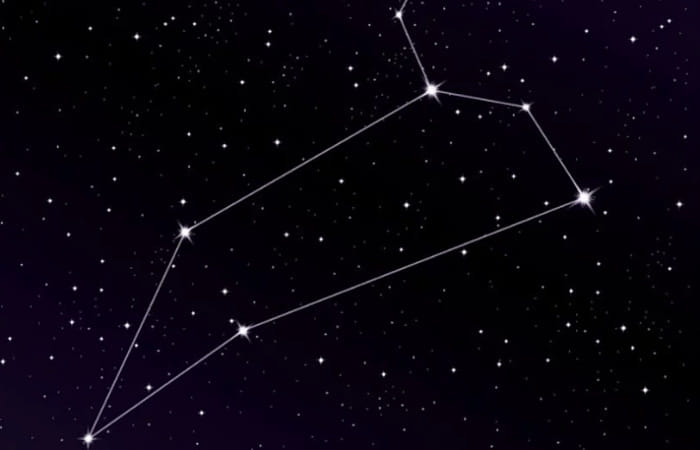
Of the 13 constellations in the zodiac, Leo the Lion is one of the easiest to identify in the night sky. Most people find Leo by first looking for a distinctive pattern in the dome of the sky: the pattern of a backward question mark. That star pattern, or asterism, is called the Sickle in Leo. Leo’s brightest star, Regulus, marks the bottom of the upside-down question mark pattern.
From the Northern Hemisphere perspective, the Lion is a fair-weather friend, leaping into the sky in the early evening hours around the March equinox. Late March, April, and May are great months to identify Leo the Lion, as this constellation becomes visible as soon as night falls and stays out until the wee hours of the morning. Remember, you are looking for a backward question mark pattern.
This pattern is the Sickle; its curve traces the mane of the Lion. Leo’s brightest star, Regulus, is a brilliant blue-white beauty of a star. It is located at the bottom of the backward question mark and represents the heart of the Lion.
A triangle of stars in eastern Leo represents the hindquarters and tail of the Lion. The brightest star in the triangle is called Denebola, which comes from an Arabic term meaning the Tail of the Lion.
Like all stars, the stars of Leo return to the same place in the sky four minutes earlier daily or two hours earlier monthly. In early April, the constellation Leo reaches its nighttime peak around 10 p.m. (11 p.m. local daylight saving time) and begins to sink below the western horizon around 4 a.m. (5 a.m. local daylight saving time). Around May 1, Leo reaches its evening high around 8 p.m. local time (9 p.m. local daylight saving time).
Also, in early May, the mighty Lion begins to set in the west around 2 a.m. local time (3 a.m. EDT). In June, you’ll see Leo descending in the west in the afternoon.
Although Leo moves progressively westward in the evening sky as the months pass, the Lion can be seen from evening through July. In late July or early August, the Lion begins to fade into the setting sun, not to return to the eastern sky before dawn until late September or October.
Find Leo star hopping from the Big Dipper.
If you are familiar with the Big Dipper asterism, you can star hop to Leo. To find Leo, first find the Big Dipper. In March, the Big Dipper stands on its handle in the northeastern sky at nightfall. At nightfall in April, look for the Big Dipper in the northeast sky, and at nightfall in May, look for the Big Dipper upside down in the north, over Polaris, the North Star.
Then identify the two stars of the Big Dipper indicator, that is, the two outer stars in the bowl of the Big Dipper. An imaginary line drawn between these stars points in one direction toward Polaris, the North Star. And it points in the opposite direction toward Leo.
Major Stars in the Constellation of Leo
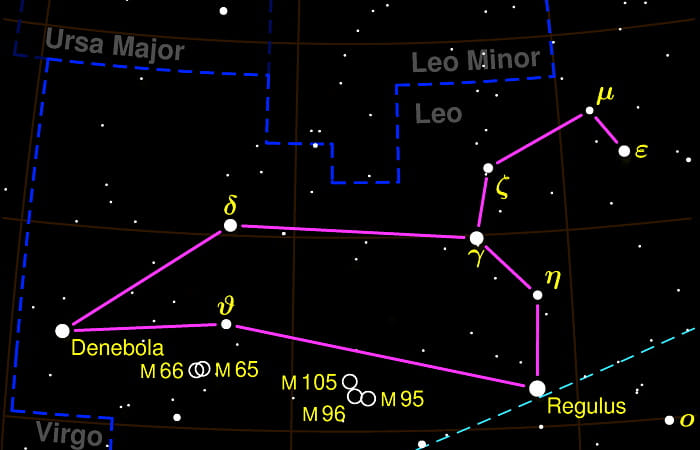
Denebola
Also known as Beta Leonis, Denebola is a bright white main sequence star located about 36 light-years from Earth. The star is only 75% larger in mass and radius than our sun.
Zosma
Also known as Delta Leonis, like Denebola, Zosma is a white main sequence star located about 58 light-years from Earth. The star has a mass and radius about twice that of the sun.
Chort
Also known as Theta Leonis, along with Denebola and Zosma, Chort forms the rump of Leo in the shape of a bright triangle. Like the other two, Chort is a white main sequence star. At a distance of 165 light-years from Earth, it is the farthest of the trio and, as a result, less bright.
Regulus
Also known as Alpha Leonis, Regulus is not only the brightest star in the constellation, but also one of the brightest stars in the night sky. Regulus is a four-star system located about 80 light-years from Earth, the system consists of the bright Regulus A and three dimmer stars. Regulus A is a large blue main sequence star with about 4 times the mass and radius of the sun.
Algieba
Also known as Gamma Leonis, Algieba is a two-star system about 130 light-years from Earth, consisting of two giant binary stars orbiting each other around 16 billion miles (26 billion km).
Adhafera
Also known as Zeta Leonis, Adhafera is a yellow-white giant star about 270 light-years from Earth, it is about six times larger in diameter than the sun with about three times its mass.
Leo Myth
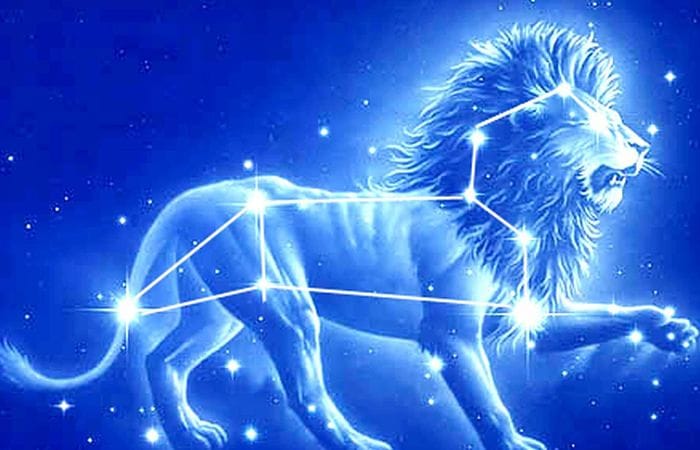
Like several constellations, Leo is based on the adventures of Hercules, a Greek mythological hero and son of Zeus. After being driven mad by his stepmother, the divine hero killed his six sons in a blind rage. When he recovered from his temporary insanity, Hercules tried to atone for his actions by serving penance for his crimes. Eventually, Hercules ended up under the control of King Eurystheus, who gave him a series of tasks.
The first of these tasks was to kill a lion that had been terrorizing the city of Nemea. Unknown to Hercules, the lion had a coat of golden skin that arrows and swords could not penetrate. On his first visit to the lion’s den, Hercules discovered that his arrows simply bounced off the beast. On his second visit, the hero blocked one of the two entrances to the den and entered armed with a large club, struck the lion with his club before strangling it to death.

