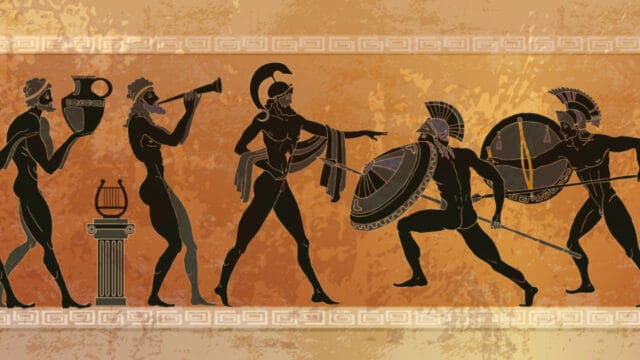
Bellona was an ancient Roman goddess of war. Her main attribute is the military helmet she wears on her head; she often holds a sword, a spear, or a shield, and wields a torch or whip while riding into battle on a four-horse chariot. Her iconography was further spread by painters and sculptors after the Renaissance.

1. Worship and temples
Originally called Duellona in the Italian languages, the cult figure who became Bellona was an ancient Sabine goddess of war and was identified with Nerio, the consort of the god of war Mars, and later with her Greek equivalent Enyo. Her first temple in Rome was dedicated in 296 BC, where her festival was celebrated on June 3.
Her priests were known as Belonarii and used to wound their own arms or legs as a blood sacrifice to her. These rites took place on March 24, called the day of blood (muere sanguinis), after the ceremony. As a result of this practice, which was similar to the rites dedicated to Cybele in Asia Minor, both Aeneas and Belona were identified with her Cappadocian aspect.
The Martius area of the Roman campus, where the temple of Bellona was located, had extraterritorial status. Ambassadors from foreign states, who were not allowed to enter the city proper, stayed in this complex. The area around the temple of Bellona was considered to symbolize foreign soil, and there the Senate met with ambassadors and received victorious generals before their Triumphs.
It was also here that the Roman Senate held meetings related to foreign wars. Next to the temple stood the war column (columna bélica), which represented the boundary of Rome. To declare war on a distant state, a javelin was thrown over the column by one of the priests responsible for diplomacy (fetiales), from Roman territory towards the enemy land, and this symbolic attack was considered the start of the war.
In the military cult of Bellona, she was associated with Virtus, the personification of courage. She then traveled outside Rome with the imperial legions, and her temples were recorded in France, Germany, Great Britain, and North Africa.
2. Representation in the arts
This deity, due to her heroic characteristics, has had a great influence on the arts and cultures.
Poetry
In poetry, the name Bellona is often used simply as a synonym for war, although in Statius’ Thebaid, the goddess appears as a character representing the destructive and belligerent aspect of war. There she is described as carrying a spear and a burning torch or riding in a chariot and waving a bloodstained sword.
In more modern times, Adam Lindsay Gordon dedicated an energetic Swinburnean evocation to the “false goddess” who leads men astray in his poem “Belona,” published in Australia in 1867. She also appears in Edgell Rickword’s World War I poem “The Traveler.”
There, the poet describes himself as marching toward the front lines in the company of Art, the god Pan, and the works of Walter Pater. Upon encountering Bellona as they approach the battle, one by one, the complacent companions are forced to flee before the violence of war, until the goddess rejoices in having him for herself.
Cantata and opera
Bellona appears in the prologue to Rameau’s opera Les Indes Galantes (1735), in which the call of love ultimately triumphs over that of war. In a dramma by Bach for the music composed two years earlier, Tonet, ihr Pauken Erschallet, Trompeten BWV 214, the goddess even abandoned her usual ferocity to congratulate Maria Josepha of Austria, Electress of Saxony and Queen of Poland, on her birthday on December 8, 1733.
However, she retains her harsh appearance in “Prometheus Absolved” by Giovanni Ambrogio Migliavacca (1718–1795). In this cantata celebrating the birth of Archduchess Elizabeth in 1762, the deities judge Prometheus, some of them asking for clemency, while Bellona and others demand severity.
He also plays a role in the “heroic cantata” created by composer Francesco Bianchi and librettist Lorenzo da Ponte, entitled “The Marriage of the Thames and Belona” (Le nozze del Tamigi e Belona). This was performed in London to mark the British naval victory over the Spanish at the Battle of Cape St. Vincent (1797).
Painting and sculpture
Bellona is commonly depicted wearing a feathered helmet and dressed in armor, or at least a breastplate with a skirt underneath. In her hand she carries a spear, shield, or other weapons, and occasionally sounds a trumpet to signal an attack. She was formerly associated with the winged Victory holding a laurel wreath in her hand, a statue she sometimes carries; when she appears in war memorials, she may have this attribute.
Examples of such an armored figure appear in the 1633 painting attributed to Rembrandt in the Metropolitan Museum of Art, and statues by Johann Baptist Straub (1770) and Johann Wilhelm Beyer (1773-1780). In the latter, she appears with the god Janus, as both were associated with Roman ceremonies of declaring war. In the case of Janus, the doors of his temple remained open throughout the period of hostilities.
Sculpture of Bellona
Straub’s statue has a Gorgon’s head on her shield to instill terror in her enemies, as in Rembrandt’s painting, although this was added later, probably in response to other examples of this new iconographic motif.
In Bertram Mackennal’s bust, she wears a Gorgon mounted on her helmet, while in other representations it is on her breastplate. Another common innovation was the association of Bellona with cannons, as in the drawing by Hans Krieg (1590-1645) and the ceiling fresco from 1700 in Hammerschloss Schmidmühlen by Hans Georg Asam (1649-1711).
An early Dutch engraving in a series of engravings depicting personifications of industrial and professional life. It suggests that it is this goddess who inspires the invention of materials of war, showing her seated in a factory workshop with all kinds of arms at her feet. In Constantino Brumidi’s fresco in the US Capitol (1855–60). There she is shown standing next to a piece of artillery and has the stars and stripes on her shield.
The sculpture of the head of Bellona (1879)
Originally created for a monument to the Third French Republic, it shows even more belligerence. Modelled on her lover Rose Beuret when she was in a bad mood, the head recoils with proud rage, turning in a dynamic movement to look along the line of her right shoulder.
Defense in war is the message of Georg Kolbe’s Belona fountain in Wuppertal. Originally commissioned in 1915, it showed the goddess wearing a helmet, carrying a sword in her left hand, and inspiring a kneeling young man. The statue was not erected until 1922, at which time it served as a war memorial.
The use of Bellona in such structures was well established before this, dating back to her prominent use on Jean Cosyn’s gate. The Temple of Bellona, designed by William Chambers for Kew Gardens in 1760, was planned as a celebration of the Anglo-Hanoverian war effort during the Seven Years’ War and eventually housed plaques honoring the regiments that served in it.
3. Public statements
In addition to their decorative function, depictions of the goddess also had a public function. Batholomaeus Spranger’s “Belona Leading the Imperial Armies Against the Turks” played its part in Austrian anti-Turkish propaganda during the long Turkish War.
A later phase of the ongoing conflict, which culminated in victory at the Battle of Zenta in 1697, is marked by Jean Cosyn’s celebratory gate in Brussels, in what is now known as the Maison de Bellone, at the center of which stands the helmeted bust of the goddess surrounded by military banners and cannons.
A dynastic political statement is made in “Marie de Medici as Belona” (1622/5), designed by Peter Paul Rubens for his public rooms in the Luxembourg Palace. He depicts her there as a holder of political power at a time when, in fact, it had faded.
She stands with armor, cannons, and muskets at her feet, and her triumphs are underscored by the emblems of victory. She carries a small statue of the winged goddess in her right hand, a smaller winged figure is mounted beneath the plumes of her helmet, while cupids hover above her, holding a laurel wreath.
Her interpretation contrasts with the representation of Bellona in Bellona with the homely features of a common Dutch woman. This makes an anti-imperial statement, with the assurance that the new Dutch Republic is ready to defend itself, especially against Spain, during the Thirty Years’ War.