Yomi or Yomi-no-kuni is the Japanese word for the land of the dead (World of Darkness). According to Shinto mythology related in Kojiki, this is where the dead go after life. The word Yomi is a comparison in Japanese mythology similar to Hell in Christian beliefs or Sheol, which means tomb and is traditionally known in Japanese beliefs as the place where Izanami retired after death.
The myth tells that Izanagi, a hero, followed Izanami to Yomi and after returning, he bathed. Yomi is a realm of death where human life seems to have a connection to the earth and is clearly not a place considered to be paradise where the soul would rest.
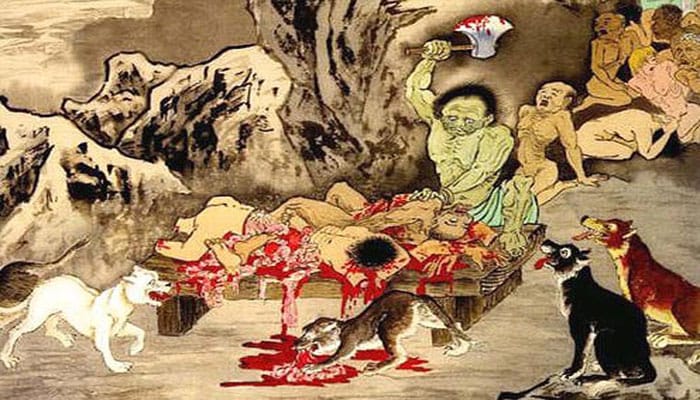
It is not described as a place of eternal punishment and perpetual torture; rather, it is represented as a place where people’s souls live repeated moments of their dark past, even if their existence in life was perfect. Most scholars and scholars believed that the representation of Yomi originated from ancient tombs in the feudal era, where bodies were left to decompose.
The underworld called Yomi was ruled by Izanami no Mikoto, the god of Yomi (Yomo-tsu-Ōkami). According to Kojiki, the entrance to Yomi is located in the province of Izumo and was sealed by Izanagi on his flight from Yomi, at which point he permanently blocked the entrance by placing a huge rock (Chigaeshi no okami) at the base of the slope leading to Yomi (Yomotsu Hirasaka).
1. Etymology of Yomi
The kanji (a form of Japanese writing) sometimes used to transcribe Yomi actually refer to the Chinese mythological realm of the dead called Diyu or Huángquán (yellow spirits), which appears in Chinese texts as early as the 8th century BC. The characters are jukujikun, meaning they were used without regard to the actual meaning of the word Yomi, which is unknown.
With regard to Japanese mythology, commentators generally consider that Yomi lies underground and is part of a triad of places discussed in Kojiki: Takamahara (“high heavenly plain,” located in the sky), Ashihara-no-Nakatsukuni (located on earth), and Yomo-tsu-kuni or Yomi-no-Kuni (“region of Yomi,” located underground), also known as Ne-no-Katasukuni (“place of the original souls”).
2. History of Yomi
The first Chinese influences on Shinto. Confucianism, which originated in China, is believed to have arrived in Japan in the 5th century AD, and by the 7th century it had spread among the people, along with Taoism and the yin-yang philosophy (harmony of two basic forces of nature). All of this stimulated the development of the ethical teachings of Shinto. With the gradual centralization of political power, Shinto also began to develop as a national cult.
The myths of various clans were combined and reorganized into a Japanese mythology with the Imperial House at its center. The kami of the Imperial House and the guardian kami of powerful clans became the kami of the entire nation and people, and the state made offerings to them every year. Such practices were supposedly systematized around the beginning of the Taika reforms in 645.
By the early 10th century, some 3,000 shrines throughout Japan received state offerings. However, as the power of the central government declined, the system became ineffective, and after the 13th century, only a limited number of important shrines continued to receive Imperial offerings. Later, after the Meiji Restoration in 1868, the old system was revived.
3. Myths about Yomi
The mythological narratives and legends that speak of Yomi vary greatly depending on the Asian region, depending on whether they are from Japan or China. All these fantastic tales are characterized by a single similarity: Yomi is an undesirable place where the immortal soul does not want to go.
One of the popular myths is the creation of Yomi, where one of the creator gods dies and is rescued; this is known as“the journey to Yomi (the underworld).”
The journey to Yomi (Yomi-no-kuni)
When the world began, it was divided between Takamagahara, the heavens, and Ashihara-no-nakatsukuni, the earth. Many gods came to the heavens, but the earth remained a formless and chaotic mass, like drops of oil floating on water, or jellyfish drifting aimlessly.
The gods of Takamagahara commissioned Izanagi and Izanami, (the first male and female gods to be born), to shape the world and create the deities that would populate the heavens and the earth. After creating the islands that make up Japan, they set about creating a myriad of gods.
Everything went well at first; the gods of the sea, the winds, the trees, the fields, and the mountains were born at that time. Then Izanami gave birth to the fire god Kagutsuchi and suffered horrible burns that made her sick and eventually died.
Izanagi buried Izanami on Mount Hiba, which lies on the border between Izumo and Hoki, and her spirit descended to Yomi, the underworld. Now that Izanami was gone, Izanagi missed her terribly. He decided to make the journey to Yomi and bring her back. He followed the dark path to its gates, where Izanami came out to greet him.
Izanagi said, “My dear Izanami, our creation of the world is unfinished. Come back with me so that we may complete what we have begun.”
To which Izanami replied sadly, “I want to go with you, but you are too late. I have already eaten the food of this land, and I can no longer return with you.” Then, thinking about it a little more, she said, “You have come all this way to bring me back, and I really want to return with you, so I will speak to the lord of this land about it. You must wait here while we talk, and you must not see me.”
Izanagi agreed, and for a while, he waited patiently. But finally he reached a point where he could wait no longer, and breaking off a tooth from the comb in his hair, he made a torch and entered Yomi. When he finally found her, he was shocked by her appearance. She was rotten and full of worms, and eight hideous thunder gods were clinging to her body. Terrified, Izanagi decided to flee from Yomi-no-kuni back to the land of the living.
“I told you not to look, and yet you ignored me! You will pay for the shame you have brought upon me,” cried Izanami, and ordered the evil witches of the underworld to pursue him. Izanami and Izanagi created the land of Japan and the gods who populate it. The entrance to the Underworld, which can still be visited today.
4. Places to visit in the myth of Yomi
Yomotsu Hirasaka, the entrance to Yomi (the underworld), is said to be located in the Iya area of Matsue, just off Route 9. It is a quiet, isolated, and gloomy place even on the clearest days, creating an atmosphere appropriate for a place said to be a border between this world and the next.
Several large rocks are in the area, and one wonders exactly which one was overturned to block the entrance. Also near this area is the Iya Shrine, and a slope near the shrine is said to be the same one that led to the entrance to the underworld.
The Tomb of Izama
Izanami’s tomb is said to be at the top of Mount Hiba, and although there are several mountains with that name, Mount Hiba in the Hakuta area of Yasugi City has a strong claim to be the actual location, as it is right on the border between eastern Shimane (the land of Izumo) and western Tottori (the land of Hoki). The Kume Shrine at the base of the mountain also enshrines Izanami.
It is also said that Izanagi ran as fast as he could, but they began to catch up with him, so he threw his hair ribbon on the ground behind him. It turned into a wild vine laden with grapes. The witches couldn’t help but stop and eat the grapes, and Izanagi continued to flee.
However, they ate faster than he expected, and soon they were about to catch up with him again. So now he broke another tooth from the comb in his hair and threw it on the ground. Bamboo shoots grew in its place, and once again, the witches stopped to dig them up and eat them. Izanagi continued to flee.
Izanami then ordered the thunder gods and an army of spirits from Yomi to pursue Izanagi. As they approached him, Izanagi drew his sword from its sheath and swung it furiously behind him as he continued to run. It was useless, as they were getting closer and closer.
But the entrance to Yomi, Yomotsu Hirasaka, appeared before him, and at its base was a peach tree growing. Izanagi plucked three peaches from the tree, turned to face the army of the underworld, threw them at his pursuers, and drove them back into the depths of the underworld.
Not to be discouraged, Izanami herself now came after Izanagi, so he picked up a large rock and rolled it in front of the entrance to Yomi, separating it forever from the land of the living. Now, standing on opposite sides of the rock, Izanami and Izanagi said their final goodbyes.
First, Izanami said, “Izanagi, for the shame you have caused me, every day I will kill a thousand inhabitants of this world that you hold so dear.” To which Izanagi replied, “If you do that, I will create fifteen hundred people every day.” And they never saw each other again.
After parting from Izanami, Izanagi bathed to wash away the impurities of Yomi. Many gods were created during this purification ceremony, but most importantly, as he finished bathing, three gods were born. The sun goddess Amaterasu was born when he washed his left eye, and the moon god Tsukuyomi was born when he washed his right eye.
When he wiped his nose, another god named Susana was born. Izanagi was pleased with his children and gave each of them a kingdom to rule: Amaterasu was given Takamagahara, the heavens; Tsukuyomi was given the night; and Susano-o was given the seas. While Amaterasu and Tsukuyomi happily took control of their kingdoms, Susana did not. He rebelled against Amaterasu and the other gods in Takamagahara. He became so evil that he was expelled from Takamagahara and banished to earth.

