Yantra is the Sanskrit word for “instrument” or “machine.” Like the word “instrument” itself, it represents Hindu symbols, processes, automatons, machinery, or anything that has structure and organization, depending on the context. Traditionally, such Hindu symbols are common in Eastern mysticism to balance the mind or focus it on spiritual concepts.
In the Hindu devotional tradition, “yantra” is the general term for instruments of worship, i.e., idols, images, or geometric diagrams. A yantra can serve as a representation of some personification or aspect of the divine, a model for the worship of a deity immediately within the heart after the paraphernalia of external devotion (idols, perfumes, offerings, audibly uttered formulas).
They have been discarded by the advanced initiate, a kind of chart or timetable for the gradual evolution of a vision, while identifying the Self with its slowly changing contents, that is, with the divinity in all its phases of transformation. In this case, the yantra contains dynamic elements.
1. Sri Yantra in Hinduism
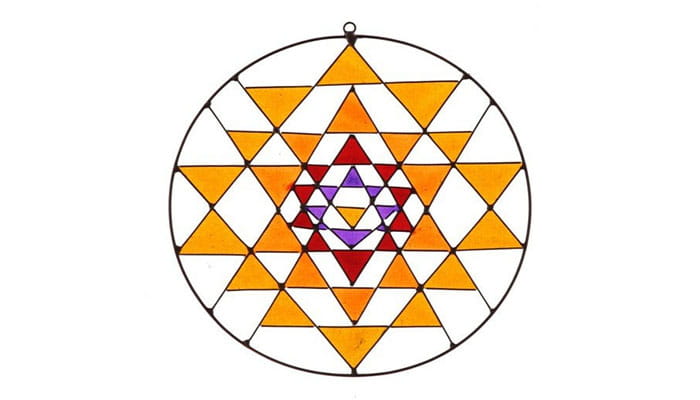
Sri Yantra is a form of mystical diagram, a tantric ritual drawing used for meditation and concentration.
The enchanting diagram consists of nine triangles that intersect at various points to form 43 smaller triangles. Five of the nine triangles point downward and represent Shakti, the feminine power. The remaining four represent Shiva, the masculine, and point upward.
In addition to its extremely complex geometric properties, Sri Yantra is interpreted as having a very deep and detailed cosmological interpretation. It has also been observed to have a number of properties responsible for psychophysiological influences that are widely used in modern suggestive therapeutic methods.
The Sri Yantra is also a very precisely constructed design based on the golden ratio, a constant equation observed throughout creation. It incorporates triangles that follow the rules of the golden ratio, often known as golden triangles.
The Sri Yantra can be divided into nine Mandalas:
- Trailokya Mohana or Bhupara (That which attracts the Universe)
- Sarva Aasha Paripuraka (Fulfiller of Desire)
- Sarva Samkshobahana (All Exciting)
- Sarva Saubhagyadayaka (Granting all good fortune)
- Sarva Arthasadhaka (Granting all objects)
- Sarva Rakshakara (Protecting everyone)
- Sarva Rogahara (Destroying all diseases)
- Sarva Siddhiprada (Granting all success)
- Sarva Anandamaya (Purely Happy)


The Sri Yantra is also considered to represent the microcosmic level of the universe and the human body. The Yantra has seven points where the apex of one triangle touches the base of another triangle.
These points are often considered to be related to the chakras in the human body. By focusing on the Sri Yantra, one can find themselves relaxing immediately. It is an immensely powerful focal point for meditation.
2. Sri Yantra as an instrument
The Sri Yantra symbolizes the continuous interaction of Shiva and Shakti in the cosmos and their generative power.

Yantra refers to “any instrument (or machine) for holding, restraining, fastening, supporting, and barriers.” The Yantra is an amulet believed to possess occult powers. In addition, some tantric practitioners employ yantra, mantra, and other elements in their sadhana.
The Yantra symbol or other permutations and related phenomena, such as Mandala, Rangoli, Kolam, Rangavalli, and other sacred geometric traditions, are endemic in all Dharmic traditions.
3. History
Historically, yantras have been used in Hinduism for a variety of purposes, as well as for devotional and ritual functions, such as astrological maps of the universe to facilitate liberation, Hindu tantric symbols of cosmic unity, sacred geometric diagrams representing divine energy, and even as weapons in warfare.
4. Sacred geometry
In its most recognizable form, a yantra is a type of sacred geometry involving a complex system of sacred religious and cultural values embedded in fundamental structures and relationships such as space, time, and form. In many religions, the basic patterns of existence are perceived as sacred, as by contemplating and communicating with them, one becomes aware of divine principles.
By studying the nature of these patterns, forms, relationships, and their multiple intra- and interconnectivity, one can gain insight into the scientific, philosophical, psychological, aesthetic, and mystical continuum. In other words, the laws and patterns of the Universe.
5. Symbolism
The Sri Yantra is fundamental to most tantric forms of Shaktism.
In Hinduism, the ritual use of the yantra is often related to the devotion and symbolism of Shaktism. The Sanskrit word Shakti (meaning force, power, or energy) refers to the active, creative, and dynamic feminine principle in the universe, often personified as a goddess, as well as the feminine aspect or consort of god.
In some Hindu systems of thought, Shakti may be worshipped as the supreme being and is responsible for the creation of the phenomenal world. Shakti, as divine energy and as a goddess, is of great importance within Tantric philosophy and practice.
The Shri Yantra is considered the most powerful yantra, consisting of nine interlocking triangles surrounding Hinduism.
These levels, starting from the outer or lower layer, are:
- Trailokya Mohana, a square with three lines and four gates.
- Sarvasa Paripuraka, a sixteen-petaled lotus
- Sarva Sankshobahana, an eight-petaled lotus
- Sarva Saubhagyadayaka, composed of fourteen small triangles
- Sarvarthasadhaka, composed of ten small triangles
- Sarva Rakshakara, composed of ten small triangles
- Sarva Rohahara, composed of eight small triangles
- Sarva siddhi prada, composed of a small triangle
- Sarvanandamaya, composed of a dot or bindu
6. Ritual functions
There are numerous yantras used for a variety of rituals and devotional purposes. Yantra symbols are considered beneficial within Hindu mythology. They can be made from various objects (i.e., paper, precious stones, metal plates, and alloys).
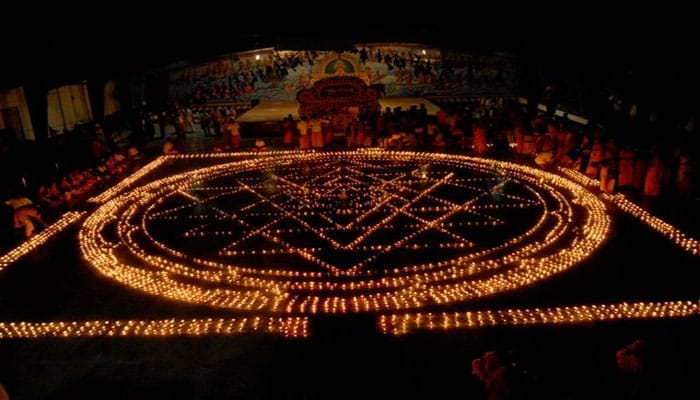
They contain geometric elements and archetypal shapes and patterns, namely squares, triangles, circles, and floral patterns; but they can also include bija mantras and more complex and detailed symbols. The Bindu is central, central, and instrumental to the yantra.
7. Yantra as an astronomical map
A common purpose of yantras is to represent the astronomical position of the planets at a given date and time. Such yantras are constructed on a particular date depending on the prescribed procedures defined in the Vedas.
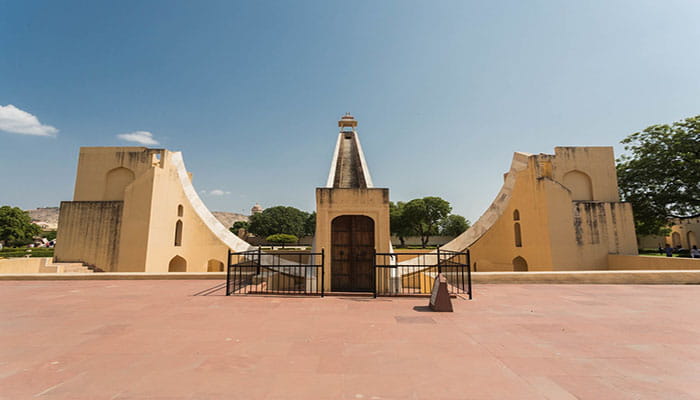
It is believed that if humans constantly concentrate on their specific representation, it will help build good fortune, as the planets above have their peculiar gravity that shapes basic emotions and karma.
8. Yantra as a portal of communion
Yantras also function in Hinduism as conduits revealing cosmic truths. As instruments of spiritual technology, yantras can be conceived as prototypical and esoteric mapping machines or conceptual looms.
Certain yantras are considered to embody the energetic signatures of the Universe, consciousness, and the ishta-devata.
9. Yantra as a tantric ritual
Some esoteric Hindu practitioners employ yantras, mantras, and other items of the saṃdhya-bhaṣa in their sadhana, puja, and yajna. Although often represented in two dimensions through art, practitioners conceive and conceptualize the yantra as a multidimensional sacred architecture and in this capacity are identical to their mandala counterpart.
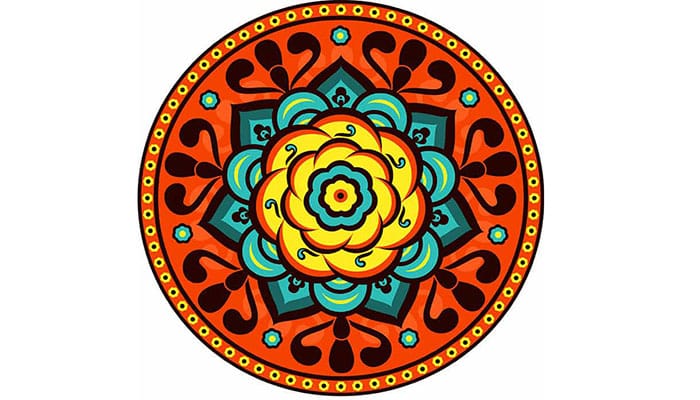
Meditation and trance induction with yantra are inverted in the various lineages of its transmission as instruments that enhance the accumulation and manifestation of siddhi.
10. Yantra as divine manifestations
According to Madhu Khanna, yantras are linked to mantras to manifest divinity:
Mantras, the Sanskrit syllables inscribed in yantras, are essentially“thought forms”representing deities or cosmic powers, which exert their influence through sound vibrations.
