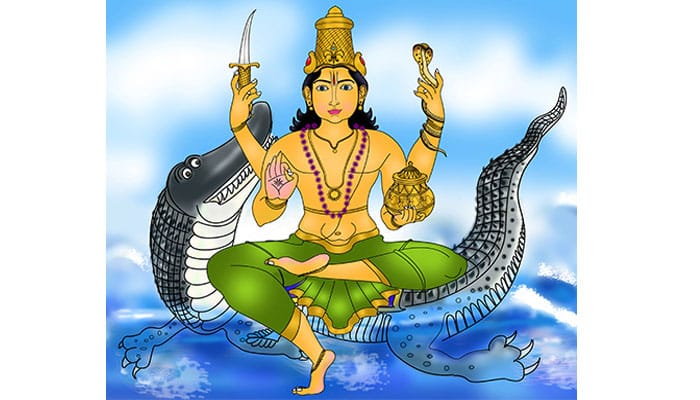
Varuna is a Vedic deity initially associated with the sky, later also with the seas, like Poseidon in Greek mythology. He is found in the oldest layer of Vedic literature in Hinduism. He is also mentioned in the Tamil grammar work Tolkappiyam as the god of the sea and rain.
Varuna is the god of the oceans, his vehicle is a creature part fish and part land creature. His weapon is a rope noose. In some texts, he is the father of the Vedic sage Vasishtha. Varuna is found in Japanese Buddhist mythology as Suiten.
1. Etymology
The theonym Varuna is a verbal derivation (“to surround, cover” or “restrict, bind”), for an interpretation of the name as “the one who covers or unites,” in reference to the cosmological ocean or river that surrounds the world, but also in reference to the “union” by universal law or Ṛta.
The identity of Varuna and the Greek god Ouranos in the first Indo-European cultural level. The etymological identification of the name Ouranos with the Sanskrit Varuṇa is based on the derivation of both names from the root with a meaning of “binding”: the god-king. Varuṇa binds the wicked, the Greek god-king Ouranos binds the Cyclopes.
While the derivation of the name Varuṇa from this root is undisputed, this derivation of the Greek name is now widely rejected in favor of the derivation from the root “to drip” (Sanskrit “to rain, to pour”).
2. Mythological Texts
The mythology of the god Varuna is based on ancient texts and scrolls from Tibet in the Buddhist religion.
Vedas
In the earliest layer of the Rigveda, Varuna is the guardian of moral law, one who punishes those who sin without remorse and forgives those who err with remorse. He is mentioned in many Rigvedic hymns. His relationship with water, rivers, and oceans is mentioned in the Vedas. Vedic poets describe him as an aspect and one of the plural perspectives of the same divine or spiritual principle.
Mitra, like Varuna, is classified as an Asura in the Rigveda, although he is also considered a Deva. Varuna, being the king of the Asuras, was adopted or made the change to Deva after the structuring of the primordial cosmos, imposed by Indra after he defeated Vrtra.
The Varuna Mitra pair is an ambiguous deity, much like the Rudra Shiva pair. Both have wrathful aspects in Indian mythology. Both Varuna and Rudra are synonymous with “sight, knowledge,” and both were the guardian deities of the north in the Vedic texts (Varuna later became associated with the west).
Both can be offered “damaged, evil offerings,” all of which suggests that Varuna may have been conceptually superimposed on Rudra. Furthermore, the Mitra-Varuna pair is called rudra. According to Samuel Macey and other scholars, Varuna had been the oldest Indo-Aryan deity in the second millennium BC, giving way to Rudra in the Hindu pantheon, and Rudra-Shiva became “timeless and the god of time.”
Varuna is called the patron deity of doctors, one who has “a hundred, a thousand remedies.” His ability and association with “all integral knowledge.” Varuna also finds mention in the early Upanishads, where his role evolves. For example, he is said to be the god of the western neighborhood, but that he is based on “water” and ultimately depends on the “heart” and the fire of the soul.
She is identified as the earth goddess. In the Vedic texts, she is said to be the mother of Varuna and Mitra along with other Vedic gods, and in later Hindu mythology, she is said to be, as mother earth, the mother of all gods. In the Yajurveda, it is said: “Indeed, Varuna is Vishnu and Vishnu is Varuna, and therefore the auspicious offering should be made to these deities.”
Ramayana
Varuna himself rose from the depths of the ocean and asked Rama for forgiveness. Rama interacts with Varuna in the Hindu epic Ramayana. For example, faced with the dilemma of how to cross the ocean to Lanka, where his kidnapped wife is held captive by the demon king Ravana, Rama prays to Varuna, the Lord of the oceans, for three days and three nights.
Varuna does not respond, and Rama rises on the fourth morning, enraged. He tells his brother Lakshamana that even the lords of the elements only listen to violence, Varuna does not respect meekness, and peaceful prayers are not heard.
Rama prepares to attack the oceans to burn the waters and create a bed of sand for his army of monkeys to cross and face Ravana. Lakshmana appeals to Rama, who must return to “the peaceful ways of our fathers; you can win this war without ruining the sea.”
Rama fires his weapon, sending the ocean into flames. As Rama increases the ferocity of his weapons, Varuna emerges from the oceans. He bows before Rama, declaring that he himself did not know how to help Rama because the sea is deep, vast, and cannot change the nature of the sea. Varuna asked Rama to remember that he is “the soul of peace and love, anger does not suit you.”
Varuna promised Rama that he would not disturb him or his army while they build a bridge and cross over to Lanka.
Sindhi Hindus
He is an incarnation of Varuna. They celebrate the Cheti Chand festival in his honor. The festival marks the arrival of spring and the harvest, but in the Sindhi community it also marks the mythical birth of Uderolal in the year 1007, after they prayed to the Hindu god Varuna to save them from persecution by the tyrannical Muslim ruler Mirkhshah.
3. Buddhism
The Pali Canon of the Theravada school recognizes Varuṇa as a king of the devas and companion of Sakka, Pajapati, and Isana. In the battle against the asuras, the devas of TÄvatiṃsa were asked to look at Varuna’s banner to dispel all their fears.
Mahayana
In East Asian Buddhism, Varuna is a Mahayana and is often classified as one of the Twelve Devas. He presides over the western direction.
Shinto
Varuna is also worshipped in the Shinto religion of Japan. One of the Shinto shrines dedicated to him is the Suitengu (“Suiten Palace”) in Tokyo. After the Japanese emperor issued the Shinbutsu bunri, the separation of Shinto and Buddhist practices as part of the Meiji Restoration, Varuna Suiten was identified with the supreme Japanese god.