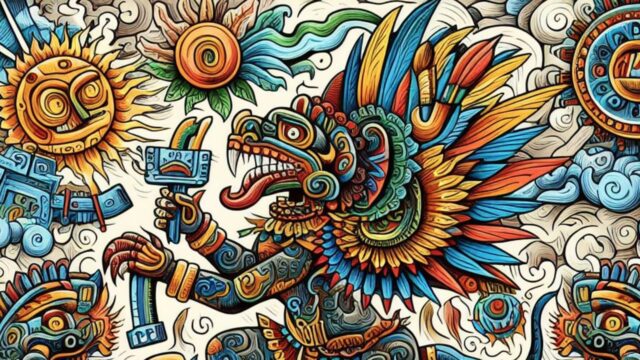
Toltec mythology historically comes from the culture of the same name, which belongs to the pre-Columbian cultures of Mesoamerica during the Postclassic period.
Where did the Toltecs come from?
Historically, the Toltec culture is located in Mexico, specifically in the city of Teotihuacan around 750 AD. However, as they were a nomadic people, it is thought that they later moved to what are now the states of Mexico City, Tlaxcala, Puebla, Hidalgo, and Morelos. These are the places where they settled and established their culture.
Historical foundations of Toltec mythology
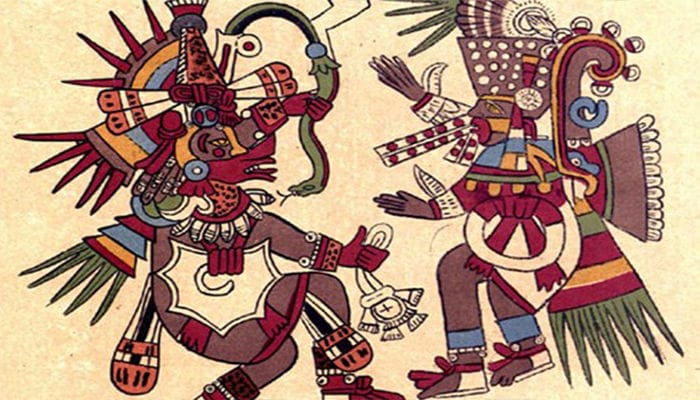
It is believed that its name means “The Feathered Serpent” and, according to historians, its role is to represent the dual nature of the human condition, since on the one hand the “serpent” is the physical body with its limitations and “the feathers” are the spiritual principles.
On the other hand, for the Toltecs, it is the deity that symbolizes knowledge, philosophy, culture, and fertility.
However, there is a dilemma as to who is the main god of this culture, whether it is Quetzalcóatl or Tezcatlipoca, both of which are major forces in Toltec mythology.
Myths
Here are some myths:
A) The Fall of the God Quetzalcóatl
In history, it is believed that this god was a ruler of Tollan during its golden age. Consequently, during his reign, he focused on perfecting his spiritual side through rituals and self-sacrifice, which led him to become obsessed with these issues and forget about the outside world.
Taking advantage of this situation, Tezcatlipoca, with the help of other gods, broke into his palace to test his vanity and overthrow him. They did this by offering him false help, which led him to become intoxicated and have intimacy with his sister Quetzalpétlatl, which ended his role as spiritual leader, thus renouncing his reign.
This also brought about the end of the golden age for Tollan, which was later ruled by Huémac, who ended up being related to the god Tezcatlipoca. Tezcatlipoca orchestrated some events that made Huémac’s reign difficult, but he managed to marry the king’s daughter and gain power.
This version is accompanied by the story that Quetzalcóatl initially buried himself alive in a stone coffin but four days later left the city, following the eastern route from Tollan towards the sea. As a result of this journey, it is said that he left a trail of rock formations and names in small towns and sites in Mexico that, according to the inhabitants, can still be seen today. until he reached the sea, where he embarked on the horizon.
B) Venus and Quetzalcóatl
This story is related to the previous one, but it suggests that Quetzalcóatl was the king-priest of Tollan and never accepted human victims as offerings, only birds, snakes, and butterflies.
His reign lasted until Tezcatlipoca expelled him from Tollan for practicing sorcery. For this reason, the deity traveled to the coast in search of divine water, where he killed himself. After four days, he turned into a bird that flew into the sky and became the planet Venus.
For Mexicans, Quetzalcóatl can be seen as a star next to the Popocatépetl volcano for eight months of the year, then disappearing for another three months. When he comes to earth, his mission is to bring fertility and harvest twice a year.
C) Quetzalcóatl and Xolotl
Within this myth, there is another version that suggests the existence of a deformed twin brother, who is presented as a dog named Xólotl. He was related to the evening star, and according to researchers, this is thought to be an analogy that seeks to relate the Sun and Venus.
2) Tezcatlipoca
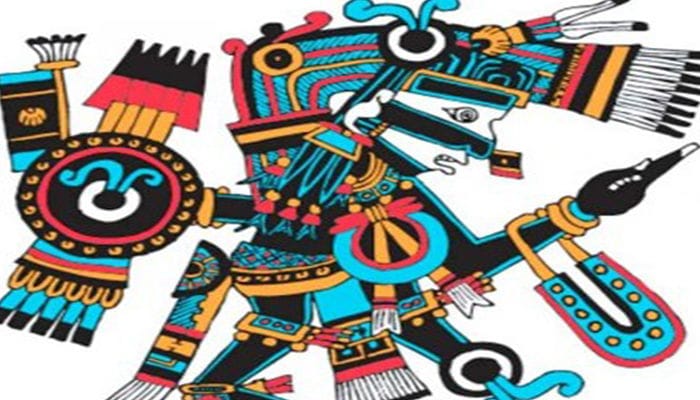
Known as the black mirror, this god was the antithesis of Quetzalcóatl, who is the white mirror. This entity is known for his warrior nature, and is also thought to be the lord of heaven and earth, the source of life and protector of man.
What does Tezcatlipoca look like?
He is depicted with a black stripe across his face and an obsidian mirror on his chest, which allows him to see everything humans do and think. He exuded human blood to kill his enemies.
He is also depicted with a leg showing the bone of a jaguar, and his emblem is a knife like his mirror, representing the black, cutting wind.
Creation Myth
In Nahuatl legends, the brothers Tezcatlipoca and Quetzalcóatl were responsible for creating the world, where initially there was only an ocean inhabited by the earth monster Cipactli.
The story continues, recounting how Tezcatlipoca offered his foot as bait to lure the monster out of the sea so that he could eat it. It was at that moment that Tezcatlipoca and Quetzalcóatl seized him and turned him into the earth, spreading him out.
Then the monster’s many eyes became lakes and shelves, and its nostrils became caves. In order to pay for the damage done, the god Tezcatlipoca demanded human sacrifices from the inhabitants.
Consecrated ceremonies
As he was a god of the mirror and the moon, his festival was celebrated on May 19 and consisted of a symbolic offering of a young man who represented Tezcatlipoca.
Therefore, at that time, a slave was chosen to be sacrificed and treated like a god on earth for a year. He was selected by:
- They must have no blemishes on their bodies.
- They must have hair down to their waist.
- She must be good-looking and strong.
During the sacrifice, he was tasked with playing a flute while being worshipped by 12 companions, one of whom would replace him if he escaped. Four priestesses also participated to fulfill all his desires during the year, and 20 days before the sacrifice, he married them.
The festival itself has six or seven phases in which the members of the town participate.
- The first four phases consist of the image of Tezcatlipoca, who is worshipped by the people and young men who cover him with corn ropes.
- At the end of the year, small animals were sacrificed so that the priests could make offerings of jewelry and blankets. Consequently, the chosen young man had his hair cut “like a captain” and was dressed in jewelry and blankets.
- The end of the festival comes five days before, when the young man walks through the city with his wives until the day he has to climb the temple located a league from Tenochtitlán, where he would break four flutes as a symbol of the cosmic points. Upon arrival, he would lie down on a stone and his heart would be torn out.
Secondary Gods of Toltec Mythology
The Toltecs believe in various deities who, although not the main ones, are still worshipped and honored. These are:
1) Tláloc
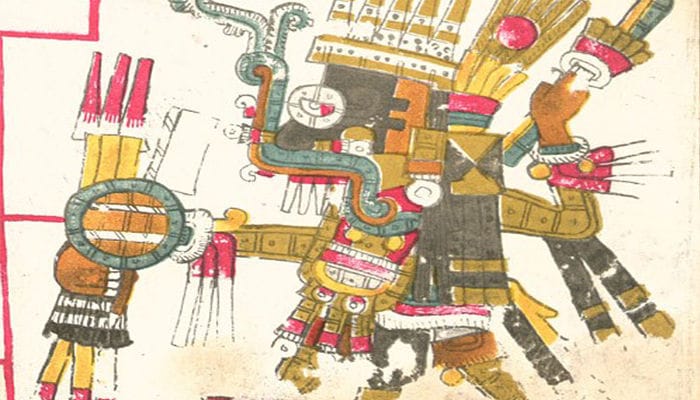
This entity is responsible for creating rain, which is why Mexicans honor him in ceremonies during the first month of the year.
On the other hand, according to Alfredo Chavero and Bernardino de Sahagún, he is the god of lightning, rain, and earthquakes.
Worship
The worship of this god spread throughout Mesoamerica and Central America.
- The Aztec nomads were the first to worship him, as they believed he was an agricultural deity.
- As a result, other agricultural communities paid homage to him, including the Teotihuacan culture, until the Nahua peoples.
Ritual
- Atlcahualo: This festival takes place from February 12 to March 3, during which seven children are sacrificed in the vicinity of Lake Texcoco in the Aztec capital.
- The Tozoztontli festival: Held from March 24 to April 12, this festival, like the previous one, involved the sacrifice of children, but the difference is that the offerings were placed in caves and consisted of priests putting the skin of the victims on themselves to pay tribute.
- During the winter period of Atemoztli, a twenty-day festival was held from December 9 to December 28 dedicated to Tláloc, as it took place before the arrival of the rains. Statues were made from amaranth dough, with eyes made from beans and teeth made from pumpkin seeds, and these were offered as food.
This continues with the opening of the dough breasts and the extraction of their hearts so that their bodies can be cut up and eaten. The ornaments with which they had been adorned are then burned in people’s courtyards, and on the last day of the twenty days, a banquet is held.
2) Centéotl
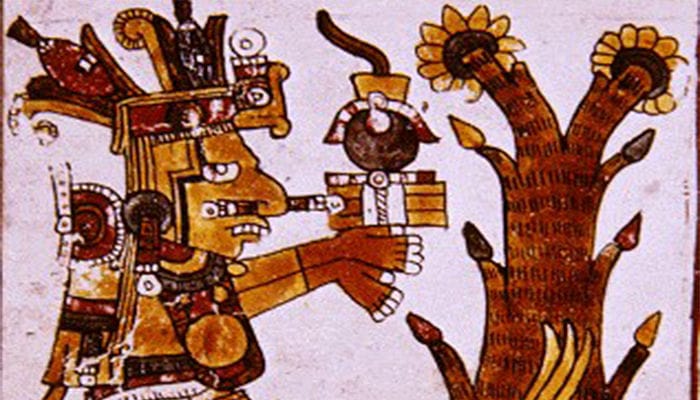
There is great uncertainty as to whether this deity is male or female, and in the latter case, it is a group of goddesses representing the growth of corn.
Consequently, this entity is the god (a) of corn and patron of drunkenness and drinking in rituals.
His male names are:
- Centéotl
- Centeotltecuhtli
The female names are:
- Chicomecóatl
- Centeotlcíhuatl
How is he represented?
Centeotl is usually depicted as a young man with a mark across his face, which appears to be a wrinkle filled with corn ears.
Sacrifices in his honor
1) Totonac ritual
In her representation as a woman, five temples were built in her honor, and she is honored three times, once in the third month, once in the eighth month, and finally in the eleventh month.
Historians say that the nation that most venerated her was the Totonaca, as she was their main protector.
They built a temple for her on top of a mountain where priestesses lived to worship her. They also made animal sacrifices to her, as they felt protected even from other entities that demanded human sacrifices.
2) Aztec ritual
In this culture, the ritual for this deity consisted of wounding the victim in the chest and then drowning them in a cenote or locking them in caves until they starved to death.
The ritual was observed by five priests, led by the king-priest, who was dressed in a red tunic, while the other priests had to wear black.
For this ritual to fulfill its purpose, the victims had to be young, beautiful, and healthy, as well as prisoners who were dressed in floral decorations for the sacrifice.
3) The sacrifice of the dancer
Known as Xalaquia (She Who Is Dressed in Sand), this ritual takes place from June 28 to July 14.
In this ritual, women let down their hair and shook it so that the corn would magically grow long in the same way. This was accompanied by the women eating chia flour and corn while dancing different types of dances in the topan.
In this sacrifice, a slave girl danced with her face painted red and yellow, the colors of corn, and her job was to dance all night until dawn, when the leaders joined her, surrounded her, and sang prayers. This is known as the dance of death.
Later, the culminating event was when they arrived at the teocalli (sacrifice pyramid), where the slave was stripped naked to be killed and her heart removed so that the god could be revived and the corn could grow.
3) Itztlacoliuhqui
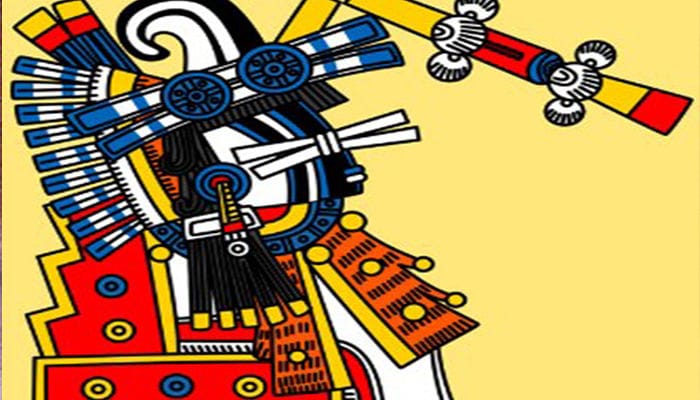
In Toltec mythology, he means justice, as well as being the god of obsidian (night), sacrifice, and disasters. He is also associated with objects such as knives and freezing or low temperatures.
He is also a deity recognized by the Mexicas, who classify him as the god of frost, winter, ice, sin, punishment, and human misery.
What does Itztlacoliuhqui look like?
He is depicted with a blindfold, which is related to his role of carrying out justice and punishment on humans and spirits in the underworld. He also incorporates the volcanic rock obsidian, and many claim that his head is actually made of this stone, which is attached to a piece of arrow sticking out of it.
However, there are many versions of what this mythical entity looks like.
Relationship with other gods
- He is associated with the god Tezcatlipoca, with whom he represents a sacred trinity consisting of the first being birth, life being the god Itzpapalotl, and finally, Itztlacoliuhqui being death.
- Related to other cultures, in this case the Maya, specifically to the deity Kisin, as he was the punisher of the underworld, who is also associated with mythical stones.
- Reflected in the book by Bernardino de Sahagún, who points out that it has a connection with the planet Venus and is also associated with Cintéotl, the god of corn.
Associations with Itztlacoliuhqui
As Itztlacoliuhqui is also the god of justice and punishment, he is associated with instruments such as a stone or a club.
The fact that he is depicted with a blindfold symbolizes that mortal and immortal beings will not be able to escape this entity’s punishment.
Equally important, he is associated with a drink sacred to the indigenous people of Mexico, pulque, which represents spiritual quest.
4) Nahual
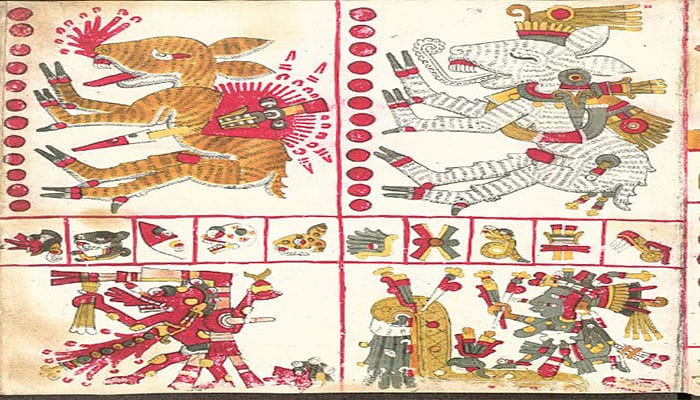
A sorcerer or supernatural being who could change his physical form into that of an animal and is known in Mesoamerican beliefs.
Myths about this entity
1) The shape-shifting sorcerer
It is believed that Nahual is a human who, through the use of magic or witchcraft, can turn into an animal, a lightning bolt, a cloud, fire, or any object he desires.
Therefore, research conducted by anthropologists accepts the idea that Nahual is a shape-shifting sorcerer and is recorded in the indigenous beliefs of central and southern Mexico.
However, in the Florentine Codex written by Bernardino de Sahagún, it is pointed out that these beings can be good or evil, and the belief that they used their powers for evil is stronger in ancient times than in modern times.
2) Nahual as a guardian animal
Many traditions invoke this mythical being as a guardian that becomes part of a person at birth and is responsible for watching over their well-being throughout their life in the form of an animal.
It is said that they only manifest themselves in dreams or through the affinity of the human with a particular animal that took them under its wing.
On the other hand, it is said that it is more of a spiritual connection between the person and their guardian animal, which is considered their alter ego, and that the destinies of both are intertwined. Consequently, whatever happens to one affects the other, not only spiritually but also physically.
This idea draws strength from the belief that many people died because their animal nahual was killed.
In conclusion, there is a dilemma regarding the presentation of Nahual as a guardian of people. Scholars point out that this is due to a discrepancy within the literature of anthropologists who studied this mythical character and how he is viewed by the current indigenous culture in their worldview. However, experts say that the correct interpretation is that of a spiritual connection between two separate entities.
3) Nahual as a spiritual entity
Mexican historian Alfredo López Austin presented his own hypothesis about the nahualli, arguing that it is not only a sorcerer or transforming entity, but a being that could change form through three soul entities that the Nahuas recognized within the human body:
- Tonalli.
- Teyolía.
- Ihiyotl: This is where the indigenous people believed that these beings were allowed to become something else, and it could also be used as a way to inflict spiritual harm on other people. It is inherited according to the sign of the calendar on which the person was born or by participating in certain rituals.