Thetis was a sea nymph in Greek mythology, or according to some myths, one of the Nereids, the fifty daughters of the sea god Nereus and Doris.
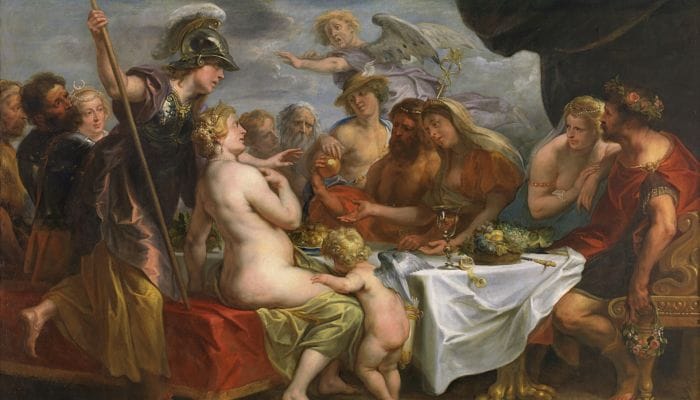
She was courted by Zeus and Poseidon, but neither of them married her, for fear of a prophecy that said that Thetis’ son would surpass his father in glory. Instead, she married Peleus, with whom she had a son, the mythical hero Achilles. The wedding of Peleus and Thetis was the main event that caused all the subsequent events that led to the Trojan War.
During the wedding, the goddess of discord, Eris, who had not been invited, threw the Apple of Discord among the guests, on which were inscribed the words “to the most beautiful.” Hera, Aphrodite, and Athena began to fight over who should receive the apple; Zeus said that Paris, prince of Troy, should make the decision.
He chose Aphrodite, after she told him she would give him the most beautiful woman in the world as his wife. This woman was Menelaus’ wife, Helen. When Hephaestus, the god of blacksmiths, was expelled from Olympus by Hera or Zeus, it was Thetis and Eurynome who helped him and placed him on the island of Lemnos. There, he worked for them as a blacksmith.
Who was Thetis?

The seas and waters of the Earth hold many mysteries, and among the shining lights of the waves is the Titan daughter of Gaia and Uranus: Thetis, wife of Oceanus and mother of the river gods, sea nymphs, and cloud nymphs. Together, they created all the waters of the Earth and set in motion forces that would protect the oceans, rivers, lakes, and streams. They are the reason why water has healing properties and carries within it the creation of life.
Origin
Theunion of Heaven and Earth, through the shared love between Uranus and Gaia, dispelled chaos and presented many more gifts to the universe than just the earth and the sky. These gifts were brought into the world through the birth of six sets of twins, as beautiful and luminous as any other being worthy of the heavens. Tethys was born among them, alongside Oceanus.
Family
Uranus and Gaia passed on their 12 beautiful children, each as radiant as the next and blessed with a unique natural attribute. One by one, their mother and father named them. The girls were named first: Mnemosyne, Theia, Phoebe, Rhea, Themis, and finally, Tethys. Then came the boys: Oceanus, Hyperion, Coeus, Cronus, Crius, and Lapetus. History would bring glory to half of them, while the rest would be doomed to defeat and imprisonment after the greatest battle in the heavens.
Myths of Tethys
Oceanus and Tethys knew they shared a common trait: they were masters and creators of the element water. Within water lies the power of life and creation, along with the power of destruction, and after destruction, the powers of renewal and purification. These powers would have to turn and flow in an endless loop of divine movement like the waves on a beach or the trickling of a stream.
The waters needed to spread throughout the world and carry these amazing qualities everywhere, and the creatures and trees of the Earth cried out for water, because it was their source of life and they could not exist without it.
Over time, thanks to the efforts of Tethys and Oceanus, a huge river surrounded the entire world. The energy of Tethys resembled an endless, nourishing ebb and flow, as well as rain falling from the clouds, while the energy of Oceanus was in the rapid flooding and unfathomable swaying of the waves as he beat his fish tail to stir the oceans.
The flow of water
The gods knew that their powers meant that water could not remain still and stagnant; it had to move to maintain its properties. Tethys carefully designed the rising and setting of the celestial bodies that mortals would call the Sun, the Moon, the Stars, and the Clouds. She also gave birth to the Nephelai, nymphs of the clouds and rain.
They would control the ebb and flow of the waters, cooling the seas and rivers, bringing rain to the Earth or swelling the seas or changing the direction of rivers, thus bringing new life and nourishment to the world. Tethys would be responsible for preserving all the freshwater streams and rivers on Earth, while Oceanus would control the oceans and salt lakes.
The Guardians
But Oceanus and Tethys quickly discovered that they would need more than just the celestial bodies when it came to controlling and preserving the waters. The mortals who lived beneath the heavens found ways to divide and manipulate water, and they began to cause disharmony and discord as their attempts to change the flow of rivers and dam up waters into lakes caused problems for others who could do nothing but watch helplessly as the water dried up and evaporated.
And when water dries up, life dries up with it. They would also pollute the waters with their corruption, bringing disease and plague when the water became impure.
To protect the waters of the world from thoughtless mortals, brother and sister formed a bond. From this bond were born 3,000 sons, the river gods known as Potamoi, and 3,000 daughters, the sea nymphs known as Oceanids. Each and every one of their children cared for and protected a spring, a river, a lake, or even a pond, a pasture, or a cloud.
Over time, there were as many as 3,000 of these guardians. Oceanus and Tethys were pleased with what they had brought into the world, and they knew that these new children would help to offset the chaos that mortals and creatures had unwittingly created when they tried to control the waters.
In turn, the children of Tethys would be fed through springs from the waters of the great river that lay underground, where even the roots of trees could not reach, and certainly were not known to mortals. He would also take care of all living things within the water: fish, seals, dolphins, whales, and sea monsters.
Tethys and Hera
Not all the countless years of the gods were as happy as the time when the Oceanids and Titans were brought into the world. The gods, like mortals, were petty and fought for power, even betraying one another and breaking oaths. By this time, Thetis had become the world’s nanny thanks to her divine gift, and she had many guardians to ensure there was enough pure water for everyone.
Then, the great battle of Titanomachy began, and earthquakes split the seas into basins as Zeus fought the Giants, shaking the entire Earth, the seas, and the heavens while the Hecatonchires hurled enormous rocks. Tethys felt the terrible earthquake and kept Rhea’s daughter, Hera, safe from the battle and became her foster father along with Oceanus.
However, even Hera’s mutual care could not prevent Thetis and Oceanus from becoming angry with each other, and they eventually stopped bringing children into the world. The estrangement that was the end result of their arguments separated the upper waters from the lower waters.
Current influence
The children of Thetis, the Oceanids, created nymphs, some of whom were servants of Leto’s daughter. Oceanus would maintain a current that never sleeps within the oceans, while Thetis would be a loving nanny to the world through her gentle ebb and flow.
Tethys would also be associated with the constellation Ursa Major, when she forbade Callisto from touching the depths of the ocean to honor and protect her adopted son, Hera, from Callisto’s jealousy and bitterness. That is why the constellation never sets below the horizon and can always be seen above the oceans.
Tethys is sometimes thought of as a diving bird, as she transformed Esacus into a bird with long legs and a long neck to protect him from his terrible fall into the ocean. And when ships pass safely over the waters and through stormy seas, sailors can often be heard giving thanks to Tethys and Oceanus, the gods of all the waters of the earth.

