Thebes was an ancient Egyptian city, a powerful religious and secular center, and even the capital of Egypt during the New Kingdom period (1570-1069 BC). At the height of its popularity, between 1353-1336 BC, Thebes was the largest city in the world.
Sources claim that the population may have reached 80,000. The ancient name of the city, Wase or Wo’se, means “city of the era” or “city of the scepter.” The names P-Amen, which translates as “city of Amun,” and Nowe or Nuwe were also used.
Where was Thebes located?
The ancient city was located in the fourth name (province) of Upper Egypt on both sides of the Nile River, approximately 419 miles south of Cairo. Most of Thebes was located on the east bank of the river, with the entire city covering 36 square miles. Today, the modern city of Luxor is the site of many of the major ruins of Thebes. The remains of the city, which stretch along the east and west banks of the Nile, are now a World Heritage Site.
History
Sources claim that Thebes had existed since the 4th Dynasty and became an eminent city around 3200 BC due to the Cult of Amun and its popularity at the time. Thebes became an important center for the worship of Amun, a combination of the earlier gods Atum and Ra. Amun was part of the Theban Triad, consisting of Amun, Nut, and Khun.
Amun represented the sun; Nut (his wife) represented the sun’s rays and the all-seeing eye; and Khons was the destroyer of evil spirits and the god of healing. A majestic temple called Karnak was built in Thebes and was dedicated to the worship of the Triad. It was one of the largest religious structures ever built and still stands today, reflecting the greatness of ancient Egypt.
The popularity of the Triad and its worship led directly to the growing prosperity of Thebes. The priests of Amun became so powerful that they seized power in Upper Egypt from the Pharaoh between 1069 and 525 BC.
Old and Middle Kingdom
In the Old Kingdom, between 2316 and 2181 BC, the pharaohs resided in Memphis, the ancient capital of Lower Egypt, and Thebes was only a small trading center. During the First Intermediate Period and the Middle Kingdom, from 2181-2040 BC, the rulers of Egypt moved from Memphis to Herakleopolis. The magistrates of Thebes had grown tired of the continued inefficiency of their rulers by this time and decided to challenge their power.
They waged war on the Kings of Herakleopolis, resulting in a Theban king finally ruling in 2055 BC. This was an important turning point, as the Theban gods became supreme among the gods of Lower Egypt and Thebes grew exponentially in popularity. During this period, work began on the resplendent temple of Karnak, reflecting the new prosperity of the area.
The Hyksos Period and the New Kingdom
The city continued to grow during the Second Intermediate Period (1640-1532 BC). The 15th dynasty was inaugurated when a group of immigrants called the Hyksos entered Egypt. Some sources cite the immigrants as being of Asian descent, but others say that the word Hyksos refers more to their ruler than to an ethnic group. The Hyksos controlled Egypt by 1650 BC and were seen as oppressive by the locals despite introducing new technologies such as the chariot.
The Thebans and the Hyksos developed a truce when foreign rulers began invading Theban territory. The truce was unfortunately broken when the Hyksos ruler Apophis insulted Ta’O of Thebes. The Theban armies then attacked the Hyksos cities and drove the immigrants out of Egypt.
During the New Kingdom, the country stabilized and began to prosper once again, especially Thebes, which had become its capital. Large palaces and temples were built, each more elaborate than the last, and lush gardens were laid out along the riverbanks of the new center.
Amarna Period
The priests of Amun in Thebes soon owned more land and wealth than the Pharaoh. Amenhotep IV (or Akhenaten as he was later called), the Pharaoh of the time, perhaps concerned about his tenuous power over his people, suddenly adopted monotheism and proclaimed Aten, the sun disk, as the supreme deity.
This was a major blow to Thebes and led to the final closure of the temples of Amun. When his son Tutankhaten came to power after his father’s death, he changed his name from Tutankhaten (living image of Aten) to Tutankhamun (living image of Amun) and restored Thebes to its former glory, with the old temples and gods no longer banned.
The decline of Thebes
Under Ramessids II, Thebes began to decline as the capital was moved to Avaris. Ramessids II built a splendid palace in Avaris, perhaps because there was little chance that a palace—or he—would stand out in Thebes. However, the priests of Amun grew even stronger. Out of sight of the Pharaoh, they continued to acquire more land until they declared themselves Pharaohs of Thebes at the end of the period.
In the 7th century BC, the Nubian pharaoh Tatanani moved the capital to Thebes. Eventually, Thebes was sacked by the Assyrian king and his army. The Assyrians forced the Egyptians to rebuild Thebes as punishment for their resistance. The city recovered in part, but was destroyed by the Roman army in the 1st century AD.
Main Archaeological Works
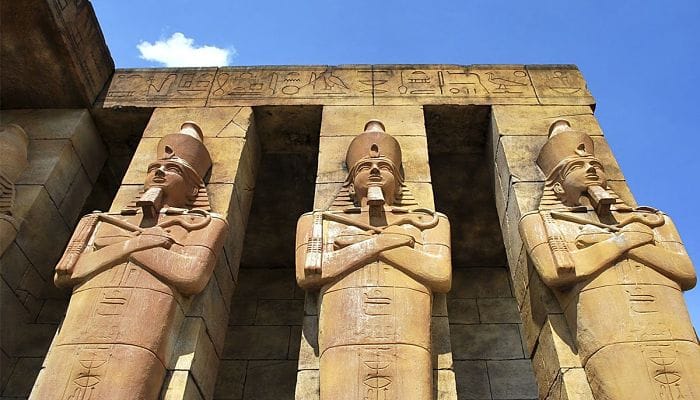
The site of Thebes contains a wealth of ancient artifacts and links to the wonderful civilization of ancient Egypt. On the eastern bank we find Karnak, the immense temple of Amun. Built over 2,000 years ago, it remains one of the largest religious structures in the world today.
It has 10 pylons, huge stone structures at the temple entrances; the Hypostyle Hall, a 54,000-square-foot hall with 12 columns reaching 80 feet; and numerous obelisks. Further north on the same bank is Luxor, another temple, this time not dedicated to a god, but to the rejuvenation of royalty. It was possibly the place where the pharaohs were crowned.
On the western bank is the famous Valley of the Kings, the burial place of pharaohs and nobles for over 500 years. The Tomb of Tutankhamun was found there recently. The Valley of the Queens is further south and was called Ta-Set-Neferu, meaning the place of beauty. The wives of the pharaohs, including the famous Nefertiti, were buried in the valley.
The men who held both secular and religious positions in Thebes and throughout Egypt wanted the same thing: power. As in modern times, it was not a thirst that could be quenched, and it led to the rise and fall of individuals, cities, and even the entire country. Although many innocent people would have suffered for their actions, they left behind a legacy that provides a deep and remarkable insight into the mysteries of Egyptian civilization.