The myth of Narcissus is one of the best-known Greek myths, due to its uniqueness and moral story. Narcissus was the son of the river god Cephissus and the nymph Liriope. He was known for his beauty and was loved by the god Apollo because of his extraordinary physique.
This myth comes in two different versions, the Greek and the Greco-Roman, as both Conon the Greek and Ovid, the Roman poet, wrote the story of Narcissus, enriching it with different elements.
The Greek version of the myth of Narcissus
According to Conon, Aminias, a young man, fell in love with Narcissus, who had already rejected his male suitors. Aminias was also rejected by Narcissus, who gave the unfortunate young man a sword. Aminias committed suicide at Narcissus’ door, praying to the gods to teach Narcissus a lesson for all the pain he had caused.
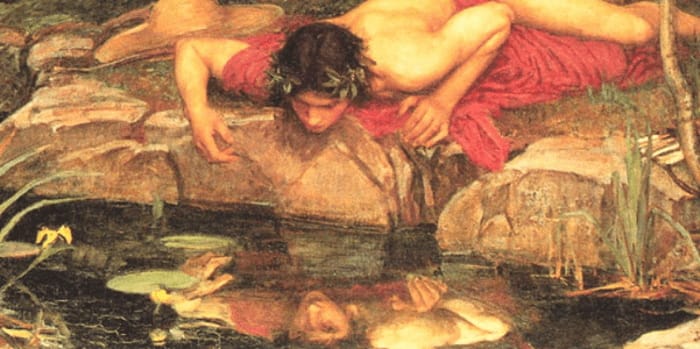
One day, he was walking by a lake or river and decided to drink some water. He saw his reflection in the water and was amazed by his beauty. He was fascinated by his own reflection. However, he could not obtain the object of his desire and died on the banks of the river or lake because of his grief. According to the myth, Narcissus continues to admire himself in the Underworld, gazing at the waters of the Styx.
Narcissus and his reflection
He was born in Thespiae, in Boeotia, the son of Cephissus (the personification of the river Boeotia of the same name) and the nymph Liriope. His mother was warned one day by the seer Tiresias that her son would live a long life as long as he never knew himself. When he reached adolescence, the handsome young man never found anyone who could stir his heart; in fact, he left a long trail of grieving and broken maidens in his wake, and one or two young men also fell by the wayside.
Then, one day, he saw his own reflection in a pool of water and thus discovered the ultimate in unrequited love and fell in love with himself. Naturally, this one-sided relationship went nowhere, and Narcissus, unable to tear himself away from the pool, wasted away in despair until he finally died of thirst and hunger.
Immortality, at least for one species, was assured, however, when his corpse (or in some versions the blood from his self-inflicted stab wound) turned into the flowers that henceforth bore his name.
The Roman version of the myth – Ovid
The myth presented by Ovid, the poet, is slightly altered. According to this myth, Narcissus’ parents were concerned about their son’s extraordinary beauty and asked the prophet Tiresias what to do about their son’s future.
Tiresias told them that the boy would only grow old if he “did not know himself.” When Narcissus was sixteen, he was walking through the forest and the nymph Echo saw him and fell madly in love with him. She began to follow him, and he asked, “Who is there?” sensing someone behind him.
Narcissus and Echo
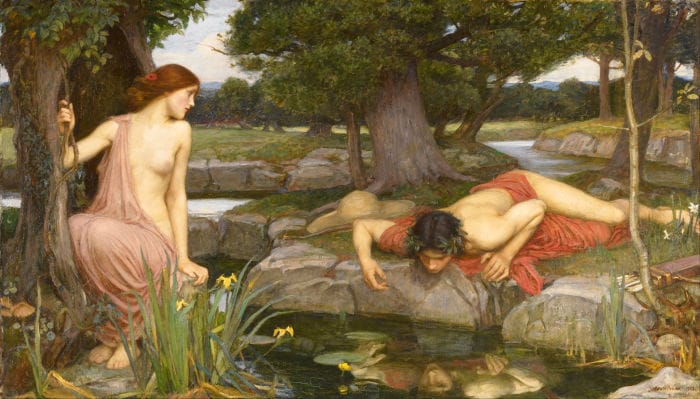
Echo replied, “Who is there?” and this went on for some time until Echo decided to reveal herself. She tried to embrace the boy, who ran away from her, telling her to leave him alone. Echo was heartbroken and spent the rest of her life in ravines until there was nothing left of her but an echo.
Nemesis, however, the goddess of revenge, heard the story and decided to punish Narcissus. From this point on, the stories are similar; he sees himself in the pond and is amazed by the beauty of his reflection. Once he realized that his love could not be reciprocated, he committed suicide.
The myth of Narcissus in modern life and art
This myth is also known for an additional reason; the narcissus flower, which is usually found on the banks of rivers and lakes, took its name in honor of the mythical hero. It is a graceful flower with 40 different species, most of which are cultivated in Europe. It blooms in early spring and is considered fragile and very beautiful, with white, yellow, and pink flowers.
The myth has also inspired several artists; the best known is Caravaggio, who painted a young man admiring his reflection in the water. The painters Turner and Dalí were also inspired by the myth, while poets such as Keats and Housman used his example in many of their works. The Russian writer Fyodor Dostoevsky created several characters with the mentality and loneliness of Narcissus, such as Yakov Petrovich Golyadkin.

