In death, as in life, the Greeks believed that the pious and the demigods lived an eternity of bliss, while a moderately good afterlife awaited the absolute and relentless torment of those who did not live a good life. The Greek underworld was part of what awaited many.
What is the Greek underworld?
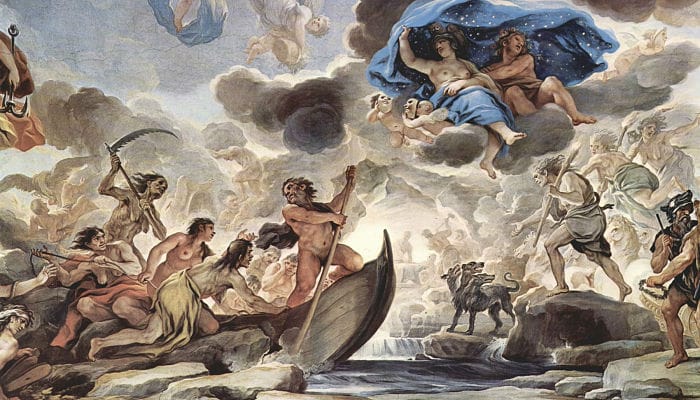
In mythology, the Greek underworld, referred to as Hades, is the gloomy place beneath the earth where souls go after death. The Greek underworld is said to be invisible to the living and ruled by the god Hades.
Destinations in the underworld
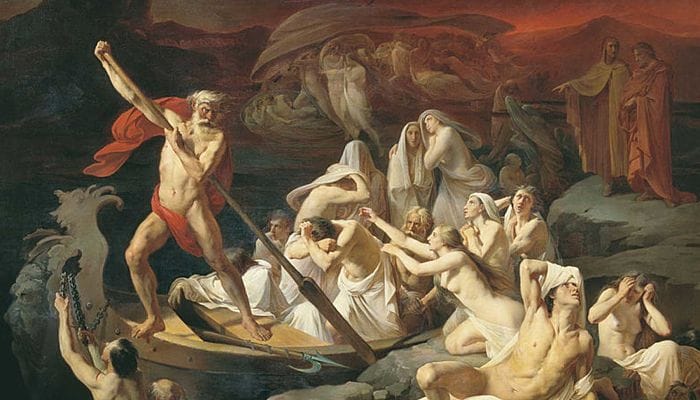
The Greek underworld of Hades is surrounded by five rivers, each representing an emotion connected to the underworld: the Styx (hatred), the Charon(pain), the Lethe (forgetfulness), the Phlegethon (fire), and the Cocytus ( lamentation). To enter Hades, souls would first have to be transported by Charon, the ferryman. Charon would receive the souls from Hermes and then guide them across the River Styx. To pay Charon for the journey, the dead were buried with a coin under their tongue. Those who could not pay, or who had not received a proper burial, were turned away.
The entrance to the underworld is not a very welcoming place, with anxiety, pain, disease, old age, hunger, fear, agony, death, and sleep awaiting you. As if that weren’t enough to scare you, the entrance is also guarded by Cerberus, a vicious three-headed dog. His duty is to prevent souls from leaving Hades.
Once Charon transports the souls to the other side, the newly dead are at the mercy of three judges: Minos, Radamantis, and Aeacus. The judges decide the fate of the souls and send them to one of three places. If they are chosen for Elysium, the souls are first taken to drink from the river Lethe, to forget everything about their previous life and begin a peaceful and stress-free afterlife, compared to the Fields of Punishment! Within the realm of Elysium are also the Islands of the Blessed.
When a soul has reached Elysium three times in a row, it is granted access to the Islands of the Blessed, where it enjoys endless happiness. The second place, the Fields of Punishment, is intended for those who commit crimes against the gods. Hades decides for himself on their individual punishment. The Fields of Asphodel, in third place, are for souls who have not achieved particular greatness nor committed crimes against the gods. Usually, demigods, heroes, and the virtuous are selected for Elysium.
Who inhabits the underworld?
When the world was divided between Hades and his two brothers, Poseidon obtained the sea as his domain, Zeus obtained the heavens, and Hades was established to rule over the Greek underworld. Hades is not depicted as a cruel jailer of the dead, but rather as a strict and moral presence; however, he was hated by the gods. He was perceived as the enemy of life by men as well as by the gods. Hades was also known as Pluto to some. He provided riches and blessed the harvest.
Persephone, the goddess of the harvest, was the beautiful daughter of Zeus and Demeter. Hades fell in love with her and decided he had to have her. He sought the help of Gaia to kidnap the beautiful girl. Persephone fell prey to his plan when she was enchanted by a narcissus flower. The attractive plant had been planted by Gaia. When Persephone tried to pick it, the ground suddenly gave way beneath her.
Hades caught her and took her to the underworld in a golden chariot. When her mother found out about her abduction, she was furious and put an end to the harvests. Zeus tried to appease her by sending Hermes to retrieve Persephone, but Hades tricked Persephone again by making her eat pomegranate seeds. The seeds bound her to Hades and his world, and she could only return to her mother outside of the winter season.
The Erinyes or Furies were three goddesses associated with the souls of the dead. They sought revenge against those who committed evil, especially against children who committed sins against their parents. They would bring madness to the perpetrator or cause illness or starvation to anyone who harbored the criminal. Many libations and sacrifices were made to the Erinyes to appease them and avoid their wrath.
The Greek Dead
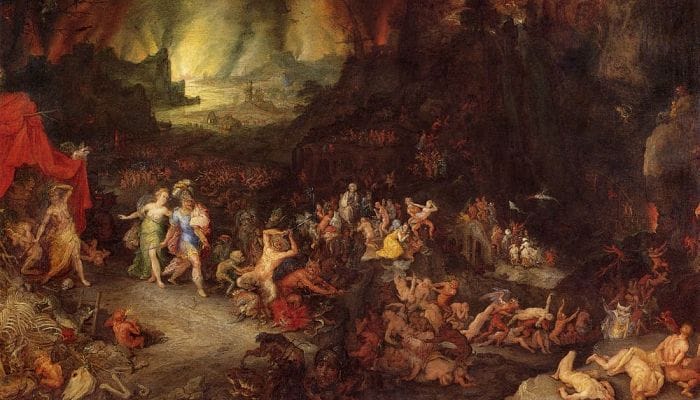
The souls of the dead lived a meaningless existence in the Greek underworld, unaware of the activities of the living. Once in Hades, they did not continue to grow mentally and their psyche became frozen, according to sources. The dead looked the same as they did in life, and if they had lost all their limbs in battle, they would look the same in the afterlife.
Offerings were made to appease the dead, who apparently became enraged if a malicious person approached their grave. Sometimes even blood offerings were made to appease discontented spirits. In Homer’s Odyssey, Odysseus had to donate blood in order to commune with the dead. Gifts of jewelry, food, and clothing were often left for the dead to use in Hades.
Time was believed not to exist in the Greek underworld, although the dead were aware of the past and the future, according to Homer. The living could only communicate with the dead if they were able to suspend their normal life and time to reach Hades.
Orpheus and Hades

Orpheus was a musician and poet who could seduce and control people’s minds with his music. When his wife Eurydice died and descended into Hades, Orpheus was determined to bring her back. He used his lyre to hypnotize all the guardians of the Greek underworld and convince Hades and Persephone to release Eurydice. They agreed, on the condition that neither of them look back while leaving Hades. Orpheus, in his excitement to see his wife again, looked back just before leaving the underworld and she was sucked back into darkness for all eternity.
Eusebia
The Greek word Eusebia means piety, although its meaning is perhaps a little more complex according to some sources. In ancient times, it referred to a person’s duty to themselves, to others, and to the gods. Eusebia was also relevant to those who had already died. In order for the dead to live well in Hades, they needed to be remembered by the living. Everyday scenes from a person’s life were depicted on tombstones in order to keep the memory of the person alive and maintain them in a state of bliss in death.
With the forgetful euphoria of Lethe, the peaceful meadows, and the perfect happiness of the Elysian Fields, a life of piety can take on a new charm. Today’s pagans have even added springs of water and wine to the already idealistic paradise. Meanwhile, the veil between the living and the dead continues to flutter mysteriously in the breeze, leaving us with the enigma of our mortality and the underworld that awaits us.