Hollywood and cinema are responsible for a great deal of misconceptions, and their distorted misrepresentation of Wiccan and Wiccan symbols is perhaps one of the most notorious of all. The beliefs that precede most “modern” religions have been vilified to the point where positive and empowering symbols are viewed with fear and suspicion.
These are some of the most powerful Wiccan symbols, some common, others less so. You have probably seen some of them many times before, but never had the opportunity to understand their true meanings.
Here is our detailed post on Wiccan symbols and their meanings
1. The pentagram
The pentagram is a Wiccan symbol that almost everyone is familiar with, both Wiccans and non-Wiccans alike, and they associate it with witchcraft. We’ll take a closer look at it in the article, but for now, all you need to know is that these elements, when taken together, signify the physical world.
From one point of view, magic deals with the supernatural. Spirits, spells, and enchantments could be considered supernatural, and there are many of them in the magical world.
Within the world of Wiccan symbolism, there is a word that sounds almost identical to pentagram: pentacle. These two similar words can be a real headache to keep straight.
-
- Error 1: One of the most common misconceptions about this Wiccan symbol is that the star pointing upwards is a pentacle and the star pointing downwards is a pentagram. Furthermore, it is also said that the downward-pointing pentagram has satanic and sinister connotations.
- Error 2: It isalso often heard that a pentagram is simply a five-pointed star, while a pentacle is the same star inside a circle.
This explanation sounds quite reasonable, but once again, it’s simply not the case. In this instance, the confusion stems from the fact that pentacle and circle both end in “cle.” However, the two terms are not linguistically related.
2. The triple moon
In Wiccan symbolism, this emblem is said to appear as a month progresses, growing from a small, faint sliver to the bright, radiant full moon. From there, it begins its journey back to nothingness as it grows smaller and smaller.
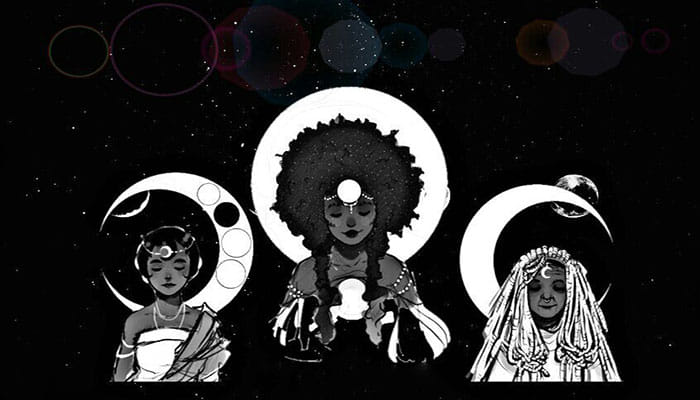
These different phases of the moon, its monthly journey, are encapsulated in the Wiccan symbol of the triple moon.
On the left side of this Wiccan symbol, you have the crescent moon. In the center, the full moon. And on the right, the dying and waning moon. The moon represents this sacred drama, month after month, in the darkness of the night sky.
However, the triple moon symbol extends beyond this: it is also a sign of the triple goddess, the most important representation of the female divinity within Wicca.
Like the moon, the triple goddess moves through three main stages of her life, and all are contained within the sign:
-
- The maiden: The maiden is the triple goddess in her youth. She corresponds to the waxing and waning moon in the symbol. Representing new beginnings, love, and purity.
- The Mother: The Mother shows the goddess as the maternal and nurturing figure that she is. She corresponds to the full moon, and her warm glow is a reflection of her divine love. The mother is a figure of guidance and protection.
- The Crone: The final phase of the moon, the waning moon, represents the Crone. This is the triple goddess at the height of her magical abilities, as old age is a time of intense spiritual power within symbolism. The Crone is a symbol of spiritual wisdom, divination, and banishing negativity.
3. The Horned God
The horned god is the main male deity in Wicca, and his symbol has several layers to unpack.
The 10 Most Popular and Scary Japanese Myths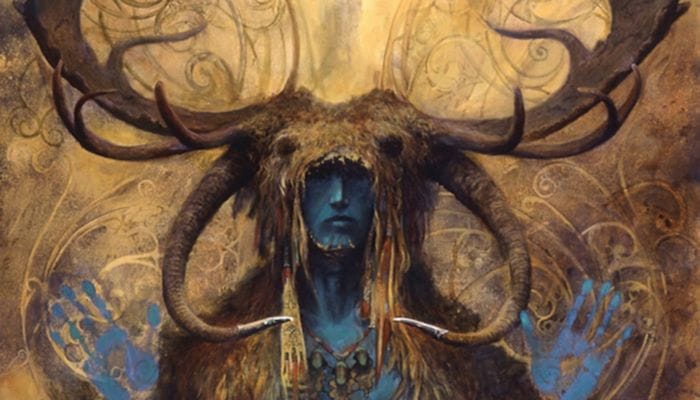
At first glance, we see a simple line drawing of what looks like a face with horns at the top. However, if you remember the triple moon symbol, you will notice that it looks similar. It could also be interpreted as a thin, crescent moon resting on top of the full moon.
-
- The Lord and Lady of Wicca: This similarity to the triple moon is no coincidence. Within Wiccan symbols, the triple goddess and the horned god are two sides of the same coin, two equal and complementary manifestations of the divine.
Their symbols are visually similar to emphasize the unity of these two deities. This is simply another way in which we symbolically link the power of the god with the power of the goddess.
4. Elemental Wiccan symbols
Within Wiccan symbolism, four traditional elements are recognized: Earth, Fire, Water, and Air.
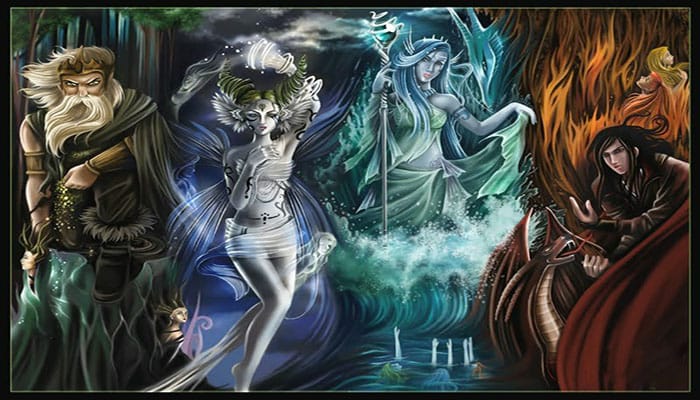
Although we now know that our universe is made up of much more than these four things, they are still used as representations of the natural world. And when it comes to magic, the natural world is extremely important.
When witches cast spells or perform rituals, they draw on some source of spiritual energy to bring our will into reality. In some cases, they may invoke a god or goddess for this purpose, but often they simply draw on the power of nature itself.
Taken individually, each element has its own unique set of strengths and weaknesses. But when combined within the sacred circle, they become a unified source of power.
9 Egyptian Symbols and Their Meanings-
- Earth: Earth is a Wiccan symbol of constancy and stability. Being very ancient, earth also represents the wisdom of experience. Ultimately, it is the most practical and pragmatic element of all.
- Fire: Fire is a sign of passion and intensity. It is the power to manifest the will, which basically means that we want to turn our desires into reality. Fire is the element that drives this desire.
- Water: Water is a symbol of quiet strength and perseverance. Unlike fire, which consumes wildly and quickly, this element does not represent spectacular and flashy displays of power. Instead, water represents a power that builds up over time.
- Air: The element of air connects us to the spiritual realm. The lightness represented by this element elevates our consciousness to a place where mystical and divine wisdom can be transmitted.
Learn more in the following video
5. The Celtic knot
The Celtic knot (also known as the triquetra within Wiccan symbols) is a three-part emblem. The single line from which it is made intersects exactly three times, creating three leaf-shaped sections in the design.

Some witches use the Celtic knot as another symbol to represent the Triple Goddess, and there is nothing wrong with that. She is a goddess closely associated with the number three, after all.
Like a circle, the Celtic knot is formed by a continuous line that has no beginning or end point. However, within this infinite line, three finite and distinct sections are created. Something tangible, something countable emerges from the infinite.
6. The witch’s knot
This shape has existed for centuries within Wiccan symbols, and during that time it has been commonly used as a means of banishing or warding off evil. However, unlike some Wiccan symbols that are only represented graphically, witches will actually use twine or string to create this knot.
Within this Wiccan symbol, we see a circle. In addition to representing infinity, circles are also a common sign of protection within witchcraft. We also see a shape similar to the Celtic cross in this design. In this case, the shape has four points instead of three.
The interpretation of this varies from witch to witch, but it is often used to represent something that can be grouped into four, such as the traditional elements or the cardinal directions.
7. Wheel of the Year
The wheel of the year helps witches navigate through the ever-changing seasons. Just as one year follows another, one rotation around the wheel of the year is always followed by another.
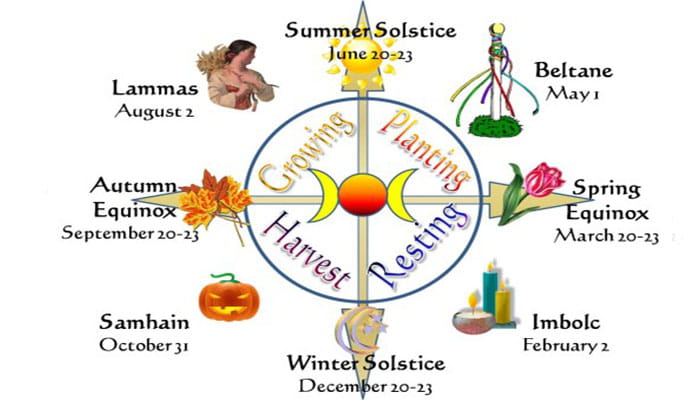
If you count carefully, you will see that this circle is divided into eight sections. Each of these sections represents a different holiday in the Wiccan calendar and are as follows:
-
- Yule (or the winter solstice)
- Imbolc
- Ostara (or the spring equinox)
- Beltane
- Litha (or the Summer Solstice)
- Lammas (or Lughnasadh)
- Mabon (or the autumn equinox)
- Samhain
Dividing the year into different sections, each with its own important day, is a way to help witches understand the passage of time. It creates a rhythm that allows us to synchronize with the natural process of birth, life, death, and rebirth.