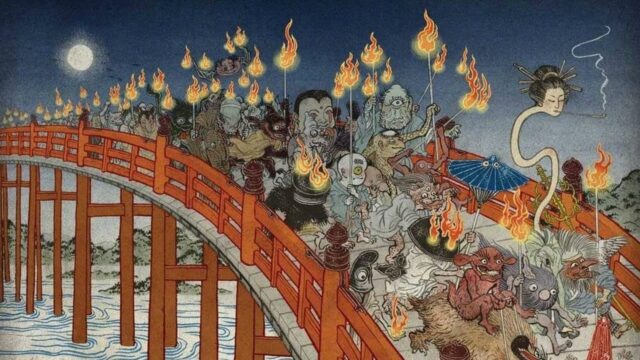
A complex system of myths that have endured over time characterize and define Japan, a country with a rich cultural mix that brings the Tanuki legend to life .
Origin of Tanuki

His personality is that of a trickster who seeks to steal money from anyone who crosses his path. In fact, the reality they present is that of a house in the forest where a beautiful young girl lives, this representation being in reality this fantastic animal.
Tanukis use a magic leaf on their heads to transform the way people who get lost in the woods perceive reality and what they see, and this is how they manage to steal their money.
Later, when the travelers wake up after dreaming that they are having dinner, they find themselves stripped of their belongings.
On the other hand, they are also thought to have a cheerful and drunken personality and to like being around humans. They are generally harmless but mischievous and playful.
What does a tanuki look like?

Their physical appearance is similar to that of a Japanese raccoon called Nyctereutes procyonoide, but their skin is like that of a panda, soft and tender.
They are always accompanied by a bottle of sake, a kimono, a straw hat, and their golden eggs (large testicles for the rest of the world).
Likewise, in typical Japanese crafts, they are depicted with a large barrel, which signifies tranquility; large eyes to see everything and make the right decisions; a gourd filled with sake, their favorite drink; enormous genitals, which signify fertility; a notebook where they write down the debts they never intend to pay; and, of course, their smiling face, full of optimism.
However, in stories, he is depicted with a magic leaf on his head instead of a cap.
Typical beliefs about Tanuki
Everyone thinks that this mythological deity is actually related to the Japanese raccoon, and this is partly true, but according to people from the provinces, it is actually related to the raccoon dog, although it looks more like the former.
What does the Tanuki represent in Japan?

Colombia is a diverse country with a rich culture that manifests itself in various forms, such as music, literature, dance, festivals, traditions, and dialects, which vary depending on the specific geographical area. Its origins can be traced back to the indigenous, African, and European cultures that settled in the country during the colonial era.
7 Characters from Colombian mythology
These beings, also known as “ánimas,” are an essential part of Colombian mythology, as they have become traditions, beliefs, and stories to tell to the youngest members of the family.
The lonely soul
This story has its origins in the time of Jerusalem, where it tells of a beautiful woman belonging to the so-called “pious women of Jerusalem” who were responsible for helping the crucified by giving them water when their bodies were parched.
It is said that there was a woman named Celestina Abdegano who was performing her duties as a pious woman on the Friday when Jesus Christ was crucified. It is said that she climbed up to Calvary and, fearing what the Jews might do to her, gave water only to Dimas and Gestas, who were the thieves condemned alongside Jesus Christ. As a result, she was condemned to wander the world thirsty and hot from the flames of purgatory on Judgment Day.
Some consider her an evil soul and others a benign soul with a large number of followers despite not being beatified by the Catholic Church, as she has performed several miracles for believers in spiritualism. She even has her own prayer that is used for love spells and prayers:
Anima Sola, soul of peace and not of war, soul of God, I ask and beg you to enter the heart of …, do not let them have any taste or pleasure in eating or sleeping with any kind of person until they come to my feet, just as our Lord Jesus Christ came to our house. White magic, combine with the Anima Sola, so that you may bring him to me, and if he has any evil thoughts against me, erase them and let him always come humbly to my will. Amen
Believers say that she grants favors to those who give her something in return, commonly candles. Interestingly, they mention that she is vengeful when taken for a fool and does not perform any acts of kindness without reward. She also appears in dark encounters, presenting herself as a beautiful woman bound in chains, screaming lamentations from the fires of purgatory.
This soul is worshipped on November 2, the day of the souls in purgatory, which is her special day, as well as on Good Friday.
In Colombian mythology, this soul is important to the peasants of the Pacific region, because they believe that being a soul full of suffering makes her a purified soul that can grant miracles.
El Patetarro
In the region of Antioquia, Santander, and Choco, the economy is focused specifically on mining, where resources are extracted from the ground, such as precious stones like emeralds and coal. Likewise, word of mouth tells of a man who sometimes appears with his right foot in deplorable condition, which has led him to put a piece of guagua, a type of bamboo, on it.
This sinister man was nicknamed “el patetarro,” which means “the lame one.” He was a large man with an aura that warned you not to mess with him, and he was also a scoundrel and a womanizer.
Because of his escapades with women, one of them infected him with a venereal disease, which led the man to a machete fight in a thirst for revenge, where he was left with a wounded leg. This caused the man to take refuge in the mines to escape the authorities, which meant that the lack of medical attention caused his leg to rot and be replaced with this piece of sturdy bamboo.
This character from Colombian mythology lives in the mountains and is heard by those who listen to his loud cries and diabolical laughter that echo throughout the mountains. Some say that he is responsible for punishing men who live a life of debauchery and unsafe sex.
La Llorona
This character is known throughout Latin America and has different stories depending on the region. However, in Colombian mythology, she is a woman who lives in constant grief and mourns the loss of her children, wandering through villages.
This spirit represents the negligence of certain parents who do not consider the consequences of having children and do not take responsibility for them.
La Madre Monte
She is considered the queen of the forests, with the appearance of an elegant woman dressed in leaves and moss, and is very fair. She is said to be in charge of punishing men who have love affairs, thieves, or those who try to ruin the fences that mark the boundaries of certain areas.
She has the power to cause dizziness or hallucinations, making her victims see every corner of the forest the same, which can cause them to walk for long hours in the forest or perhaps never leave it.
It is said that to get rid of the madre monte, you must smoke tobacco throughout the entire journey or carry cabalonga seeds in your pocket, as well as wearing a scapular and blessed medals or reciting prayers to San Isidro Labrador.
The Caiman Man
In the Plato area of Magdalena, there is a story about an unscrupulous man who liked to spy on women who went down to bathe. This obsession was so great that he went to a witch doctor and had himself transformed into a caiman so that he could admire the women moving around in the river without being seen.
The witch doctor gave him two drinks, one that allowed him to be a man and the other an animal. Legend has it that this man took his friend with him, and the latter, shocked at seeing him as a caiman, dropped the drinks, and a few drops fell on his head, turning him into the caiman man forever.
The fishermen of the river say that this character appears to beautiful women or to women doing their laundry.
La Patasola
She is a beautiful and sensual woman with a penetrating, aggressive gaze, surrounded by snakes. She has the ability to bewitch men with her gaze in order to satisfy her sexual desires.
In Colombian mythology, it is said that this woman was faithful to her husband, but when he found her with another man, he cut off one of her legs and sent it to her lover. He then took her to the jungle and abandoned her to die slowly and pay for all her sins. Of course, the jungle did not let her die, and she suffered various mutilations, losing her genitals and her only leg, which turned into the claws of a bear.
The Goddess Chía
This goddess is also known as Huitaca, one of the two essential mothers of humanity and protector of dance, fun, joy, and the arts. Her beauty is matched only by her evil, as she leads men to corruption and sin. She has the appearance of an owl or barn owl that hides in the darkness.

Regions of Colombia
Due to the wide variety of geographical areas with beautiful spaces that Colombia currently has, each specific region also has its own stories full of mystery with characters that are both sinister and enigmatic.
Andean Region
Since ancient times, during the Spanish conquest, the Andean region has had countless stories that have remained over the years, becoming an essential part of the culture as popular beliefs. Most are stories of paranormal beings that appear in the middle of the night.
Among the best known in the streets of Bocayá is El Cucacuy, a mysterious man charged with locking demons in a dark dungeon to keep peace in the world of the living.
Caribbean Region
We move to the warm climate of the Caribbean region, which is home to the stories of Caballo Cojo and Keralia, two mythological beings that have struck fear into people’s hearts for many years. Despite being part of Colombian mythology, this region is a melting pot of cultural diversity, as it also includes elements from Europe, Africa, and America.
Starting with the Lame Horse, a three-legged horse that roams the central and southern areas of the department of Bolívar. It is a creature with a loud gait, distinguished by its dark coat, blood-red eyes, and the smell of sulfur.
Keralia, or Fuego Fatuo, has the peculiar ability to transform itself into both an animal and a person that attacks men and, according to the villagers, impregnates young women with just one glance. It frequents the areas of Guajira.
Island Region
This region, made up of beautiful islands, is attractive to all fans of ecotourism and adventure. Gorgona and San Andres are areas full of important stories in Colombian mythology.
The beast of San Andres, the Rolling Calf has the build of a bull with bright, intimidating eyes and emits a strong smell of sulfur. This is one of the best-known areas in the region thanks to its sea of seven colors and its cultural diversity (American, European, and African).
On the other hand, there is no established tradition in Gorgona because it has been semi-inhabited throughout various periods, although it does have some stories of great relevance. This natural park was declared a World Heritage Site by UNESCO in 1984 due to its natural beauty.
It was also a maximum security prison in the 1970s, and because several men died from snake bites, it was named Gorgona Island, which is a beast from Greek mythology that has snakes instead of hair.
Commemoration of Colombian Mythology
Since 1974, the city of Medellín and other municipalities such as Antioquia have held a parade or festival of myths, dances, and legends from October 31 to December 7. This event is a display of faith and national identity, commemorating various characters from Colombian mythology.
This celebration takes place during the Christmas season and takes place in the main streets of the city, such as the Pablo Tobón Theater, where it ends with a beautiful moonlight parade full of color and creativity. The townspeople make floats of all sizes that move around during the festivities.