The swastika is a symbol that is an integral part of the Hindu religion and has been shared with many other religions and cultures as a result of their interaction with early India. The symbol dates back to Hinduism and India 5,000 years ago and has been deeply rooted in their society ever since.
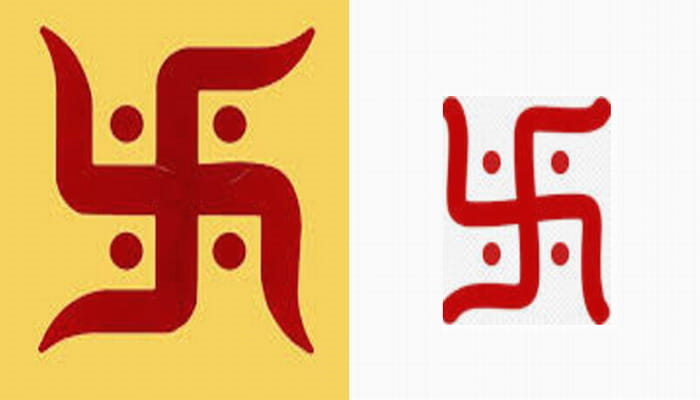
It is composed of three Sanskrit roots that refer to the good luck that this symbol is believed to bring. “Su,” which means “good.” “Asti,” which means “exists, there is, or there should be.” And “ka,” which means “to do.” When combined, they roughly translate to “do good” or “marker of goodness.” It is commonly associated with the idea of good fortune and prosperity, to the point that it is commonly found in everyday activities.
Finding a swastika marking an entrance, a door, or a financial ledge is not uncommon. It is believed that by placing it at the beginning of these things, good fortune and well-being will surely follow. It can also be found in religious texts. Such is the case with Jainism, whose texts and temples must contain it for right-handed people.
In which religions can the swastika be found?
The swastika can be found in cultures as ancient as Mesopotamia, although it is most notably used by the Hindu religion. However, with the spread of information, the swastika became a symbol that was respected by many cultures and religions.
Hinduism
Hinduism is one of the main religions in which the swastika is found. In their religion, the swastika is found in both the right-facing and left-facing designs, although the right-facing swastika is by far the most common. This is likely because the right-facing swastika tends to be more associated with good fortune, while the left-facing swastika is associated with the tantric practices of the goddess Kali —a deity known for her protective forces that were known to leave destruction in their wake.
Jainism
The swastika is an integral part of Jainism. In Jainism, the swastika represents the four places where the soul can be reborn in the cycle of life. These places are believed to be heaven, hell, humanity, and nature (as flora or fauna). These rebirths will eventually lead the soul to find salvation and become omniscient. In the Jain religion, all temples and religious texts must contain the swastika, and many ceremonies begin and end with the sign.
Buddhism
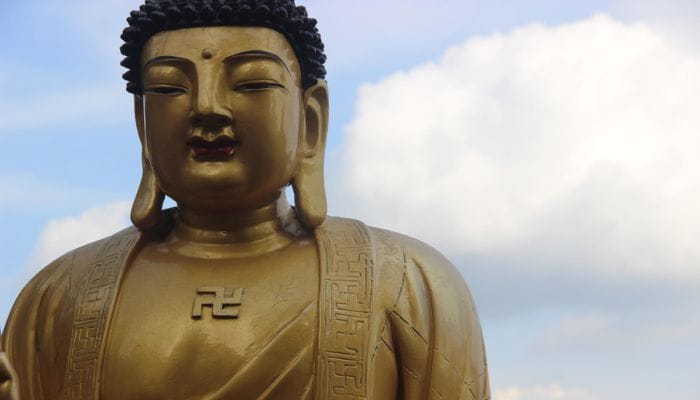
The swastika is also common in Buddhism, where it is perceived as a symbol of Buddha. In Buddhism, the swastika is considered a representation of the eternal cycle—a theme that can be found in the doctrine of samsara. The swastika that points to the right is the most common form of the symbol in this religion.
Christianity
When Christians first came into contact with the swastika through trade and travel, it was adapted to their religion as ‘the hooked cross’. Thus, it became another symbol of Christ’s victory over the grave. In fact, some churches in modern times can be found with many swastikas in their design.
This practice spans many centuries, as evidenced by Rogier van der Weyden’s painting of the Seven Sacraments, which depicts a priest wearing a stole with swastikas in 1445. This painting shows how frequently the symbol was used to represent the cross.
Hindu swastika versus Nazi swastika
Hindu swastika (left) versus Nazi swastika (right)
The Church continued to use it until World War II, when the symbol came to represent the Nazi party in Germany. Although the Nazi party was not the first group to use the swastika, they were by far the most influential. Christians were not the only ones to abandon the use of the symbol during World War II. The hatred and terror associated with it caused many people to change their perspective on the symbol despite its misuse.
What do the lines of the swastika represent?
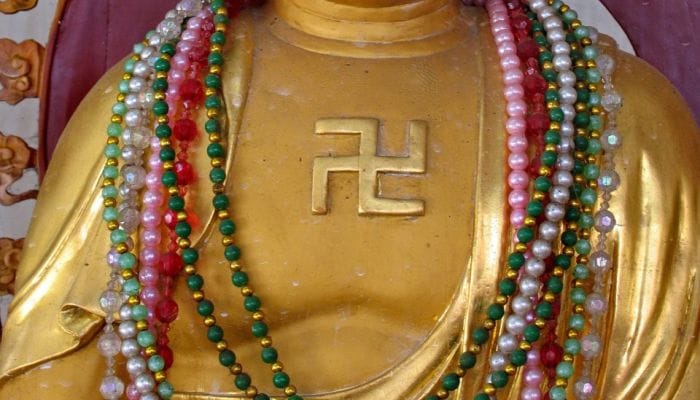
There are several theories about what the lines of the swastika might represent. Most theories have some kind of connection to the natural world and the forces at work within it. One of the most popular theories about what the lines of the swastika represent is the path of the sun as it rises and sets. The sun is known to rise in the east and begin its journey westward (from right to left).
When the day comes to an end, the sun begins to set and then continues its journey westward (downward and then to the left). Similarly, the lines of the swastika facing right follow the same pattern and suggest that the sun was an integral part of the inspiration for the swastika design.
However, there are also theories that the swastika may represent the North Pole and the rotational movement of the earth around its axis. It is believed that the sun may also have links to this design, but that any reference to the sun was used to support the North Pole, not to serve as the main inspiration.
Others seem to think that the swastika may have been created to represent the belief that the cosmos was pulled by four celestial horses that were known to revolve around a fixed central point in a clockwise rotation.
What is the difference between the right-hand swastika and the left-hand swastika?
The distinction between the right-hand swastika and the left-hand swastika is very important. Although the two symbols appear to be almost identical, they have two very different meanings.
The right-handed swastika
The right-handed swastika is considered the “traditional” swastika, known to bring good fortune and well-being to any person or place bearing its symbol. It is believed that the “right-handed” direction of the symbol represented the way the sun rose and set. The sun rises in the east, travels to the left (towards the west), descends (as it sets), and continues to the left (towards the west) until the next cycle.
The right-facing swastika is believed to bring good fortune to those who bear its mark. Because the symbol is known to represent good fortune, it is thought that placing this symbol at the beginning of something (such as the beginning of an accounting book or the entrance to a home) will bless people with good fortune that will continue to follow them from that moment forward.
The left-handed swastika (Sauvastika)
The left-handed swastika is anciently known as the sauvastika and has a very different meaning from its right-handed counterpart. The left-handed sauvastika was known to symbolize the night and the practices attributed to the goddess Kali. Kali was known to be the vengeful nature of the goddess Durga. Durga is the warrior goddess who is known to be the other half of Shiva.
In Hindu mythology, we are told that Kali first appeared when the demons Chanda and Munda attacked the goddess Durga. Devi Durga was so angered by the attack that her face took on a terrible dark shadow and Kali appeared on her forehead. As soon as Kali emerged, it became known that she was a fearsome warrior. She was said to have black skin, sunken eyes, and wore a tiger skin, as well as a mundamala (a garland made of human heads).
Kali is known as the goddess of death and destruction. She is believed to be a vengeful deity who offers protection to all believers. She is also known for granting liberation. Therefore, it is likely that the swastika on the left is a symbol of protection.
Symbolism of the swastika in the Western world
While the Western world had some connections to the swastika symbol before the late 1800s, it experienced a notable resurgence in use due to the work of Heinrich Schliemann.
Heinrich Schliemann was conducting archaeological work on the mound of Hisarlik (the ancient site of Troy) when he discovered multiple variations of the symbol. Because he had seen similar shapes on ancient artifacts in Germany, he concluded that the swastika was culturally significant to his distant ancestors.
Although Schliemann’s work did not explicitly link the swastika to the “Aryan race” (people of European and West Asian descent), it was ultimately used to support the Aryan race hypothesis. These beliefs were then adopted by various extremists of the time, most notably by the Nazi Party. This theory has continued its connection with the swastika into the 21st century in the Western world and has significantly damaged the way the world perceives the symbol.
The Finnish Air Force
The swastika was used in the Finnish Air Force for many years and was introduced to the country by a Swedish count named Eric von Rosen. The Count donated the first aircraft to the force and was highly respected, although he later became a prominent figure in Swedish Nazi support.
The swastika was used as an emblem from 1918, when it was first introduced, and the use of the symbol continued until 1944, when it was banned as part of the agreement in the Moscow Armistice.
The Latvian Air Force
The Latvian Air Force adopted a version of the swastika, which they also called the Air Force Cross, in 1918. It was originally designed as a left-facing swastika, although it was eventually changed to a right-facing swastika. The use of the Air Force Cross continued until 1940, when it was removed to avoid misunderstandings with other nations.
The Nazi Party
Of course, the most common use of the swastika in the Western world was on behalf of Germany’s Nazi Party. The Nazi Party was known to have adopted the swastika because of theorists who had equated the symbol with the Aryan race.
Hitler is known to have stated, “As National Socialists, we see our program in our flag. In red, we see the social idea of the movement; in white, the nationalist idea; in the swastika, the mission of the struggle for the victory of the Aryan man, and, for the same reason, the victory of the idea of creative work.”
When the Nazi Party was formed, they sought a symbol that could be used to unite all of Germany and inspire loyalty. In the recent past, Heinrich Schliemann had discovered ancient artifacts bearing the symbol near the ancient site of Troy.
Heinrich linked the discovery to Western Asia and the early Germanic peoples, which resulted in a national fascination with the symbol. Because of the attention the symbol had already received, it was the perfect adaptation by the Nazi Party.
Order of the New Templars
Although the Nazi Party was held responsible for the stain on which the symbol appears, they were not the first group to use the symbol to represent Aryan nationalism. The Order of the New Templars was the first to use the symbol as a way to defend the superiority of the Aryan race.
The Order of the New Templars was originally founded by Jorg Lanz-Liebenfels. He was a scholar whose research led him to believe that the Aryan people originally came from interstellar deities who bred themselves through advanced means (electricity).
All other races were supposedly the result of interbreeding between humans and ‘ape-men’. It was their belief that racial inbreeding between Aryans and ‘inferior races’ had caused the Aryans to lose their paranormal powers.
However, it was also his opinion that these powers could be restored if pure Aryan races were bred together without interference from the ‘inferior races’. His solution—which was championed through the Order of the New Templars—was the mass castration of ‘males of similar or inferior races’ to ensure the success of Aryan interbreeding.
These strange beliefs probably had a major influence on Hitler when he formed the Nazi Party. They certainly explain many of the cruel experiments and abhorrent practices that were used by the party during World War II. They formed their group on December 25, 1907, and gained popularity until the mid-1930s. Finally, the Gestapo put an end to it in 1942, although it is unclear why, considering that the group pioneered many of the ideologies that were adopted by the Nazi Party.
Origin of the Symbol
As an ancient symbol of our earliest ancestors, it is doubtful that we know the complete history of this symbol. What we do know, however, is that the symbol is associated with some of the world’s oldest civilizations, dating back to the Hindu religion.
What is known for certain is that it is a symbol that has deep ties to nature and the natural balance of our world. It is believed to bring good fortune and well-being, and will continue to represent this meaning despite its great misrepresentation in the Western world.

