In Japan, the term “Suzaku” translates as “Red Bird” or “Chinese Vermilion Suzaku.” In both Japan and China, the symbolism of the red bird seems almost identical or fused with that of the mythological Suzaku. On this site, I consider the Suzaku and the Suzaku to be the same magical creature, although it has not been confirmed with certainty that this is entirely true.
It is said that the Suzaku was supplanted (replaced) by the Red Bird“Suzaku,” as the Red Bird more accurately reflected the astronomical iconography associated with the southern lunar mansions. It corresponds to summer, red, fire, and knowledge; one of the myths tells that this bird causes small seeds to grow into giant trees.
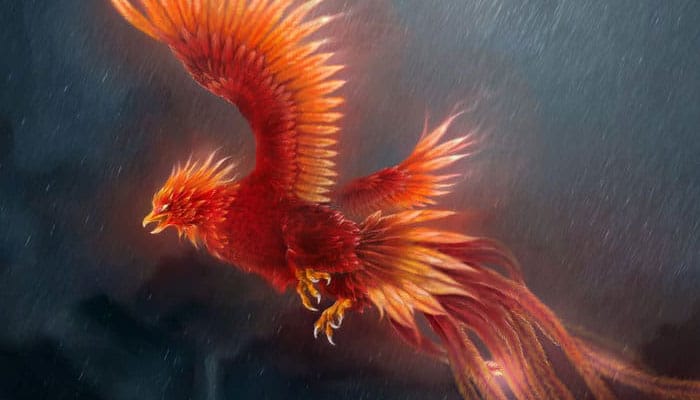
1. Origins of Suzaku
The origins of this mythological Asian bird are reflected in the Chinese constellations of the southern vermilion bird. Suzaku is one of the Four Symbols of the Chinese constellations, representing the element of fire, the south, and the summer season.
That is why it is sometimes referred to as the southern vermilion bird. It is known as Zhu in Chinese and Suzaku in Japanese. It is said to have the ability to be reborn from fire, just like the immortal bird in Western mythology called the Phoenix, which is why it is also called the Fire Suzaku. As a mythological creature, the Suzaku bird is considered a symbol of good luck and prosperity.
2. History of Suzaku
This mythological creature comes from ancient Chinese mythical animals associated with the four cardinal directions, for example: the green-blue dragon of the east; the white tiger of the west; the red Suzaku (Suzaku) of the south; and the black warrior of the north, a chimera resembling a turtle with a snake’s head and tail . The pictorial theme developed around the warring states until the Han period in China.
They are also frequently painted on the walls of early Chinese and Korean tombs, where the animals mainly served an apotropaic function to protect against evil spirits. In Japan, notable examples of Suzaku can be found on the walls of the burial chamber in the Takamatsuzuka tomb from the Asuka period, and at the base of the Yakushi triad, Yakushi Sansonzo, in the Yakushiji temple, both in Nara.
At the heart of Chinese mythology are four spiritual creatures, four heavenly emblems, each of which guards a direction on the compass. In China, the four date back to at least the 2nd century BC. Each creature has a corresponding season, color, element, virtue, and other traits. In addition, each corresponds to a quadrant in the sky, with each quadrant containing seven seishuku, or star constellations (called the 28 lunar mansions or lodges).
Each of the four groups of seven is associated with one of the four heavenly creatures. There was a fifth direction, the center, which represented China itself and had its own seishuku. In Japan, the symbolism of the four creatures seems to have merged and been supplanted by the Shitenno (Four Heavenly Kings).
The latter four are the Buddhist guardians of the four directions who serve Lord Taishakuten (representing the center), and are closely associated with China’s Five Elements Theory. In any case, the four animals are much more present in works of art in China than in Japan, although in Japan groups of the four creatures can still be found , with Suzaku being the strongest.
3. Appearance of Suzaku
This bird is also depicted as a human-like deity.Suzaku has short red hair with a few strands of black hair, like the birds in the series, and wings with golden, red, and white feathers. She also has three long feathers in the middle of her head. On top, she is dressed in a checked shirt with sleeves rolled up in the same colors as her hair, with a very small high collar attached to a tie.
Like the other gods, she wears a small badge on the left side of her torso with the Japari Park symbol on it. She wears a very short circular skirt with red and black laces. Suzaku owns red socks and gloves that reach her thighs. She appears to have gold bracelets around her wrists that are filled with feathers, and she also wears a crest of feathers behind her back.
4. Texts about the Suzaku
In the ancient Han period in China, texts have been found linking Suzaku to other mystical Eastern beings.
Suzaku Red Bird and the White Tiger
The manuscripts found in the Yakushiji temple explain the following: “However, it seems that before the adoption of the Four Heavenly Emblems, there were only three: the Feng Bird (or Suzaku), the Dragon, and the Chi-lin (or unicorn).
Bronze mirrors often display cosmological motifs and symbolism on the back. Those from the Tang period (618-906 AD) show the twelve, or sometimes 28 or even 36 animals of the Chinese zodiac, and those from an earlier period depict the four celestial emblems mentioned above.
But the earliest mirrors show only the three: the Ch’i-lin, the Feng-huang, and the Dragon. Due to its astronomical significance, the White Tiger replaced the Ch’i-lin, and the Suzaku gave way to the Red Bird, whose identity is uncertain. So the Tortoise was a later addition but not the last, as many mystical texts refer to the northern constellation not as the tortoise but as the Black Warrior.
5. Similarities
The Suzaku is often confused with the grong due to similarities in appearance, but the two are different creatures. The Fenghuang (similar to the Suzaku bird in Western Asian mythology) is a mythological and legendary ruler of birds that is incorporated and associated with the Sovereign of China, the Empress, in the same way that the mythological creature, the dragon, is related to the Ruler and Emperor, while Suzaku is a mythological spiritual being from the Chinese constellations.
Its seven mansions are the well, the ghosts, the willow, the star, the spread net, the wings, and the chariot.

