A sphinx was a mythical monster with the head of a human and the body of a lion. Sphinxes also appeared in Egyptian mythology; the two cultures had close ties and had influenced each other considerably.
In Greek mythology, the sphinx was considered a woman. In Greek mythology, only one sphinx was believed to exist; she was the daughter of Orthus and Echidna or Chimera. In addition to a human head and lion’s body, she had eagle wings and a serpent’s tail. According to the myth, she lived outside the city of Thebes and asked all travelers a riddle before letting them pass.
The riddle she asked is famous: what creature has one voice but four feet in the morning, two feet in the afternoon, and three feet in the evening? Anyone who struggled to answer was devoured by the monster. However, Oedipus managed to answer correctly; he replied “man,” who crawls on all fours as a baby, walks on two legs as an adult, and needs a cane to walk when he is old.
It seems that there was a second riddle after the first: “There are two sisters; one gives birth to the other, who in turn gives birth to the first. Who are they?” The correct answer is “day and night,” two words that are feminine in the Greek language.
After Oedipus answered both questions correctly, the Sphinx committed suicide, either by throwing herself off the rock on which she rested or by devouring herself. This seems to be the literary way in which the ancient Greeks moved from the old religious practices, represented by the Sphinx, to the new ones and the establishment of the Olympian deities, represented by Oedipus.
Who was the Sphinx?

A Sphinx was a chimeric creature with the characteristics of a human, a lion, and a collection of other animals. These chimeras once protected sacred places throughout the ancient world, using riddles to judge how worthy a person was to approach their protected treasure.
Origin
The sphinx first appeared in Egypt around 2600 BC. When the Greeks discovered Egyptian statues of this beautiful and powerful creature in 8 BC, they decided to bring it back to their own culture, claiming that it had been summoned from Africa by the gods. From Greece, the chimera spread to surrounding cultures, including Mesopotamia and Southeast Asia. Eventually, it could be found in India, the Philippines, Burma, Thailand, and Sri Lanka.
Appearance
Sphinxes are powerful and real creatures, but their exact appearance varies from region to region.
- In Greece, there is officially only one Sphinx, a divine lady with the legs of a lion, the wings of an eagle, and the tail of a snake. Criosphinxes, which have the head of a ram, and Hieracoesphinxes, which have the head of a hawk, have also been described in Greek legend.
- In Egypt, chimeras are usually male and resemble a god or pharaoh, with the traditional pharaoh’s headdress. They have lion hindquarters, but are otherwise human.
- In India, the guardians are part man, part eagle, and part lion. In some works of art, the lion’s fawn-colored body is replaced by the slinky spots of a leopard, and the wings are left out. Ornate headdresses crown these seductive creatures.
Personality
Of all mythological creatures, the Sphinx has the most famous personality. Unlike other creatures, she is not simply an obstacle to be overcome. She is a complicated, sentimental creature with a gaze that sees into the souls of men. At the same time, she keeps her own soul shrouded in mystery.
Sphinxes are often placed as guardians outside sacred places. When they have something to protect, they can be fierce, killing any unworthy person who tries to approach their treasure. On the other hand, they can also be merciful, and even generous. For example, the lions that guard temples in India bless anyone who enters the temple with a pure heart.
Finally, these chimeras are fantastically intelligent. They possess a high level of wisdom that few humans can approach, and they can never be outwitted. Occasionally, they try to share some of their wisdom with humans through prophecies, but these prophecies are usually written in such abstract language that they cannot be understood.
Special abilities
The Sphinx’s most famous talent is her ability to guess. She uses all her cunning to cook up these riddles, then uses her riddles to test the worth of men. Anyone who fails to answer the riddle is eaten.
The hidden legend describes the “Four Powers of the Sphinx”: to know, to want, to dare, and to remain silent. Men are encouraged to develop these powers so that they can attain the ideal state of wisdom of the chimera and master the four elements: water, air, fire, and earth.
Related creatures
Greek legend proposes a variety of parents for the Sphinx. Its father may have been Orthrus, a two-headed dog; Typhon, a deadly giant who was also the father of Orthrus, Cerberus, Chimera, Hydra, Medusa, and the dragon of Colchis; or Laius, a hero of Thebes. Her mother may have been Chimera, a fire-breathing lion with an extra goat-like head, or Echidna, a snake-like monster woman.
Egyptian legend has a different explanation for the rise of the Sphinx. She represents a relationship between Sekhmet, a lion-shaped sun goddess, and several pharaohs, including Amun, Hatshepsut, Hetepheres II, and Khafre or Khufu.
Famous myths of the Sphinx
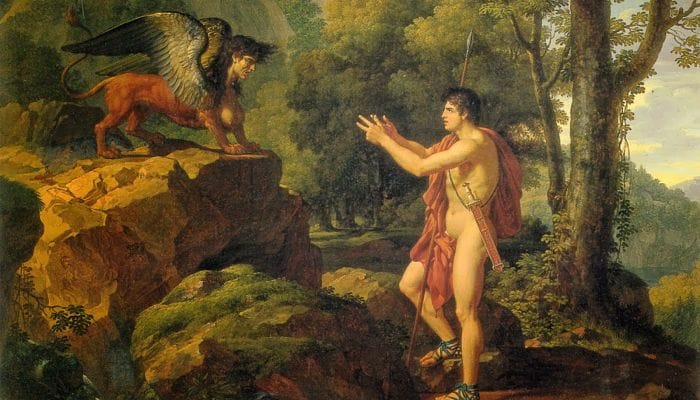
The most famous legend of the Sphinx is its reign of terror in the Greek city of Thebes. Several gods were angry with the Thebans. Hera, Ares, Dionysus, and Hades all had reasons to take revenge on the city, so it is unclear which of these angry gods decided to summon the Sphinx of Africa and set it loose on Thebes. It was instructed to act as a plague upon the people, but instead of running frantically through the streets and causing mass slaughter, the enigmatic chimera decided to perch atop Mount Phikion and challenge the Thebans to answer a riddle.
Greek scholars have proposed versions of this riddle:
“What has a voice but four feet, then two feet, then three feet?” The solution to this riddle, which the Sphinx learned from the Nine Muses, is “man.” As a baby, man crawls on all fours. As an adult, he walks on two feet. As an old man, he uses a cane to make three feet.
“There are two sisters. One gives birth to the other, who in turn gives birth to the first. Who are they?” The solution to this riddle, which the Sphinx learned from the Oracle of Cadmus, is “day and night.”
An oracle told the Thebans that they would only be free of the dreaded Sphinx when its riddle was answered, so they held convention after convention, trying to find the answer. But all the answers they tried were wrong, and the chimera devoured the men who answered incorrectly. After losing many of Thebes’ best men, the king of Thebes gave up. Anyone, he declared, who could answer the Sphinx’s riddle would become king of Thebes.
Oedipus responded to this offer. He climbed Mount Phikion, alone, to face the murderous chimera, and answered its riddle correctly. Some versions of the story explain that Oedipus knew the answer because it was given to him in a dream. Other versions claim that the Sphinx was tired of slaughtering the people of Thebes, so she told Oedipus the answer. When her riddle was solved, the creature leaped from Mount Phikion and fell to its death.
Modern Use
Today, the Egyptian pyramids and the Sphinx of Giza have become inseparable images. This weathered chimera is one of Egypt’s greatest icons. It can be found on coins, stamps, and official documents. It has also created a hot spot for tourists, who contribute hundreds of thousands of dollars to the Egyptian economy each year.
The Sphinx has also been adopted by fantasy writers around the world, including JK Rowling, Edgar Allen Poe, and Alexander Dumas. These incarnations generally stick with the Greek tradition; they attract females with a penchant for secrets and riddles.

