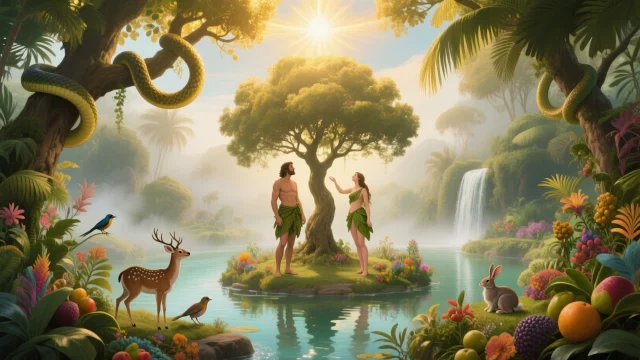
Shangri-La is a mythical utopian village located in the unexplored regions of the Himalayan mountains. Although the term originated in the 1930s, the concept is very similar to ancient paradises such as Shambhala and the Garden of Eden.

It is said that the inhabitants practice traditional Buddhist customs, free from materialism and other Western influences, live for hundreds of years, and exist in harmony with nature. Within the range of high peaks, the well-hidden village has a sacred palace and a lake, according to sources.
Source
The term is based on James Hilton’s novel Lost Horizon, published in 1933. The story is perhaps drawn from the ancient Tibetan myth of Shambhala. It was in the 1580s, however, when the Western world first heard mention of the Shambhala or Shangri-La type of paradise. European travelers of the time were welcomed at the court of Emperor Akbar and heard all about the mythical utopia.
Location
Sources reveal that paradise may be located in the Kunlun Mountains, one of the longest mountain ranges in Asia. In the Jin Dynasty, from 265 to 420 BC, the Chinese poet Tao Yuanming mentions a place similar to Shangri-La. In his story, a fisherman accidentally discovers a group of people living in an isolated and lush area after his boat passes under a mysterious cave. The villagers were friendly and welcomed the fisherman to their happy home. In 2001, the area was renamed Shangri-La to attract more tourists to the site.
The authors also claim that the Hunza Valley is another possible location for paradise. It was supposedly the basis for Hilton’s book, but as there is no Tibetan influence in the area, it is a less likely candidate. In the 1920s and 1930s, a National Geographic journalist lived in the Yunman province region of China and presented articles and photographs of the lush valley. This may also have been another potential Shangri-La, according to some sources.
Lost Horizon
In Hilton’s novel, the hidden Shangri-La is a lamasery run by a 200-year-old monk, supposedly located in the Kunlun Mountains. The inhabitants lived a peaceful life, free from money or greed, and kept the secrets of their ancient culture.
The novel may have gained popularity due to the effects of the Great Depression, providing a means of hope and escape for its readers. A copy of the book was reportedly found at Camp David at the time, according to some insiders.
Shambhala
Stories of mythical, lost kingdoms have existed long before Lost Horizon. For hundreds of years, tales have existed in Buddhist teachings of a place in the Himalayas where the most sacred teachings of Buddhists are preserved. It is believed to be a place that is more spiritual than physical, and is known as Shambhala.
Agarti
Agarti, or Agarta, is a legend, similar to the hollow earth theory, of a hidden underground city located in the Himalayas. Alexandre Saint-Yves d’Alveydre, a French occultist, wrote about Agarta. The mythical kingdom was believed to have highly advanced technology. Madame Blavatsky, a renowned theosophist, took the story further, claiming that Shambhala could be reached through the tunnels of Agharta.
Modern references
Shangri-La is the name of a dark section of Saturn’s moon Titan, which is filled with liquid hydrocarbons. It is said to be another sign of the similarity between Titan and Earth and perhaps provides hope for a Shangri-La outside our own planet!
After the acclaim of Hilton’s novel, a film of the same name was made, and it was a huge success in 1937. In recent films, the theme has also been used; for example, in Sky Captain and the World of Tomorrow, the characters wake up to find themselves in Shangri-La. Numerous television series have used the concept of the hidden paradise, as well as several books and songs.
The word utopia derives from Latin and means “no place.” This is an essential element of a utopia, Shambhala, Eden, or Shangri-La. If it could be found, it would probably be flooded with visitors and lose its essential utopian qualities. Perhaps, as many Eastern philosophies claim, we can only truly find these idyllic places within ourselves.