Saraswati is a Hindu goddess. Her name means watery, fluid, or elegant. Originally, her name was attributed to the river Saraswati, but later the sacred river was personified and took the form of the deity. The river Saraswati, now called the Sarsuti River, is known for bringing good fortune to those who bathe in it, as well as fertility and purification.
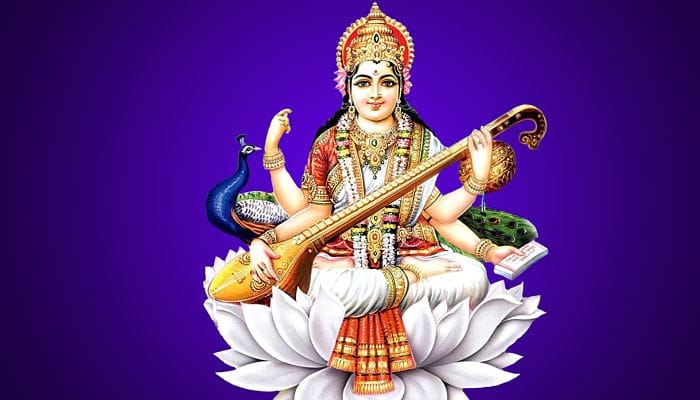
The goddess is believed to be the creator of Sanskrit (meaning perfectly made), the ancient language of Hinduism. She is often the muse of Hindu artists and is worshipped in India and Nepal. Saraswati is part of a trinity of goddesses called Trivedi, along with Lakshmi and Parvati. She is also known as Bharti, meaning eloquence or Vedamata, mother of the Vedas, and Shatarupa, meaning existence, as well as Vishnu.
Origin
Saraswati is first noted in the Rigveda, ancient Sanskrit hymns dating from approximately 1500–1200 BCE. The goddess has been worshipped since the Vedic period and is still worshipped today.
Legends and Stories
She is represented differently in the legends of various regions. Many temples are dedicated to her, including the Gnana Saraswati Temple in India, which is visited by pilgrims every year.
The Curse of Saraswati
In the curse of Saraswati, the goddess curses her husband when she sees him participating in a religious ceremony with another woman instead of her. Brahma had been waiting for his wife to join him, but she arrived late and delayed the important ceremony.
Brahma prayed to the gods for advice, and they responded by creating a new wife for him. When Saraswati encountered the new woman, who had apparently replaced her, she cursed her husband. He was never to be worshipped again.
Saraswati and the song of the Gandharva
One day, demigods called Gandharvas emerged from the scent of flowers. The Gandharvas stole a plant that was prized by the deities, the Soma plant. The plant contained sap that was intoxicating and invigorating. Saraswati went to the demigod’s abode to reclaim the special plant and enchanted the thieves with her veena, a classical stringed musical instrument.
The Gandharvas were enchanted and begged her for her mystical music. The goddess agreed to teach them, but in return, she wanted the Soma plant. The terms were agreed upon, and she taught them to play music as she did. The demigods later excelled in music, to such an extent that their melodies had more power than the intoxicating plant.
Saraswati and Shiva’s Third Eye
Shiva, the destroyer of the universe, one day looked down upon the world and saw how evil and corrupt it had become. He decided that the only solution was to wipe everything out with his destructive third eye, and he opened it. A vicious fire emanated from his third eye, to destroy the three worlds: the physical world, the world of ancestors, and the home of the gods. Saraswati did not agree with him. She appeased the people, saying that those who were pure would not be destroyed. To save them, she transformed herself into a river, and her pure waters absorbed the deadly fire.
Festivals
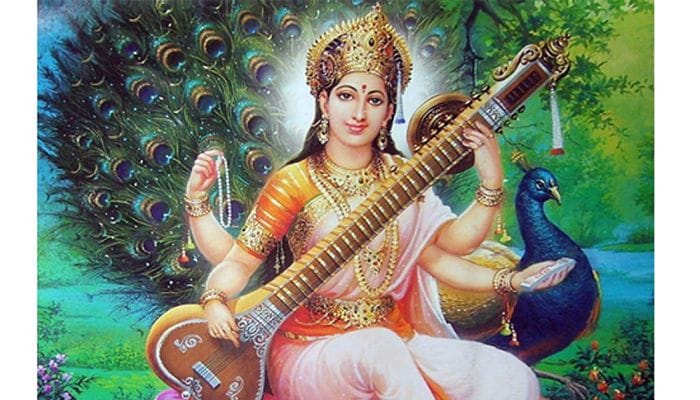
The festival, Saraswati Puja, is celebrated on the first day of spring. She is worshipped with offerings of yellow and white flowers, books, inkwells, and instruments to invoke her blessing on music and writing. Followers dress in yellow, which is associated with wisdom, and also adorn statues of Saraswati with yellow silk. No one reads or writes a book on that day, with the exception of young children.
It is the ideal day for them to learn to write, and they do so in a ceremony called Hatey-Khori. The ceremony is believed to prepare one to become a learned person. Students often pray to the goddess before exams, as the goddess of wisdom, and musicians before a performance, as the goddess of music, or simply before a lesson of any kind.
Family
The goddess’s husband is Brahma and her son is the sage Sarasvata. In certain Hindu beliefs, the first man, Manu, was also born from the union of the goddess and Brahma. Manu wrote the Manu-smriti or Laws of Manu, approximately in the year 100 AD, prescribing dharma to Hindus.
Appearance
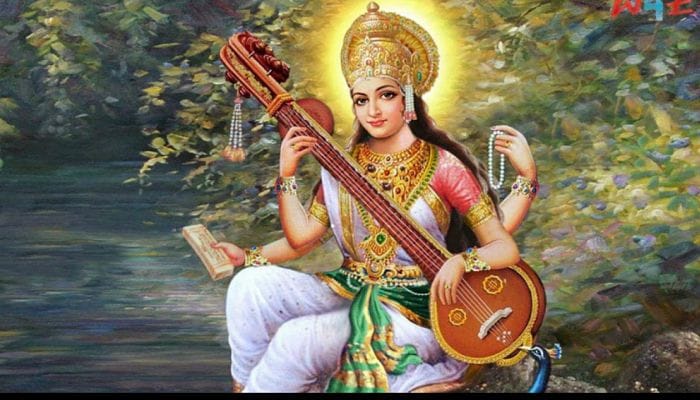
The goddess is depicted as a young woman with white skin, often wearing a white sari. Her disinterest in material possessions is demonstrated by her lack of jewelry or bright colors. She is often depicted sitting on a lotus flower or riding a goose or swan. Saraswati usually appears holding symbolic objects in her four arms. The objects on the left are a water vessel, signifying purification, and a palm leaf manuscript.
On the right, one hand performs the varada mudra, the gesture of giving gifts, while the other holds a white lotus flower. Alternatively, she is also often seen holding a classical Hindu musical instrument called a veena, which represents creativity in the arts and the emotions conveyed through music.

