The Roman sun is represented by two deities through the gods Sol Indiges and Invictus, one of the oldest gods in Roman mythology. Early history records him as one of the many deities introduced by Emperor Titus of the Flavian dynasty.
The sun god disappeared from literature for some time and was reintroduced by Emperor Aurelian as Sol Invictus, meaning “unconquered sun.” The differentiation in name may have come later to help people discern between the myths of the two. It has its meaning as the mandala in Buddhist and Hindu mythologies.

Origin
Sol Indiges was one of the first gods introduced by Titus around 79 AD, during a time when the Romans and the Sabines were allies. In Virgil’s epic Latin poem, the Aeneid, the Trojan hero Aeneas was a Roman who fled to Italy after the defeat of Troy. Once there, he married the daughter of Latinus, a Latin king. Latinus’ mother was Circe, the daughter of the sun. That is why we call him one of the Roman sun deities.
This marriage into the sun family shows the importance of the deity to the Roman state, and is also a sign of the unity of the Latins and Romans. Several festivals dedicated to the sun god were held. On August 9, at the temple in the Quirinal cult center, a fair was held in honor of the sun, which is necessary for a good harvest.
On August 28, the dedication of Templum Sol et Luna was celebrated at the Circus Maximus, which was the main temple that the sun god shared with the moon goddess. Circus is derived from the name Circe, daughter of the Roman sun.
Sol Invictus
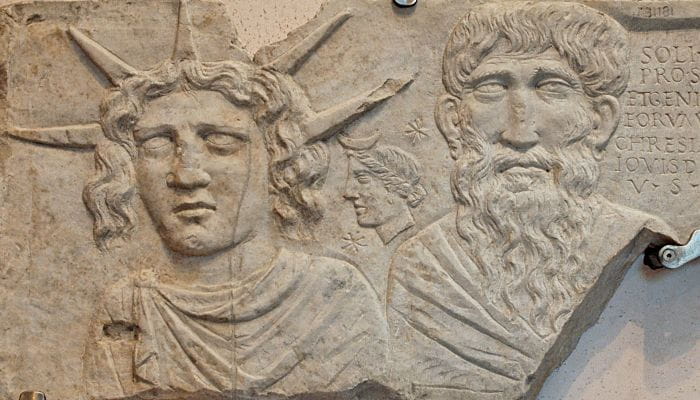
Emperor Aurelian reintroduced the sun god and his worship in 274 AD. On December 25, the birthday of the unconquered sun was celebrated in the Roman festival Dies Natalis Solis Invicti. There is ongoing debate about this date. Was it before Christmas, or was it chosen later to be the same day? We know that Sol Invictus was worshipped in Rome until Christianity became the dominant religion during the reign of Constantine in 300 AD.
Historical influence
Some believe that December 25 was chosen as the date for Christmas after the pagan celebration of Sol Invictus, while other theories say that the date of Christmas was chosen first. The Romans believed that Sol had died for three days and was reborn on December 25. The three days following December 21 are the darkest of the year: the three days when neither the sun nor Jesus can be seen.
There are theories that connect Christianity with astrology and the sun. Jesus had 12 disciples, which corresponds to the 12 constellations of the zodiac. The halo in many paintings of Christ bears a resemblance to the cross of the zodiac.
The sun god also played a role in the secret religion of Mithraism, which was practiced during the 1st to 4th centuries of the Roman Empire. It is unclear whether Sol can be definitively identified as Mithra—who was originally a Persian god—but it is known that the center of worship for Mithraism was in Rome.
Sol Invictus is found on many ancient Roman coins, as several of the emperors of Rome during the later era were partial to Sol, including Constantine the Great, who was committed to the sun god in addition to Christianity.

