Since the dawn of time, humans have looked up at the sky with wonder, awe, and fascination. The wind, the sky, the clouds, thunder, and lightning are things that have captured the imagination of humanity and have held an undeniable mystical quality for us since time immemorial.
Long before the age of reason and science, people have gazed at the heavens and tried to explain the various phenomena of the vast skies above, seeking some way to understand how these wonders fit into the universe they know.
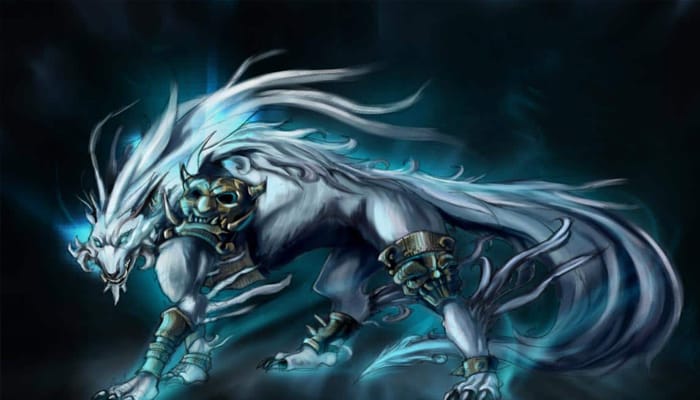
Raiju (or Raiju), meaning animal thunder or thunder beast, is a legendary creature from Japanese mythology that is said to be the companion of Raijin, the Shinto god of lightning (i.e., an ethnic religion of Japan).
The thunder beast. The Raiju as depicted as “thunder animal” or “thunder beast” is a legendary creature from Japanese mythology. Raiju is a wolf-like creature from Japanese mythology. It can be a wolf, a dog, a fox, a cat, or a weasel. It is like the “pet” of the god of thunder, Raijin. Its most common form is a wolf or dog that is white and blue, the colors of lightning.
It will jump around fields, trees, and sometimes buildings. During a thunderstorm, if lightning strikes your tree, it is said that it was scraped by Raiju’s claws. Sometimes, Raiju can be strange and sleep in people’s belly buttons. Raijin then shoots arrows into the person’s belly to wake Raiju, thereby hurting the person.
1. Origins
Raiju is a creature with origins in Japanese mythology. In the myth, Raiju is the pet and companion of Raijin, the kami of lightning and thunder. Long ago, Raiju was one of the most well-known and feared supernatural creatures in Japanese folklore. However, today it is relatively minor and virtually unknown to the average person.
This drastic reversal is due to advances in science during the 19th and 20th centuries. In the Edo period and before, lightning and other natural disasters were believed to be the work of the gods. Only the gods had the power to shake the earth and send fire from the sky. Lightning strikes so quickly and randomly that it is impossible to observe.
But it has very observable effects: the terrible booms that shake the ground, the strange burn patterns on things it strikes, and the fires it ignites. In ancient Japan, when all buildings were made of wood and tightly packed together, a single bolt of lightning could cause widespread destruction. The damage caused by lightning was indiscriminate: it destroyed everything from peasant huts to imperial palaces. Lightning was rightly feared by all.
During the Edo period, “real” Raiju were popular attractions, along with kappa and mermaids. Mummified and taxidermied remains of cats, monkeys, and dogs were presented as Raiju and toured the country in traveling exhibitions. Spectators could pay a few coins to get a close and safe look at a dead Raiju in a glass case.
During the Meiji period, society was rapidly transformed by the influx of foreign science and technology. Yokai such as Raiju were among the first victims of this modernization. People were actively discouraged from clinging to superstitions because they were perceived as a disgrace to the country.
New knowledge about electricity and lightning, and the invention of the airplane, explained the most defining characteristics of the Raiju: its life in the unreachable sky and the divine power of lightning. Once those mysteries disappeared, the Raiju no longer held power over people’s imaginations, and it was quickly forgotten.
2. History
Japan has a long history of stories about these strange entities that fall from the sky, and some reports even claim that they were killed and eaten by farmers. Other stories tell of angry farmers who attacked and killed the creatures when they infested the forests and began to rage out of control. In addition, there are many accounts of these fallen Raiju actually being captured alive.
One such account refers to a Raiju that was captured in the 18th century on Mount Asama in Shimane Prefecture. This specimen was then kept in an iron net and put on display for all to see. Most viewers described the animal as resembling a fox and a weasel, with sharp, curved claws. The creature refused to eat or drink during its captivity and would become very agitated before the evening rain.
Buraq: Islamic Creature. Horse With a Woman’s FaceDuring stormy weather, its hair would bristle and it would emit a high-pitched, shrill noise that instilled fear and panic in anyone within earshot. Another such creature was captured in Lord Nagai’s fiefdom in the Iwatsuki district of Saitama Prefecture.
The Raiju was supposedly captured while crossing a garden and damaging vegetables after a storm. After its capture, the creature was kept in a cage for some time before dying from refusing to eat or drink. The animal was reported to have the unusual appearance of a puppy with the claws of a bear. Its feet were described as having many knuckles and its skin was thin, except for thicker fur below the legs.
A Raiju allegedly fell into a well in Izumo Province, where it became entangled in ropes and was captured alive. The creature was later displayed in a bronze cage in the courtyard of Tenjin Shrine in Matsue City. The animal was said to resemble a badger.
When the weather was clear, the Raiju was quite docile and calm, sleeping peacefully in its cage most of the time. On occasion, it was said to even perform tricks and pranks for curious onlookers. However, during storms it would transform into a fierce, hissing beast, barely contained by its cage, with eyes that were said to blink and flash sinisterly as if filled with lightning.
3. Appearance
Raiju’s appearance varies from story to story, but everyone agrees that it is a beast made of lightning. One form is that of a blue and white wolf wrapped in rolls of lightning. To move, it turns into a ball of lightning. Its cries sound like thunder.
Descriptions of Raiju’s appearance vary, ranging from a dog to a squirrel, but it is most often seen as a wolf or a badger. Its celestial form is that of a wolf enveloped in lightning, and its cry is said to sound like thunder.
A Raiju is the embodiment of lightning in animal form. They had long, sharp claws and fierce faces. Generally, they were thought to resemble wolves, dogs, raccoons, or even weasels or cats. Much more extravagant forms also existed. Sometimes Raiju were said to look like small dogs, but with four hind legs and two tails.
Sometimes they were said to resemble insects or crustaceans. Others looked like miniature dragons. Even more exotic, Raiju were said to be chimeric monsters composed of many different animals.
Byakko: White Tiger of the Western Sky4. Behavior
Raiju are normally placid beasts. This changes when a storm arrives. The Raiju goes into a frenzy, jumping from tree to tree and field to field, leaving burn marks with its claws. When the frenzied Raiju sees a human sleeping, it sinks into the sleeper’s belly button to rest. Because of this, many superstitious Japanese people still sleep face down during storms.
Raiju loves to sleep in human belly buttons. This leads Raijin to shoot lightning arrows at him, waking him up and hurting the person on whose belly the creature is resting. Therefore, it is vital to keep your belly button protected during a thunderstorm by sleeping face down.
Raiju live in the sky, a world that was completely out of reach for humans before the 20th century. Because of this, almost nothing can be said about their true nature or behavior. They ride lightning bolts to the earth when thunder claps, and they create chaos wherever they land. For seemingly no reason, they attack buildings, starting fires and causing massive destruction.
5. Abilities
Raiju seems to have the ability to change shape, given its multiple contradictory appearances. Raiju can also control lightning.
While Raiju is generally a calm and harmless creature, during thunderstorms it becomes agitated, falling from the sky with lightning bolts and jumping from tree to tree, to fields, and even to buildings. After the storm has passed, evidence of Raiju’s presence can be seen in the torn and deeply gouged tree trunks where Raiju dug its claws.
Trees damaged by Raiju are much harder to reach, fell, and harvest for their bark, which is used for Raiju- The bark heals toothaches.
During storms, Raiju will also swoop down on anyone taking shelter under a tree and enter any unprotected house. However, it cannot pass through a mosquito net, so the windows, doors, and chimneys of houses are often covered with netting to prevent the beast from entering. This creature also hates the smell of incense, which is often lit before and during a storm.
6. Interactions
Long ago, Raiju were seen as divine beasts, similar to the thunder gods (raijin). Nothing was known about them except that they were fast, ruthless, and deadly. Whenever lightning struck, people believed that the gods had sent a Raiju to punish them for one reason or another.
Small Raiju like to dig into the belly buttons of humans to hide from the angry thunder gods. This is the origin of a Japanese superstition that says you should cover your belly button when you hear thunder.
7. Mythology
Its body is composed of lightning bolts, and its most common form is that of a white and blue wolf (or even a wolf wrapped in lightning bolts), although it can be represented in other forms such as tanukis, foxes, weasels, or cats. It can also fly like a ball of lightning (in fact, the creature may be an attempt to explain the phenomenon of lightning, such as ball lightning).
This leads Raijin to shoot lightning arrows at Raiju to wake the creature and thus harm the person in whose belly the demon is resting. Stories of creatures riding balls of lightning or crashing into the ground on lightning bolts may understandably make many skeptical of the existence of a creature like the Raiju.
With such fantastical elements, it may seem that these are surely beasts from the depths of the human imagination rather than the sky. At the very least, it seems obvious that the tales of these creatures have been greatly embellished and imbued with folkloric elements. However, is it possible that somewhere at the heart of this folklore there is a zoological explanation for the Raiju?
8. Legends
Despite its elusive nature, Raiju’s physical form has been captured on multiple occasions. The Edo period (i.e., between 1603 and 1868 in Japanese history) in particular has many such cases. Once, Raiju became entangled in the ropes of a well and was captured alive. It was later displayed in a bronze cage at the Tenjin Temple in Matsue. There, it took the form of a badger that slept during good weather but would become active during storms with its eyes glowing.
Because they were so terrifying, Raiju are usually portrayed in stories as beasts to be killed, like the oni. The most famous example is probably the nue, which attacked Kyoto and was killed by Minamoto no Yorimasa in 1153.
Another legend is that of the samurai Tachibana Dosetsu. One night, he was sheltering from a storm under a tree when lightning struck. He drew his sword just in time to strike the bolt. When the smoke cleared, there was a dead Raiju on the ground next to him. He then named his sword Raikiri, or “lightning cutter.”
The Farmer and the Raiju
A farmer captured another Raiju in 1766, when one fell from the sky in Oyama, in Sagami Province. The farmer displayed the animal for money on the Riyo-goku bridge. It was described as black in color, slightly larger than a cat, and resembling a weasel. Each of the creature’s legs was adorned with five prominent, vicious claws.
Like the other captured Raiju described so far, this specimen was also tame and lethargic during calm weather, but wild during storms, during which it shook and scratched furiously at its cage, as well as lunging at anyone who approached it. It also refused any food given to it.
9. Historical Culture
In Japan, thunder and lightning were the elements of the Raiju, or literally “thunder beast,” the powerful servants of the Shinto god of thunder. These creatures were most often described as resembling a badger, weasel, cat, or fox, although they were sometimes said to resemble a wolf or monkey as well. Some accounts speak of creatures with wings or multiple tails.
They are often dramatically depicted enveloped in crackling tendrils of lightning, and their voices are said to rumble like thunder. Raiju were said to descend to earth on lightning bolts, ride on illumination, or travel in the form of balls of lightning.
Raiju were generally said to be quite docile in nature, but during storms they would become extremely agitated and aggressive, lighting up with lightning and frantically leaping from tree to tree, tearing off bark in the process with their formidable claws. In ancient Japan, it was said that trees dotted with lightning were the work of Raiju’s claws, and that burnt tree trunks were the result of their anger.
With all this fierce and dramatic imagery of lightning and thunder surrounding the Raiju, it is perhaps not surprising that the people of Japan have long feared and respected these otherworldly creatures. Moreover, although at first glance they appear to be entirely mythical constructs, these beasts were once considered quite real to the people of Japan.
Most rural dwellers knew very well which forests were inhabited by Raiju and took care to stay away during storms. In fact, areas said to be the lairs of Raiju were avoided for the most part, as they invoked a powerful fear in most people.
Raiju’s fearsome reputation was not helped by the fact that these thunder beasts were thought to dip down from the trees to bite and strike passersby indiscriminately. It was said that one of Raiju’s favorite targets was the navel, forcing many to protect their stomachs with armor or heavy cloth wrapped around their midsection, or to lie face down during storms.
However, despite all the power and menace they projected, Raiju was thought to be curiously unable to pass through mosquito nets and also to abhor the smell of incense. During storms, it was not uncommon for villagers in rural areas to burn large quantities of incense or erect nets in an effort to deter the beasts.
10. In popular culture
Two of these creatures appear in the anime Naruto: Shippuden. The character named Sasuke Uchiha forms a lightning Kirin in a storm to attack Itachi Uchiha. Kakashi Hatake briefly forms a dog or wolf from lightning chakra to attack pain.
One of the kaiju in the Pacific Basin is named Raiju. It resembles a crocodile or mosasaurus, has a three-part head armor that protects its actual worm-shaped head inside. It is portrayed as a fast swimmer with powerful jaws, but it does not possess electrical abilities.
The Pokémon Raikou is described as a legendary beast with electrical abilities that usually appears during thunderstorms. It appears as a yellow tiger-like creature with a curly purple mane and a blue tail that resembles lightning. Other Pokémon similar to Raiju are the wolf Manectric and the cat Zeraora.