A phoenix in Greek mythology was a bird that could live for a long time and could also regenerate or be reborn from the ashes of its predecessor. Some sources say that the phoenix simply died and decomposed before being reborn, but others claim that it would burn and die engulfed in flames. It was believed that it could live for more than 1,400 years at a time.
In ancient Greece, the phoenix was also linked to the civilization of Phoenicia, which has a similar sound. Phoenicia was famous for producing a purple dye from snail shells; this shade was also believed to be the color of the bird’s feathers. Other sources, however, say that it was similar in color to a peacock, or that it was red and yellow.
Who was Phoenix?

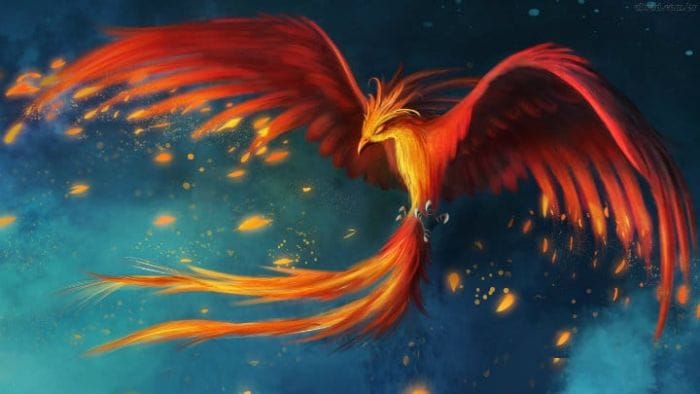
It was a fabulous bird with red and gold feathers, whose body emitted rays of pure sunlight. The creature lived for five hundred years and feasted on Arabian balm and frankincense. When it died, a new bird emerged completely from its body. It then encapsulated its father in a myrrh egg and carried it to the great Egyptian temple of the Sun God in Heliopolis.
What does the Phoenix look like?
In the oldest recorded images of the phoenix, these nebulous creatures usually have seven rays, like Helios (the sun Titan in Greek mythology). Pliny the Elder also describes the bird as having a crest of feathers on its head, and Ezekiel the Dramatist compared it to a rooster.
Although the phoenix was believed to be colorful and vibrant, sources do not provide a clear consensus on its coloring. Tacitus says that its color set it apart from all other birds. Some said that the bird was similar in color to a peacock, and Herodotus’ claim that the phoenix was red and yellow is popular in many versions of recorded history.
Ezekiel, the playwright, stated that the phoenix had red legs and striking yellow eyes, but Lactantius said that its eyes were blue like sapphires and that its legs were covered with golden scales with pinkish-yellow claws.
Herodotus, Pliny, Solinus, and Philostratus describe the phoenix as being similar in size to an eagle, but both Lactantius and Ezekiel the playwright claim that the phoenix was larger, while Lactantius stated that it was even larger than an ostrich.
Meaning and symbolism of the Phoenix
The mythical animal totem of the bird is the guardian of fire throughout creation. It signifies transformation, death, and rebirth in its fire. As a powerful spiritual totem, the phoenix is the ultimate symbol of strength and renewal. As a symbol of both fire and the sun, the phoenix animal guide symbolizes the sun, which “dies” when it sets each night and is reborn when it rises the next morning.
In this sense, it never truly dies; rather, it is an immortal creature that continually rises from the ashes. All of its attributes remain consistent with these ideas. In addition to the above-mentioned traits of power, transformation, rebirth, and life, the phoenix spirit totem is also widely regarded as a prominent symbol of seasonality, consistency, longevity, imagination, and protection.
Myth of the phoenix
There are also several variations in the Phoenix myth regarding the age at which the creature is reborn. Some legends claim that the bird lives to be 1,461 years old, while others claim that the bird lived for 1,000 years. Other sources estimate that the birds’ lifespan is significantly shorter.
Regardless of which version of the story is being told, there appear to be no records stating that the Phoenix dies before the age of 500, and the general limit for the powerful bird’s life cycle is typically less than 1,500 years. This can be explained by the symbolism of the story in question and what the Phoenix was supposed to represent in the story.
Where do the legends of the Phoenix come from?
Due to the confusion surrounding Egyptian texts, the origin of the Phoenix story is usually attributed to Greek mythology.
Bennu – Egyptian Mythology
The Greek Phoenix is commonly traced back to the Egyptian deity Bennu. The creature called Bennu was known to be a bird that was similar to a heron. Bennu is said to have lived on top of stones and obelisks and was worshipped by the people of ancient Egypt in a similar way to how Osiris and Ra were worshipped. In fact, Bennu was thought to be a living symbol of the god Osiris.
Bennu was believed to symbolize the flooding of the Nile, which was known to bring wealth and fertility to the land. For this reason, it was one of the most respected creatures in Egyptian mythology. Furthermore, the cycle of birth and rebirth is identical to that of the Phoenix (although the timeline is different). Instead of being reborn every 1,000 years, Bennu was reborn every 500 years.
Jewish mythology also refers to a creature believed to be the Phoenix. In their version, the Phoenix is known as the Milcham. The story begins in the days when people were still allowed to enter the Garden of Eden. It is said that when Eve gave in to the temptations of the serpent and tempted Adam with the fruit, she also offered the fruit to the other animals in the garden.
The Milcham bird was one of the animals that refused to partake of the fruit and was therefore rewarded for its loyalty. It was given a village where it could live in eternal peace. Every 1,000 years, the Milcham bird completed a life cycle, but being immune to the Angel of Death (because it had remained faithful to God), it was reborn again.
Garuda – Hindu mythology
Garuda is a solar bird known for being the mount of the god Vishnu and was also seen as a protector against the evil serpent. He is known to have been described as “the King of all birds” and is often depicted as a giant bird in flight.
Thunderbird – Native American mythology
The Thunderbird is also believed to have loose connections to the Phoenix. Like Garuda, the Thunderbird is known for protecting against the evil serpent and is considered a protector.
Firebird – Slavic Mythology
The Slavic firebird has obvious ties to the Phoenix and was probably created in their folklore when ancient cultures exchanged stories and legends along their trade routes. However, unlike many other cultures that spoke of the Phoenix, the Firebird was depicted as a giant hawk rather than a peacock. This is believed to be because the falcon symbolizes ultimate masculinity in Slavic culture.
The Slavic Firebird was also different from the traditional Phoenix due to its life cycle. Their Firebird symbolizes the different seasons of the year. The bird ends its life cycle in the autumn months but is revived again in the spring. With its rebirth comes beautiful music that brings happiness and new life.
Ideologies that adopted the Phoenix legend

The myth of the Phoenix was not only common in ancient mythology, but was also adopted by various religions and was sometimes used to represent theoretical ideas and the reign of powerful kingdoms. The element of rebirth in the story has often been used to describe a wide range of ideas.
Symbolism in Ancient Egypt
Although the Phoenix was known as Bennu in ancient Egypt, the two mythical creatures have been identified as the same entity. In Egypt, however, the sign of the sun bird was used to symbolize rebirth and immortality. The story of Bennu’s rebirth was thought to closely follow the rebirth of the human spirit as well.
Symbolism in Ancient China
The Phoenix was the symbol of the Chinese empress and was also believed to represent feminine grace and the sun. It was considered good luck to see a Phoenix. This was known to symbolize the ascension of a wise leader and a new era.
The Phoenix was also known to represent some of the most valuable virtues such as kindness, reliability, and goodness.
Symbolism in Christianity
In addition to being used in ancient cultures, the Phoenix is known to have been adopted in modern times as well. One of these adaptations was made by the Christian religion.
Early Christians used the Phoenix to represent the terms of Christ’s death and resurrection. This connection can be clearly seen in the death of the deity (Christ or the Phoenix) followed by a period of three days, during which a rebirth occurred. After the third day, the new cycle of life began.
The two ideas are so closely related that the Phoenix was used on early Christian tombstones to help symbolize the connection between the two figures. The images also serve as a reminder that death is not the end—it is simply a new beginning.
Cosmic fire and the creation of Earth

The story of the Phoenix has also been proposed as a possible way of retelling the creation of the Earth. Because the Phoenix is so closely associated with the sun, there are some who would hypothesize that the birth of the Phoenix could also be the birth of a new world. This birth would be the result of a cosmic fire that could be symbolized by the bright colors of the Phoenix’s feathers, as well as the flames from which it emerges.
When exploring this version of the story, it is often concluded that the death of the Phoenix describes the death of a world or galaxy through the explosion of its sun. However, this explosion is not the end of life, as it gives way to the creation of a new world.
Metempsychosis
In Greek mythology, the story of the Phoenix is often thought to be used to describe a philosophical term called “metempsychosis.” This reflected the spiritual beliefs of many who lived in Ancient Greece.
Metempsychosis is known as “the transmigration of the soul.” This is the process in which a person’s spirit is reincarnated after death. The use of the Phoenix to symbolize this belief helps to explain that a person’s soul never truly dies. It is simply transformed and reborn into another life as it moves from a person’s body at death and back to Earth when it is ready to enter a new cycle of life.
Possible explanations for the creation of the Phoenix myth
The East African flamingo. There has always been much speculation about the inspiration for such an impressive creature as the Phoenix. Some hypotheses suggest that the East African flamingo may have served at least as part of the inspiration for the story.
The East African flamingo is known to live in an area that is too hot for its young to survive. Therefore, it has to build a mound of earth to raise its nest so that the eggs and young can survive the heat. It is said that the convection currents around the mounds created by this bird are similar to the movement of a flame, which could have been the reason why the Phoenix was associated with fire.
Megafauna
There are also those who speculate that the story of the Phoenix may have been inspired by a species of megafauna that no longer lives. It is believed that the story of the Phoenix could therefore be an embellishment describing a real species of bird.
Sources
The most common source attributed to the inspiration for the Phoenix is simply the metaphorical narrative used to describe the spirituality of ancient cultures. Because many of the cultures that embraced the Phoenix were known to believe in the possibility of immortality through reincarnation (or transmigration), it is likely that the story of the Phoenix was created to give a more vivid description of the cycle of life.