Greek mythology shows that Patroclus was the son of Menoetius, one of the Argonauts. The identity of his mother is unknown, with the names of many different women documented in different stories. He was the best friend of the well-known hero Achilles. They fought together in the Trojan War, which would eventually become Patroclus’ legacy.
Origins
The story of Patroclus is found in the Iliad. He was the son of Menoetius, who had at least four marriages. For this reason, the exact identity of his mother is unknown.
When he was still a child, Patroclus got into an argument with one of his close friends while they were playing dice. His friend, Clysonymus, argued with Patroclus, and things quickly escalated. As the argument became more heated, an accident occurred and Patroclus unintentionally killed his friend.
To avoid dealing with the deceased’s family, Menoetius took his son to Phthia. It was here that Patroclus met Achilles. They immediately became great friends, and their friendship played an important role in the Trojan War.
Family
Although Patroclus did not have a family of his own, the family around him was very important.
Menoetius
Menoetius was Patroclus’ father. He was a Titan god and was known for his violent anger and rash actions. A small amount of this trait may have been passed on to his son, as his decisions ultimately led to his death.
Mother
His father married four times. It is unclear which of these women was his biological mother. Apollodorus of Athens has identified three women as the possible mother of Patroclus, including Periopis, Polymele, and Sthenele. Gaius Julius Julius Hyacinthus identified Menoecius’ fourth wife, Philomela, as the mother of Patroclus.
Achilles
Although they were not related, Patroclus and Achilles could not have been closer. They have been described as closer than brothers. Some scholars have even speculated that they may have been lovers, but the evidence for this claim varies from source to source.
Appearance
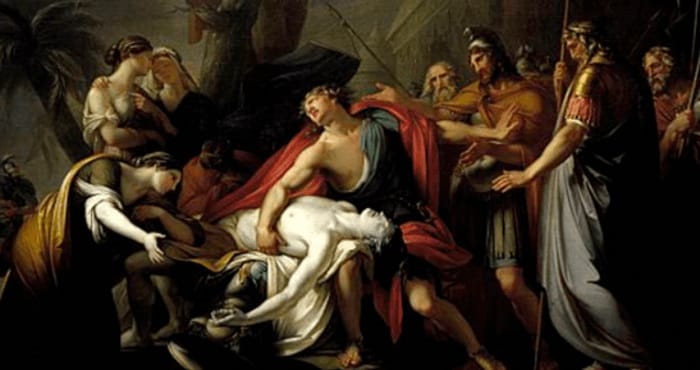
In almost all artistic representations, whether sculpted or painted, he is dead. The representations focus mainly on those closest to him in mourning. The best-known picture of him alive does not show his face. Instead, his naked body looks away from the viewer, seeming to symbolize the vulnerability of which he is unaware.
Legends and Stories
Patroclus played an important role in the outcome of the Trojan War. It is no exaggeration to say that the war could have had a totally different outcome without his participation.
Patroclus the Soldier
Patroclus and Achilles were already good friends when they both wanted to pursue Helen. Helen was already engaged, however, so they took the oath of Tyndareus, which stated that all suitors of the beautiful Helen would promise to protect both her and her future husband from any kind of danger or threat.
Helen married her fiancé, but quickly eloped with Paris, the prince of Troy. Her husband, Menelaus, quickly invoked the Oath of Tyndareus, which brought together all of Helen’s former suitors, including Patroclus and Achilles. This was essentially the beginning of the Trojan War, which would last 10 long years and result in enormous loss of life for both the Greeks and the Trojans.
As the Trojan War continued, Patroclus began to develop his battle skills. He was no match for Achilles, but he was inspired to improve. The Trojans had finally advanced and were beginning to threaten the Greek ships. Confident in his abilities, he convinced his friend to let him lead the army and force the Trojans away from the ships. Achilles finally agreed and allowed him to lead his army into battle. Before Patroclus left, Achilles warned him to only push the opposing army back. He was not to attack.
He succeeded in his quest and saved the ships. The enemy was repelled, but this was not enough for him. He did not heed Achilles’ warning and ordered the soldiers to attack the Greeks. This resulted in the death of many Trojan soldiers and heroes. The god Apollo was enraged by Patroclus’ actions and stunned him. This allowed him to be sought out by Hector, son of the Trojan king and brother of Paris. Hector killed Patroclus, which proved to be a catalyst for the end of the war.
Achilles was devastated when he learned of Patroclus’ fate. He blamed himself and wanted nothing more than to turn back time and stop destiny. Once Patroclus’ body was recovered from the opposing army, Achilles was filled with rage and attacked the Trojans with more fury than they had experienced so far in the war.
Achilles sought revenge for his friend and managed to kill Hector. To rub salt into the wounds of the Trojans, he dragged the body of their hero behind his chariot, disrespecting Hector’s memory and destroying his father, who had lost several sons in the war.
This incident was the turning point in the war. The Trojans had lost their hero, and the war quickly came to an end. Although Achilles had succeeded in avenging his friend’s death, he did not escape the consequences of his actions. He knew that even before he pursued Hector, he would pay the ultimate price for his decision, just as Patroclus had done.
Paris, Hector’s brother and the man responsible for starting the Trojan War, shot an arrow at Achilles’ heel, the only vulnerable part of his body. The arrow’s tip was poisoned and killed the Greek hero. He was cremated and his ashes were mixed with those of Patroclus, their unbreakable bond lasting into the afterlife.
Symbolism
As morbid as it may seem, he is symbolized by death. His life was cut short by his own poor decisions and his uncontrollable anger towards the Trojans. He wanted to be like his friend and hero Achilles, but his battle skills were not advanced enough. Instead of heeding Achilles’ warning, he attacked Troy and Hector. If only he had listened to his friend, he could have been saved.

