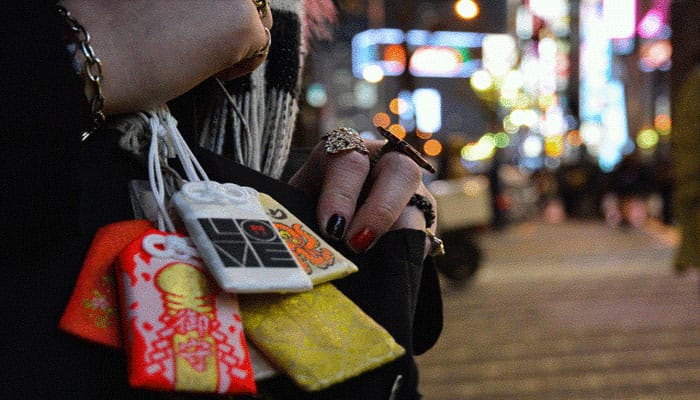
Omamori (omamori) are Japanese amulets commonly sold at Shinto shrines and Buddhist temples, dedicated to particular Shinto kami, as well as Buddhist figures, and are said to provide various forms of luck or protection.
1. Origin
The word mamori means protection, with Omamori being the sonkeigo (honorific) form of the word “protect.” Originally made of paper or wood, modern amulets are small objects that are usually kept inside a brocade pouch and may contain a prayer or religious invocation inscription. Omamori are available at both Shinto shrines and Buddhist temples, with few exceptions, and are available for sale regardless of religious affiliation.
Omamori become sacred through ritual use and are said to contain busshin (spiritual emanations) in a Shinto context or kesshin (manifestations) in a Buddhist context. While omamori are intended for personal use by temple visitors, they are primarily considered a donation to the temple or shrine being visited. Visitors often give omamori as gifts to others as a physical form of well-being.
2. Design and Function
The amulet cover is usually made of brocaded silk and encloses papers or pieces of wood with prayers written on them that are supposed to bring good luck to the wearer on particular occasions, tasks, or orders. Omamori are also used to ward off bad luck and are often seen in bags, on cell phone straps, in cars, among other places.
Omamori has changed over the years from being made mainly of paper and wood to being made from a wide variety of materials (i.e., bumper stickers, bicycle reflectors, credit cards, among others). Modern commercialism has also taken a small part of omamori creations.
This usually happens when popular shrines and temples cannot meet the high demand for certain charms. They then turn to factories to manufacture the omamori. However, priests are known to complain about the quality and authenticity of the products manufactured by factories.
According to Yanagita Kunio (1969):
It is likely that the Japanese have always believed in amulets of one kind or another, but the modern printed amulets now given out by shrines and temples became popular in the Tokugawa period or later, and the practice of a person wearing miniature amulets is also new. The latter custom is particularly common in cities.
3. Uses
An omamori from a shrine in Kumamoto. This item claims to “grant protection” to the wearer. The logo above denotes the Fujisaki Hachimangū Omamori shrine. Omamori can provide general blessings and protection, or they can have a specific focus, such as:
- Traffic safety protection for drivers and travelers of all kinds
- Avoid evil
- Open luck, better fortune
- Education and exam success for students and academics
- Prosperity in business success and financial matters
- Acquisition of a partner and marriage for singles and couples to ensure love and marriage
- Protection for pregnant women for a healthy pregnancy and easy childbirth
- Family safety (well-being), peace, and prosperity in the home
Omamori are not usually opened to avoid losing their protective benefits. They are carried on the person or tied to something such as a backpack or bag. It is not necessary, but amulets are generally replaced once a year to avoid bad luck from the previous year. Old amulets are usually returned to the same shrine or temple where they were purchased so that they can be disposed of properly.
Amulets are commonly returned shortly after the New Year. This way, the visitor to the shrine or temple has a fresh start for the New Year with a new omamori. Traditionally, traditional omamori should not be thrown away, but burned as a sign of respect for the deity that helped the person throughout the year.
If a shrine or temple visitor cannot find an omamori that meets their needs, they can request that a priest make one. If enough people request this same type of omamori, the temple or shrine may begin producing them for daily availability.
Protective amulets called omamori are widely available at Buddhist temples and Shinto shrines. The amulets are believed to ward off calamity and bring good fortune to the holder. Usually pieces of paper or wood printed with religious symbols such as the names of deities and shrines, mantras, and Sanskrit characters, omamori are displayed inside doors or on the main beams of buildings or carried on one’s person.
Omamori are rooted in the animistic belief of Shinto that spirits or gods inhabited all objects. In ancient times, stones, pieces of wood, and other items from nature were placed in dwellings or near settlements with the belief that the spirit inhabiting the object would ward off calamity. This practice was eventually adopted by shrines and temples, which began offering parishioners protective amulets that house the shrine’s deity or are imbued with the power of a particular Buddhist sutra or image.
There are omamori for almost every occasion in life, including those that guarantee health and longevity, success in studies and romantic relationships, safe childbirth and family life, success in business, and protection against traffic accidents. Omamori are generally purchased for personal use, but they can also be given as gifts, even to sick people in the hope that they will recover or to students sitting entrance exams.
Amulets come in a wide variety of designs, including pendants, wooden arrows, and small figurines. The most typical omamori is a small purse-like bag. HatsumÅde, the first visit to a shrine or temple in the New Year, is a popular time to purchase charms in hopes of ensuring good fortune in the coming months. Parishioners can return old charms at this time, which the shrine or temple then incinerates in a ceremony.
4. Modern commercial uses.
There are modern commercial versions of these that are not usually spiritual in nature and are not issued by a shrine or temple. It has become popular for stores in Japan to include generic omamori featuring popular characters such as Mickey Mouse, Hello Kitty, Snoopy, Kewpie, and others.
Omamori are amulets offered at Buddhist temples and Shinto shrines that are believed to protect or bring good fortune to the wearer. People often start the New Year by purchasing a new charm.
Individuality Amulet
Certain temples and shrines offer omamori that are considered to have greater power and are highly prized by certain groups of people. The ancient Mitsumine Shrine in the Chichibu Mountains in Saitama Prefecture is a famous “power spot.” People from all over the KantÅ region visit the shrine to purchase omamori imbued with the spirit of the shinboku, or divine tree, which is believed to have special attributes.
Suitengū, in Tokyo, has long been associated with childbirth, and its omamori are popular among pregnant women. Typically, women in their fifth month of pregnancy visit the shrine on inu no hi, a day associated with the zodiac sign of the dog (dogs have large litters and are considered auspicious for childbirth) to offer a prayer and purchase an amulet.
There are numerous shrines around Japan affiliated with the 9th-century scholar Sugawara Michizane, who after his death was deified as a god of learning. Amulets from shrines such as Dazaifu Tenmangū in Fukuoka, Kitano Tenmangū in Osaka, and Yushima-tenjin in Tokyo are popular with students, particularly in the run-up to entrance exams.
There are also sites for people seeking luck in love, such as the Jinushi Shrine in Kyoto and the Daijingū in Tokyo. The omamori from both places are popular charms believed to protect relationships.
5. Types of Omamori for Every Occasion
Success talisman “katsumori”
Potentially one of the most sought-after omamori, the “success” talisman is likely to be found in almost every temple and shrine. While “success” may be vague at first glance, it holds great promise: the wearer channels their energy into a single goal, and the “success” talisman ensures that it will happen. They often bear the image of an arrow, which is a common symbol in Shintoism for pointing toward a goal.
Many people choose to pick one up at a spiritual power spot. There are six such famous areas throughout Tokyo, including Meiji Jingu (considered the most powerful of all). Priests at shrines and temples urge wearers to use each talisman for a single purpose to maximize its power.
Amulet to ward off evil “yakuyoke”
Ward off evil
The most popular counterpart to the Omamori above, the distinction between this amulet and the Success talisman is the way it tries to help you with your goal. While the Success talisman actively helps you in your endeavors, the evil-warding amulet prevents potential illnesses (formerly personified as demons) that could inhibit your success. Those who feel plagued by one bad event after another may carry this as a way to quell any superstition and bring some relief.
Money talisman “shoubaihanjou”
Consequently, this omamori comes in the form of a money pouch or is wrapped in a striking yellow color, all with the intention of helping you in the finance department. You can see some of these hanging from the briefcases of salarymen walking through Nihonbashi.
At some shrines, there are specific money talismans for investments or savings, business, or personal finances. In other cases, there are money bags that are geared toward luck in finding money, inheritance, or even good deals when shopping. Whether or not these talismans help your wallet recover more quickly from online shopping remains an open question.
Education and learning talisman “gakugyou-jouju”
With less emphasis on education and schooling and more on the acquisition of knowledge, this talisman is popular with students. Dangling from their key chains and backpacks, students carry them throughout their school careers, using them as encouragement in their studies. This one is not designed to help pass any tests; there is a different one for that.
The Yushima Shrine, founded by a famous scholar of yore, is one of the best places to visit: it is teeming with hopeful students between February and March, just before the start of the school year. Acting as a cute souvenir and a little guardian for students makes it an appropriate charm. A learning omamori from Setagaya Hachimangu Shrine
Traffic safety amulet “koutsuanzen”
Tokyo holds a handful of records when it comes to cities, including “most populous” and “safest,” including traffic. While there may be negative people who credit this to careful driving (though cyclists and pedestrians would disagree), some might attribute it to their traffic safety omamori.
Taxi drivers, heavy travelers, and students hoping to get their driver’s licenses are almost certain to have one hidden under the steering wheel, hanging from their rearview mirror, or stuck to their dashboard. Drivers often personalize them and include their train, bus number, or route on the omamori itself. It can serve not only as a comfort for the driver but perhaps also as a little comfort for passengers, especially those taking driving tests.
Love Talisman “Enmusubi”
Love is a common theme among omamori seekers, and just as love is complicated and no two people have the same story, these talismans for love come in several categories.
- Single: If you are single, there is still an omamori for you. An “ordinary” omamori bearing a simple message of love may be a good choice. They are meant to bring people together, to make interactions and potential relationships blossom. Don’t rely on it to get you a partner tomorrow: the priests insist that it is a “slow-working” omamori, to ensure a longer and happier relationship when the right one comes along.
- Couples: On Saturday afternoons, somewhere in Tokyo, a poor high school student is dragged by their partner to a shrine to buy an omamori to solidify their relationship. They usually come in pairs and are decorated with a Western-style color combination of pink and blue. These are cute charms that many dream of owning.
- Married: A young couple’s omamori may come in two parts, so they can always remember each other, but for marriage, even numbers are considered unlucky. Because of this, omamori for marriage are usually just one piece, for the couple to share. They tend to be larger, with a clean white front featuring an image of a crane or flowers.
- Childbirth: Known as “anzan,” these help ensure a quick and safe delivery for mothers and their babies.
- Family: there are also complete family sets (“kanai-anzen”): these offer small reminders of the boundless love between parents and children and continue to strengthen the marriage during family difficulties. Those for children most often have main characters attached to them, including Hello Kitty, much to the dismay of traditionalists.
Luck-Enhancing Talisman “Kaiun”
Sometimes all you need is a little luck, and this Omamori will help you. If you don’t have a specific goal in mind, or just want a small souvenir from a shrine to remember your visit, a general luck charm is a safe choice. With no commitments or specific guidelines to follow, you are free to carry it with you and feel confident in your decision-making. These tend to be purchased and given as souvenirs and bear the name of the shrine or temple without much further embellishment.
Shiawase Happiness Amulet
Among all the talismans and amulets for money, family, love, luck, and business, one may be surprised to see one labeled “happiness,” a concept that can be forgotten until the option is available. Omamori has a nuance of helping the user with methods and ways to improve their life; this one whispers a small hint of, above all, staying happy.
One’s happiness can be lost to others or exchanged for other benefits, and it serves as a pleasant trick for everyone to use as a way to take a step back from time to time and remember what life is all about. Special omamori for the road
Lying Bird
The name doesn’t sound very positive, and the design is quite simple compared to others, but it is considered one of the rarest omamori in the world. Released only at Yushima Shrine on January 25th each year, this handmade wooden omamori is more traditional than one might think. The story behind it is that the bird will take all your lies and secrets and turn them into a song of truth and guidance.
Honestly, the story doesn’t sound very encouraging: an omamori that turns lies into truths seems more ironic than anything else, especially since it’s sold at the most popular shrine for students, but it’s one of the most powerful for education. Perhaps a more cheerful interpretation is that it takes your misunderstandings and helps guide you toward the truth. I’m crossing my fingers for that, at least.
Sexual health omamori
Standard health omamori (“kenkou”) exist everywhere, but there’s only one place to get an omamori made just for sexual health. Most people visit Kanayama Shrine in April for the ever-popular fertility festival (“Kanamara Matsuri”), but the shrine also provides omamori and blessings for year-round protection and fertility boosts.
Families trying to have children often pray there. On the surface, many curious visitors may loiter to observe the strange collection of phallic statues and explicit ema boards, but fundamentally, the shrines aim to provide very real protection, especially against HIV/AIDS.
Donations to the shrines are often sent to charities that support the fight against HIV/AIDS; statistics have risen dramatically in Japan, prompting health officials to address the issue. The phallic omamori may seem like a good example of “Japan’s weirdness,” but there is a serious underlying purpose: to shed light on and address sexual health issues.
Pet amulets
Long ago, shrines and temples were divided between a few purposes: health, war, and agriculture. Agricultural shrines and temples were responsible for helping farmers grow crops, receive favorable weather, and protect their livestock. Today, some places remain dedicated specifically to agriculture (including the nearby Tama Shrine in Futako Tamagawa), but most have replaced livestock protection charms with pet amulets.
They come in more unusual shapes and sizes, from paw prints to hearts, animal tags or animal shapes, and in some places, you can have your pet’s name inscribed on them. Pet-specific shrines are often visited by families who bring their pets along; turtles, dogs, snakes, cats, birds, rabbits, and even rhinoceros beetles can be found under the arches, seeking blessings.
Sports talisman
At Kanda Shrine, with flags from the 2020 Olympics around the perimeter of the grounds, you’ll find a large number of sports-themed omamori. Shaped like a variety of different sports teams, they are meant to provide an increase in agility and scores. The staff recommends buying the piece just before your season starts and returning it for a ceremonial ceremony at the same shrine when the season ends.
There are also more obscuresports omamori aimed at observers who simply want their team to win. You’ll also find some national omamori for the upcoming 2020 Olympic Games there. Naturally,
Flight Protection
Fifteen minutes north of Sensoji Temple is the much smaller Tobifudo Shrine. Shrouded in the shadow of nearby apartment complexes, it makes for an eerily quiet visit. Dedicated almost entirely to flying, it is a shrine for those who fear flying, wish to pray for the safe arrival of loved ones, and for those who work in the industry. They have a series of impressive airplane-themed omamori, with bright colors and rich designs.
Not to be confused with the “travel”omamori, this omamori is intended for the airplane and the flight itself. The “travel” omamori are for vacations or business trips, which can be found at Zenjoji or Zenkokuji temples. At Tobifudo, you will see a wall of ema boards near the burning incense; through the smoke, you can see specific flight numbers and routes written on the boards, with a good wish for each one.
The priest is especially kind and eager to help visitors and talk about flying with anyone and everyone. By offering touches of comfort as you prepare to head for the skies, there is something genuine and realistic about this shrine that helps you take flight.
Zodiac
Some shrines, including Meiji Jingu, Jindaiji, and Yushima, offer pocket-sized omamori with zodiac and astrological themes. These more personalized zodiacs are more powerful if purchased at the beginning of your designated month of the year and are meant for you to return year after year to collect the new design.
Simpler than other omamori, these are meant to act as general good luck charms, providing you with fond memories and positive alignment of the stars for your special year or month.
Usually marked with the animal emblem on them, they are easy to spot and a good “go-to” if you can’t make up your mind about all the other options.
Good luck cat
Centuries ago, a lone, hungry, and defeated samurai was walking through a dark and rainy night when he saw a gleaming white cat standing in a doorway with its paws raised, as if calling the samurai forward. He followed it and found the home of a priest who provided him with lodging and food for the night.
Today, the Gotokuji temple honors that cat. The sprawling, serene temple is beautiful in spring, and tucked away in a cove behind one of its main halls is a shrine dedicated to the cat. It is covered with hundreds of small statues of “lucky cats,” and around the corner is a small shop where you can buy the cat in omamori form. With a story like that, there may be something to it.

