Ogopogo is a lake monster, generally seen as a series of humps moving across the surface of Canada’s Okanagan Lake. The story is full of sightings of the giant lake serpent, and many cryptozoologists have conducted research on it. To date, there is no conclusive evidence that can confirm or deny the idea that the elusive Ogopogo lurks in the depths of Okanagan Lake.
Physical Description
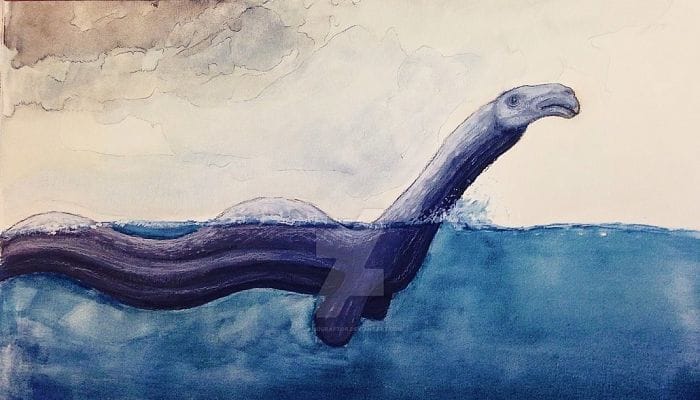
The monster is usually described as having a snake-like body, measuring between 15 and 40 feet long. On top of its body is a head that various people say resembles a snake, a horse, or even a goat. Long ears or horns adorn the monster’s head in some descriptions, and its skin is dark blue or dark brown in color.
Behavior
According to early descriptions by Native Americans, the Okanagan Lake monster is a violent carnivorous predator capable of turning humans into prey. Early Native Americans would not travel across Okanagan Lake without having livestock on board their crafts, ready to be sacrificed to the hungry beast.
Today, Native Americans believe that the monster’s home is on a barren island called Rattlesnake Island. In addition to its home island, Ogopogo also frequents the headwaters of some of the rivers that flow into Lake Okanagan.
Related Creatures
Scotland’s Loch Ness Monster comes to mind for many people when they first hear about Ogopogo. Like Ogopogo, Nessie is a lake-dwelling creature that is often seen moving in serpentine humps. However, sightings of Ogopogo predate Nessie’s rise to stardom by about seven years, so it is unlikely that sightings in Loch Ness inspired sightings in Okanagan Lake.
It is much more likely that Ogopogo was inspired by Native American tales of an ancient monster called N’ha-a-a-tik (“snake in the lake”), which is similar in appearance and inhabits the same waters as the current monster.
Cultural Representation
Long before the first sighting of Ogopogo, Native American tradition held that Lake Okanagan was inhabited by a terrifying creature called N’ha-a-a-tik. It is unclear whether N’ha-a-a-tik was a literal monster or simply a spirit that, if provoked, could destroy any life in its path. Whether N’ha-a-a-tik had a corporeal form or not, the natives certainly feared him and attributed supernatural powers to him.
Modern sightings
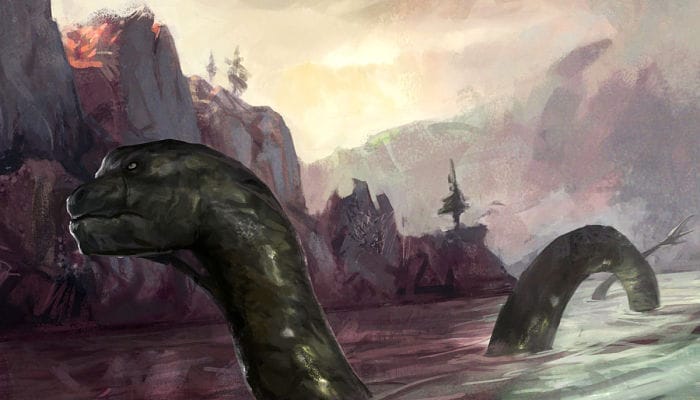
If you dig through local newspaper archives, you can find documented sightings of a monster in Okanagan Lake dating back to 1872. The decades between then and now are littered with testimonies, photos, and even video clips of the monster.
In 1914, a group of Native Americans from Nicola Valley and Westbank discovered a strange carcass near Rattlesnake Island. The carcass weighed 400 pounds and measured between 5 and 6 feet long. It was bluish-gray in color and had fins and a tail. Most people believed the carcass was a manatee, although it was unclear how a manatee could have entered Okanagan Lake.
A small sect of people supported the idea that the carcass belonged to Ogopogo and that the beast’s long neck had broken off as the carcass decomposed. In 1926, Ogopogo was seen by 30 cars full of people, as described above. A couple of decades later, in 1947, people aboard a group of several boats reported seeing the beast.
These multiple witness accounts have helped differentiate Ogopogo from other legendary creatures. Many cryptozoologists consider the evidence for Ogopogo to be even stronger than the evidence for its famous Scottish counterpart, Nessie.
In 1968, a man named Arthur Folden filmed the most convincing video of Ogopogo. In Folden’s video, an animal is moving across the lake, leaving a tremendous wake. In 2011, another video was produced by Richard Huls. The video also shows a large wake moving across the lake.
Photographs of Ogopogo appear regularly. The best known are the 1964 Parmenter photo, the 1976 Fletcher photo, the 1978, 1979, and 1981 Gaal photos, the 1981 Wachlin photo, and the 1984 Svensson photo. The photos show a large wake or a series of low, broken humps in the water.
In total, more than 200 eyewitness accounts have reinforced the Ogopogo tradition. These stories often appear in local newspapers, where they become immortal pieces of legend.
Research
The sheer volume of Ogopogo sightings has attracted countless cryptozoologists to the shores of Okanagan Lake over the years. Many hours of video analysis and even underwater exploration have been devoted to unearthing the truth about the lake’s resident monster.
In 1991, an underwater expedition studied the depths of Okanagan Lake with a remote-controlled vehicle and a miniature submarine. Despite the devices probing to a depth of 840 feet in the belly of the lake, no evidence of Ogopogo appeared.
In 2005, National Geographic’s television program Is It Real? featured Ogopogo in one of its episodes. Acclaimed cryptozoologists Benjamin Radford, Joe Nickell, and John Kirk analyzed images of the creature, concluding that the images had not captured a monster.
Art and literature
In addition to a number of non-fiction books that have been written about the legend of Ogopogo, the lake monster also appears on the entertainment side of art and literature. The name “Ogopogo” was taken from a British tune called “The Ogo-pogo: the Funny Fox-trot.”
The song was popular around 1924, when the Okanagan Lake monster began to grow in fame. Since then, Ogopogo has appeared in the Nancy Drew book series, the popular Final Fantasy video game series, and even on Canadian postage stamps.
Explanations of the myth

Although Ogopogo is nothing more than a fun and slightly comical tourist attraction in the eyes of most people, the debate over the monster’s existence can heat up among cryptozoologists or among local true believers. Several prominent cryptozoologists have dismissed photographic and video evidence of Ogopogo as cases of mistaken identity.
The impressive wake of Folden’s famous images is usually attributed to a beaver. Similarly, Huls’ most recent video is said to show two logs floating side by side. Skeptics point out that Lake Okanagan is full of wildlife and logs, which are transported across the lake by the local logging industry.
Any of these objects could appear monstrous when viewed from the wrong angle. Believers often claim that Ogopogo is a member of a species once thought to be extinct. Many believers think it could be a Basilosaurus, a species of primitive serpentine whale, or a Plesiosaur, a long-necked marine reptile.

