Discover with us the god Odin and all the myths surrounding him. Learn about his origins, family and how he has endured in history.
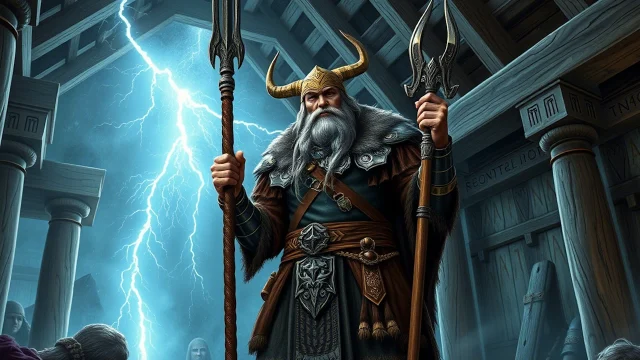
Who is Odin?
Odin was the main god in Germanic and Norse mythology. He was the son of Bor and Bestla and became famous mainly because of the admiration of the Vikings. During the 8th and 9th centuries, he was known as the supreme god. The Vikings admired the god’s love of battle and he became known as the “father of the dead”, while demonstrating the importance of war.
Although he achieved fame in Germanic mythology, he was associated with knowledge, sorcery, healing, death, battle, poetry and the runic alphabet in Norse mythology. He was the ruler of the Aesir, a group of gods. He played a central role in many myths surrounding the creation and destruction of the world.
Purpose
Odin was known for his love of causing conflict and shifts in power. For example, he helped a Danish king named Harold in war tactics and helped him achieve victory for years. But in the final battle, Odin took the place of Harald’s enemy and conquered him.

Although Odin was known for his penchant for deception, violence and war, he also possessed many admirable qualities. He was the wisest god and proved several times that he would sacrifice anything, even himself, for more knowledge.
Odin was the recipient of many human sacrifices, especially those that were of royalty, nobles, or enemy armies. Sacrifices were typically completed by a spear, a rope, or both.
Origins of Odin
The exact origins of Odin are unknown, but many believe him to be an evolved concept based on a mostly overlooked proto-Norse god. The name of this god, who would have been worshipped during the migration period, is unknown, but is speculated to be close to Odin, like Wodin. Tyr was the original king of the gods. But Odin, who had roles similar to Zeus and the Celtic god Lugh, quickly assumed the position. Because of this transition of power, many wonder if the battle between the two tribes of gods, the Vanir and the Aesir, is more symbolic than it seems.
Mythology
There are many myths, both of Norse and Germanic origin, that speak of the life of Odin. They were originally transmitted orally by poets. When the Norse met the Christians, they adopted the Roman alphabet. It was then that they began to write the stories down. The traditions of passing on the stories orally died out as people began to rely on written versions of the tales. Some go as follows.
The myth of Odin’s lost eye
Odin was willing to pay any price for wisdom and was always looking for new quests. He wanted to understand the mysteries of life and answer all questions. On one occasion, he went to the Well of Mimir, also known as the Well of Urd. It was among the roots of the world tree and was home to Mimir, a dark and shadowy creature whose knowledge could not be matched by anyone else. Mimir had acquired his knowledge by drinking water from the well.

Odin wanted to take a drink from the well and asked Mimir for permission. Mimir agreed, but only if Odin would give him one of his eyes. It is not known how much time passed after this demand, or whether or not Odin debated or argued with Mimir, but eventually he took one of his eyeballs and dropped it directly into the well in front of Mimir. With the task complete, Mimir took his horn and dipped it into the well, retrieving a large drink of the enchanted water. Odin drank from the horn and received the wisdom it contained.
Odin’s self-sacrifice
Here is another myth about Odin’s quest for infinite wisdom. He sacrificed “himself” by hanging on Yggdrasil, the world tree. Odin then stabbed his side with a spear and remained there for nine nights and nine days. He received no food or water during this display. At the end of it all, he received the runes, the name given to the ancient alphabet of the Germans, charged with magic. It was said to contain many of the secrets of existence. In the written myths, the following quote is uttered by Odin after receiving the runes.
- “Then I was fertilized and became wise;
- From one word to another they led me to a word
- From one work to another, they led me to a work.”
Odin tricks a giant
One day, Odin’s competitive team took him to challenge the wisest of all the giants in the land. He challenged the giant to a contest about knowledge. The prize was fierce. The winner would receive the loser’s head. Because of all his knowledge, he won the contest by asking his opponent something only Odin would know. His competitive nature was stronger than his morals. He claimed his prize and returned home.
Odin’s family
He was the son of Bor and Bestla. He had many other names, among them Alfather and Alfadir, which signified his reputation as the father of the gods. Odin was married to Frigga, who was the mother of Balder, Hod and Hermod. Odin fathered Thor with a goddess named Jord and Vider with a giantess named Grid.
Odim’s appearance
Odin has been said to have a single eye and a long beard. In artistic depictions, he carries a spear called Gungnir and wears a cloak and hat. He is usually followed by his animal companions, wolves named Geri and Freki and ravens named Huginn and Muninn. Odin also had a horse named Sleipnir that could fly and had eight legs. He rode Sleipnir across the sky and into the underworld.

Symbology
The most recognized symbol of the god is the Triple Horn of the god of the Vikings. It consists of three drinking horns, all intertwined, and is a common symbol of the Asatru faith. The symbol is a tribute to the horns mentioned in mythological stories of the Roman god and for their use in traditional Norse roasting rituals. Several of Odin’s myths involve his quest for a magical mead brewed from the blood of a god, which he would drink from his horn.

