Nuwa, also known as Nügua, is the mother goddess of Chinese mythology, the sister and wife of Fuxi, the emperor god. She is credited with the creation of human beings and the restoration of the Base of Heaven.
Who is Nuwa?
In Chinese mythology, Nuwa is a mythological Chinese character best known for creating and reproducing people after a great calamity. Some scholars suggest that the female Nuwa was the first Chinese creative deity, appropriate for the ancient Chinese matriarchal society, in which childbirth was seen as a miraculous event that did not require the participation of men.
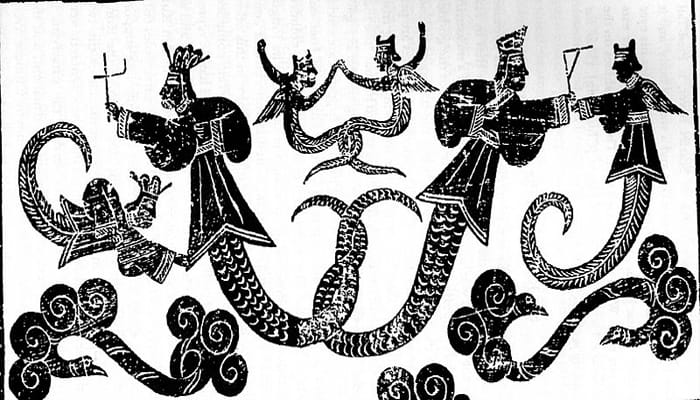
Early myths depict Nuwa as a woman in a procreative role; in later stories Nuwa has a husband/brother named Fuxi, who assumes a primary importance. In ancient art, Nuwa is often depicted with a snake’s body and a human head.
According to the myth, Nuwa formed the first humans from yellow clay, then grew tired, dipped a rope into the mud, and spun it. The mud splatters that fell from the rope became common people, while the handcrafted ones became the nobility. Another myth recounts how Nuwa saved humanity from terrible floods and destruction.
Name
Nuwa is a combination of two kanji prefixes. The first is a meaning “woman” and is a common prefix in the names of goddesses. The proper name is wa or gua. The Chinese character is unique to this name. Birrell translates it as “charming,” but notes that “it could be interpreted as ‘frog,’ which is consistent with her aquatic myth.” She has also been described as a “mythological goddess of snails.”
Description
The Huainanzi recount how the sages Nuwa and Fuxi brought order to the kingdom by following the Way and its power.
Nuwa as depicted on one of the silk flags from Mawangdui, Han dynasty. The Classic of Mountains and Seas, dated between the Warring States period and the Han dynasty, describes Nuwa’s intestines as scattered into ten spirits.
In Liezi (c. 475 – 221 BC), chapter 5 “Questions of Tang,” the author Lie Yukou describes Nuwa repairing the original imperfect sky using five-colored stones and cutting off the legs of a turtle to use as props to hold up the sky.
In Songs of Chu (c. 340 – 278 BC), chapter 3 “Asking Heaven” (Chinese: 问天), the author Qu Yuan writes that Nuwa molded figures from yellow earth, giving them life and the ability to have children. After demons fought and broke the pillars of the heavens, Nuwa worked tirelessly to repair the damage, melting the five-colored stones to repair the heavens.
In the Shuowen Jiezi (58 – 147 AD), China’s first dictionary, under the entry for the author Nuwa, Xu Shen describes her as the sister and wife of Fuxi. Nuwa and Fuxi were depicted with intertwined serpent tails in an Eastern Han dynasty mural in the Wuliang Temple in Jiaxiang County, Shandong Province.
In the collection Four Great Books of Songs (c. 960-1279 AD), compiled by Li Fang and others, volume 78 of the book Imperial Readings of the Taiping Era contains a chapter “Customs of Yingshao of the Han Dynasty” which states that there were no men when heaven and earth were separated. Thus, Nuwa used yellow clay to make people.
But the clay was not strong enough, so she put strings in the clay to make the bodies stand upright. It is also said that she prayed to the gods to let her be the goddess of marriage. There are variations of this story.
Appearance in Fengshen Yanyi
After Zhou felt completely overwhelmed by lust upon seeing the beautiful and ancient goddess Nuwa (who had been sitting behind a curtain of light), he wrote a short poem on a nearby wall and took his leave. In his anger, he swore that the Shang Dynasty would pay for his transgression.
After Nuwa realized that King Zhou was already destined to rule the kingdom for another twenty-six years, Nuwa summoned her three subordinates: the Thousand-Year Fox (who would later become Daji), the Jade Pipa, and the Nine-Headed Pheasant.
If you follow my orders and do well, you will be allowed to be reincarnated as human beings.” With these words, Nuwa was never heard from again, but she would remain an important indirect factor in the fall of the Shang Dynasty.
Creation myth
Nuwa is not considered a creator of the entire physical universe, but a creator and protector of animals and people. It is said that Nuwa existed at the beginning of the world. The earth was a beautiful place with trees and flowers in bloom, and full of animals, birds, fish, and all living creatures. But as she wandered around, Nuwa felt very lonely, so she began to create animals.
On the first day, she created chickens. On the second day, she created dogs. On the third day, she created sheep. On the fourth day, she created pigs. On the fifth day, she formed cows. On the sixth day, she created horses. On the seventh day, she bent down, took a handful of yellow clay, mixed it with water, and molded a figure in her image.
As she worked, the figure came to life: the first human being. Nuwa was pleased with her creation and continued to make more figures of men and women. They danced around her, and her loneliness dissipated. She created hundreds of figures, but grew tired of the laborious process.
She then dipped a rope into the clay mud and spun it around her. Soon the earth around her was covered with clumps of mud. The hand-made figures became the rich and noble; those that emerged from the splashes of mud were the poor and common.
A variation of this story tells that some of the figures melted in the rain while Nuwa waited for them to dry, and that this is how diseases and physical abnormalities came into being.

Flood myth
There was a fight between two of the most powerful gods, Gong Gong, the God of Water, and Zhu Rong, the God of Fire, and they decided to settle it with a fight. They fought from the sky to the earth, causing havoc everywhere. When the Water God Gong Gong Gong saw that he was losing, he struck his head against Mount Buzhou, a mythical peak believed to be northwest of the Kunlun mountain range in southern Xinjiang and said to be a pillar supporting the sky.
The pillar collapsed, half the sky collapsed, the earth split open, forests caught fire, floodwaters gushed forth from beneath the earth, and dragons, snakes, and ferocious animals leaped upon the people. Many people drowned, and others were burned or devoured.
Nuwa was distressed that the humanity she had created was suffering so much. She decided to repair the sky and end this catastrophe. She melted the five colored stones and patched the sky with the molten mixture. Then she killed a giant turtle and used its four legs as four pillars to hold up the fallen part of the sky. She caught and killed a dragon, which scared the other beasts away from the land of Qi.
She then gathered and burned a large amount of reeds and used the ashes to prevent the flood from spreading, so that the people could live happily again.
Legend has it that the only trace left of the disaster was that the sky tilted toward the northwest and the earth toward the southeast, and thus, ever since, the sun, moon, and all the stars revolve toward the west, and all rivers flow toward the southeast.
Other versions of the story describe Nuwa climbing up to the sky and filling the gap with her body (half human, half snake) to stop the flood. Because of this legend, some of the minorities in southwestern China hail Nuwa as their goddess, and festivals such as the “Water Splashing Festival” are, in part, a tribute to her sacrifices.
Creation of Man
Nuwa created humanity because of the loneliness that grew greater and greater over time. She made part of humanity by molding yellow earth, or in other versions yellow clay, into the shape of humans. These people later became the wealthy nobles of society because they were created directly by Nuwa’s hands.
However, most of humanity was created by Nuwa dragging a rope through the mud to produce humans en masse. She did this because creating each human by hand consumed too much time and energy. This creation of humanity provides an etiological explanation for the social division among the people of China.
The batch of humans handmade by Nuwa believed that being made directly by the goddess gave them more importance than most of those who were mass-produced because Nuwa took the time to create them and they were touched directly by her hand.
In another version of the creation of humanity, Nuwa and Fuxi were survivors of a great flood. By order of the God of Heaven, they married and Nuwa had a son who was a ball of flesh. This ball of flesh was cut into small pieces and the pieces were scattered throughout the world, which then became humans.
Matchmaker
Nuwa was born three months after her brother, Fuxi, whom she later took as her husband; this marriage is the reason why Nuwa is credited with inventing the idea of marriage.
Nuwa and Fuxi
Before they got married, they lived on Mount K’un-lun. A prayer was said after the two became guilty of falling in love with each other.
Misty vapor gathered after the prayer, which meant that the two could marry. When they were intimate, the two made a fan out of grass to protect their faces, which is why in modern marriages, the couple holds a fan together.
By connecting, the two were representative of Yin and Yang; Fuxi being connected to Yang and masculinity throughout Nuwa being connected to Yin and femininity. This is further defined by the fact that Fuxi receives a carpenter’s square symbolizing his identification with the physical world because a carpenter’s square is associated with straight lines and squares that lead to a more direct mindset.
Meanwhile, Nuwa was given a compass to symbolize her identification with the heavens because a compass is associated with curves and circles that lead to a more abstract mindset. In other versions, Nuwa invented the compass rather than receiving it as a gift.
Nuwa in Pop Culture/Reception
The worship of this goddess has inspired great musical compositions in honor of this mystical Chinese deity.
Music
Nuwa invented multiple musical instruments: the Shenghuang flute, Saengwhang, and the Hulusi gourd flute (all of these instruments are various reed pipes). Nuwa created the Shenghuang around the idea of reproduction; the Shenghuang is used in marriages and reproduction rites.
As for the Saengwhang, Nuwa created this instrument to resemble the god of music, Bonghwang.
Overview
In Chinese mythology, Nuwa was a mythological figure, usually depicted as a woman (other later traditions attribute this creation myth to Pangu or Yu Huang). Nuwa appears in many Chinese myths, playing various roles as wife, sister, man, tribal leader (or even emperor), creator, or maintainer.
Most myths present Nuwa as a woman in a procreative role, creating and reproducing people after a great calamity. Nuwa is also associated with a flood myth, in which the water god Gong Gong struck his head against Mount Buzhou, a pillar supporting the sky, causing it to collapse and bringing great floods and suffering upon the people.
The first literary reference to Nuwa, in Liezi by Lie Yukou, describes Nuwa repairing the heavens after a great flood, and states that Nuwa molded the first people out of clay. The name “Nuwa” first appears in “Elegies of Chu,” chapter 3: “Asking Heaven” by Qu Yuan, in another account of the Nuwa figures molding the yellow earth, giving them life and the ability to have children.
Then the demons fought and broke the pillars of the Heavens, and Nuwa worked tirelessly to repair the damage, melting five-colored stones to repair the Heavens.
Some scholars suggest that the female Nuwa was the first Chinese creative deity. Ancient Chinese society was matriarchal and primitive. Childbirth was seen as a miraculous event that did not require the participation of men, and children knew only their mothers.
As the reproductive process was better understood, ancient Chinese society moved toward a patriarchal system, and the male ancestral deity, Fu Xi, took on paramount importance. By the Han dynasty (206-220 AD), Nuwa was described in literature with her husband Fuxi as the first of the Three August Ones and Five Emperors, and they were often called the “parents of humanity.”
In the first Chinese dictionary, Shuowen Jiezi, by Xu Shen, Nuwa is said to have been both the sister and wife of Fuxi. However, paintings depicting them together as half-human, half-snake or dragon date back to the Warring States period (5th century BCE to 220 BCE). A stone tablet from the Han dynasty, dated 160 CE, depicts Fu Hsi with Nuwa, who was both his wife and his sister.
Some of the minorities in southwestern China hail Nuwa as their goddess, and some festivals, such as the “Water Splashing Festival,” are partly a tribute to her sacrifices. Nuwa is also the traditional divine goddess of the Miao people.
Nuwa and other traditions
The stories of Nuwa’s floods share common elements with other world flood traditions, such as:
- Flood or global calamity (destruction of Gong Gongs)
- Destruction of humanity and animals (described explicitly)
- Survival of the calamity (Fuxi and Nuwa in most Chinese versions)
- Select a partner who survives on a boat or in a gourd (Zhuang version)
- Similarity of names (Nuwa, Noah, Nu, Manu, Oannes, etc.)
- Rebuilding humanity after devastation (described explicitly)
- Colored celestial object (five colored columns, rainbow)
Similarly, aspects of Nuwa’s creation myths, such as the creation of humans from clay, the brother-sister pair Fuxi-Nuwa, the half-serpent element, and survival of a flood, resemble creation myths from other cultures. Nuwa and Fuxi resemble the Japanese sister deities Amaterasu and Susanoo.
Nuwa in primary sources
Below are some of the sources that describe Nuwa, in chronological order. These sources do not include local tribal stories or modern recreations.
- (475 – 221 B.C.E.) author: Lie Yukou, book: Liezi, chapter 5: “Questions of Tang,” paragraph 1: account: “Nuwa repairs the sky” Detail: Describes Nuwa repairing the heavens after a great flood. It also says that Nuwa molded the first people out of clay.
- (340 – 278 B.C.E.) author: Qu Yuan, book: “Elegies of Chu,” chapter 3: “Asking Heaven” story: Detail from “Nuwa Mends The Firmament”: The name Nuwa appears here for the first time. This story says that Nuwa molded figures from yellow earth, giving them life and the ability to have children. Then demons fought and broke the pillars of the heavens. Nuwa worked tirelessly to repair the damage, melting five-colored stones to repair the heavens.
- (179 – 122 B.C.E.) author: Liu An, book: Huainanzi, chapter 6: Lanmingxun, account: Detail from “Nuwa repaired the sky”: In ancient times, the four poles of the universe collapsed, and the world fell into chaos: the firmament could no longer cover everything, and the earth could no longer sustain itself; fire burned wildly, and waters flooded the earth.
- The sky collapsed and the world with its nine regions was divided.
- (58 – 147 CE) author: Xu Shen, book: Shuowen Jiezi, entry: Detail Nuwa: The Shuowen is China’s first dictionary. In it, Nuwa is said to have been the sister and wife of Fuxi. Nuwa and Fuxi were depicted with intertwined serpent tails in a mural from the Eastern Han Dynasty (25-220) in the Wuliang Temple in Jiaxiang County, Shandong Province.

