Within Spanish mythology, there is the figure of Martinico, a goblin who belongs to the region of Andalusia and Castile.
Who is Martinico?

A highly recognized elf in Spanish folklore, he differs from any other elf in Spanish mythology.
His appearance is reflected in the engraving called “Duendecillos,” which is a story about these mythical beings in the text Los Caprichos by Francisco de Goya.
What is his personality like?
He is known for being mischievous, somewhat rude, and messy, but without a trace of malice, as he simply likes to play pranks on the people who live where he chooses to dwell.
The story continues with the inhabitants being unable to do anything against Martinico, but rather put up with him while he decides to play hide and seek with their things or move them around, and sometimes even wait until they are asleep to make noises that scare them and wake them up.
It should be noted that there is a moment in his personality when he succumbs to anger, and that is when he fails to carry out his misdeeds, especially when someone interrupts him, even if they do not harm anyone.
For his part, he not only plays tricks on those he lives with, but also on his neighbors and those who pass by his home.
He does not only have this mischievous side, because if he is treated well by someone, he responds with generosity and helps men in extreme need.
Likewise, when he becomes attached to a family, he decides to leave with them, backpack in hand, whether they want him to or not.
What does a Martinico look like?
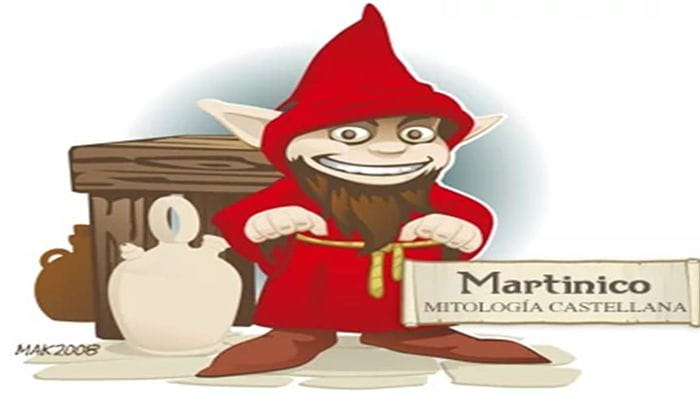
He is described as a small, unattractive man, as he is chubby and has a noticeable hump, a large, long nose, and a beard. He dresses like a priest in a red habit.
How is Martinico represented in other regions?
As part of Spanish folklore, Martinico appears in several regions and is presented in stories or legends in different ways, such as:
-
Castile
They inhabit various houses, and when a family recently moves into a home, they like to play pranks on them before revealing themselves. However, if the family has problems, they do everything they can to help them, and if the family moves away and they have grown fond of them, they go with them.
-
Aragon
They watch over children’s dreams, as adults often tell them before they go to sleep, “Martinico is coming.”
-
There are several versions in Andalusia
*Córdoba
Legend has it that a Martinico fell in love with the owner of the house where he lived, but his feelings were not reciprocated.
For a long time, he protected her from her brother, who wanted her dead so he could inherit her possessions. The elf would alert all the neighbors whenever he saw him nearby.
However, the owner, tired of his insistence, moved away, and one day his brother managed to kill her. The authorities were never able to discover who killed her, so he went unpunished and moved into her house, where Martinico later suffocated her and strangled her with a rope. At dawn, the neighbors and authorities arrived at the house where they found him next to the body and told them that justice had been served, and then he disappeared.
*Granada, specifically in Albancín
It is believed that the goblin Martinico is the guardian of the cisterns and water tanks, and that he liked to scare children so that they would not dirty the water used for drinking in the city, as he was responsible for preventing infections.
*Granada
The virtual library of Andalusia has an audiovisual archive with a video recounting the legend of Martinico, which tells that when a child died without being baptized, he became the Martinico of the house, and the only way to get him to leave was to pay a fine to the church. This story is also told in Baza.