The history of the Mapuche people is very extensive but at the same time very discreet. Little is known about this ancient people of the Chilean mountains who still coexist with modern civilization. Mapuche symbolism has inspired the Chilean flag, and their exotic but richly crafted handicrafts have survived to this day. Here we present four Mapuche symbols and their meanings.
1. The Ancestral Flag
In Mapuche symbolism, according to Pedro Subercaseaux, the ancestral flag, also known as the Lautaro flag, iconographically represents the planet Venus, but it has also been mistakenly thought to represent the cinnamon tree, which is considered sacred among the Mapuche. The guñelve, also called the “Star of Arauco,” was the inspiration for Bernardo O’Higgins to create the current flag of Chile.
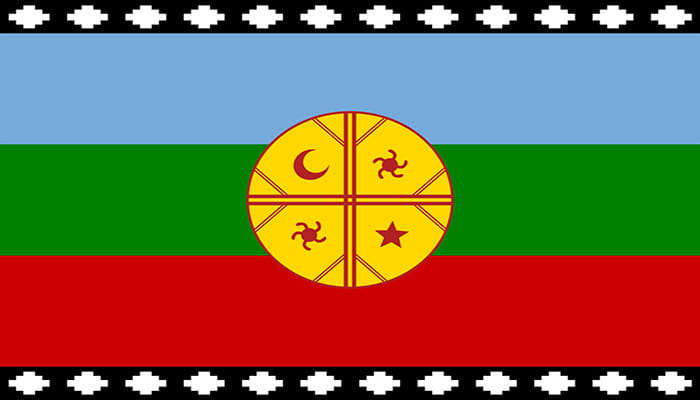
The most prominent and outstanding feature of this ancient flag of the Araucanian regions is the guñelve (Wunelfe) In March 1991, the Mapuche organization in Chile known as Aukiñ Wallmapu Ngulam in their native language and also recognized as the CTT (Council of All Lands), made a very special call to urge the authorities to establish the flag of the Mapuche nation.
The colors and geometric shapes of the Mapuche flag have important meanings for this culture:
- The color yellow (chod or choz): signifies renewal and is the symbol of the sun.
- Blue (kallfu): represents life, order, wealth, and the universe. In Mapudungun, it is also known as an adjective that translates as “sacred” and “spiritual.”
- White (luq): this color symbolizes wisdom, healing, prosperity, cleanliness, and longevity.
- Red (kelu): the color red represents strength and power, and is the most prominent symbol in Mapuche history.
- Green (karu): on the Mapuche flag, the color green characterized the earth or represented nature, the fertility of crops, the wisdom of the people, and the power of healing.
- Gemil (ngumin) Cross or stepped star, similar to Chakana or Inca Cross, or rhombus with twisted edges: represents the art of craftsmanship, science, and knowledge; symbol of the writing system
2. Guñelve
In Mapuche symbolism, this emblem known as the guñelve or wünelfe from the Mapudungun region is an iconographic representation of Mapuche culture. It is seen as a specific geometric figure in the shape of an octagram or an eight-pointed star. It represents the planet Venus, but it has also been mistakenly thought to represent the cinnamon tree, which is considered sacred among the Mapuche people.

The guñelve, also called the “Star of Arauco,” was the inspiration for Bernardo O’Higgins to create the current flag of Chile. Currently, many designers have used the guñelve, one example being the 2015 Copa América in Chile, where it was used as the symbol of the cup.
The guñelve is a representative Mapuche emblem described as a star with a shape particularly similar to an octagram. An interesting fact is that the guñelve inspired the creation of the Chilean flag because of its exact symmetry and what it represented.
3. Lukutuwe
Lukutuwe is a Mapuche symbol that was widely used in textile design for indigenous women’s clothing in the region. The meaning of this symbol is the reincarnation of a deity or supreme being on earth.
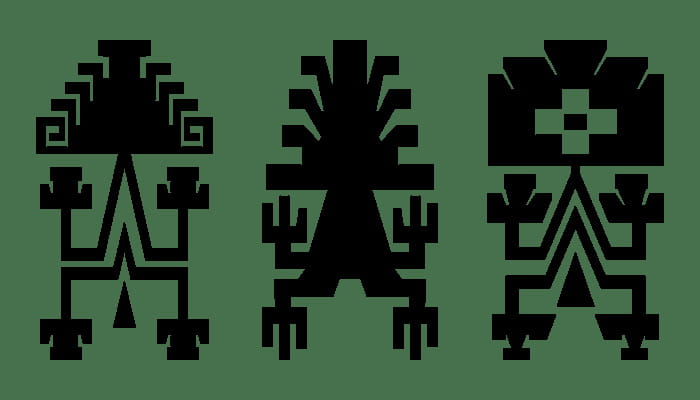
Almost all Mapuche textiles feature designs with geometric shapes and objects ranging from diamonds to squares and triangles, symbolizing cosmology and cosmogony and imbued with the religious ideas of the Mapuche world, thus providing the inspiration for designs that have endured to this day.
In Mapuche symbolism, there are two pronunciations of these prominent figures called Lukutuwe and Lukutuel, which have important meanings:
- Lukutuwe: this word is translated as the place where they kneel
- Lukutuel: also known as the kneeling man, this symbol is represented in anthropomorphic form and appears in many textile designs of the Mapuche culture
According to Mapuche symbolism, the anthropomorphic form represents the identity of human beings within their beliefs. Another meaning is the incarnation of the Mapuche deity on earth. According to research in the work “Secret Sciences of the Mapuche People,” the deity or god is similar to the avatar in the Buddhist religion. In short, it is a supreme being that reincarnates every so often on earth to bring balance to the world.
4. Ketru metawe
This strange word, Ketru matewe, is a compound word in Mapuche symbolism. Ketru means duck, and the general term metawe is used for a vessel, pitcher, or vase.
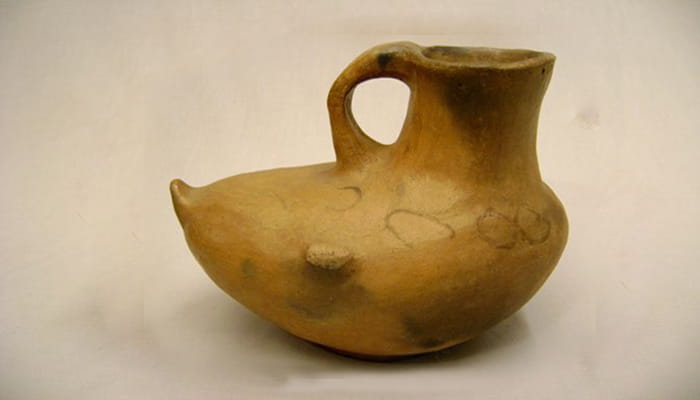
In the pre-Hispanic culture of the Chilean Mapuche people, Ketru metawe is a duck-shaped vessel used in religious ceremonies. This symbolic Mapuche sculpture is related to fertility, marriage, puberty, childbirth, and death.
This emblem is closely related to Mapuche women. It is a vase or vessel with an asymmetrical shape resembling a duck. The vast majority of the vessels are sculpted with wings, legs, or a bird’s tail and female breasts. The ketru metawe was given by the shaman priests called machis to Mapuche women after they had taken their wedding vows, and then, as dictated by the customs of their people, they had to leave their home or group and go to become part of their husband’s family.
This behavior is based on the life of the flying duck ketru, symbolizing the family headed by a dominant male and his submissive spouse, establishing a strong and territorial bond of union and familiarity. The man is the protector and provider, and the woman is his offspring or protégé. The ketru metawe is used only by married Mapuche women.

