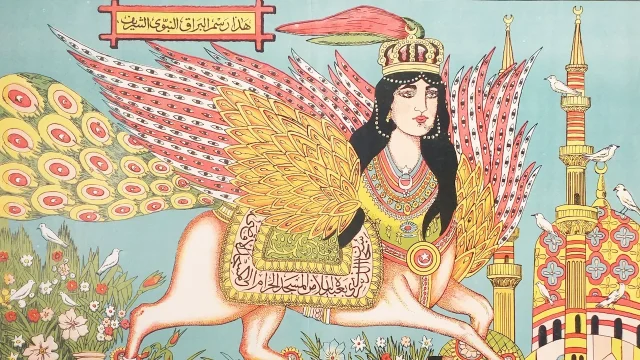
The goddess Manat Manat (Arabic: Manat Arabic pronunciation: (maˈnaː) was a Semitic goddess worshipped in the Arabian Peninsula before the rise of Islam and the Prophet Muhammad in the 7th century. She was one of the three main goddesses of Mecca, along with her sisters Allat and Al-‘Uzzá, and among them she was the original and the eldest. Her idol was destroyed after the rise of Islam and her cult disappeared from the Arabian Peninsula.

1. Etymology
There are two possible meanings for the goddess’s name. The first is that it probably derives from the Arabic root “mana,” in which case her name would mean “to put,” or alternatively “to determine.” The second is that it derives from the Arabic word maniya, meaning “destiny.” Both meanings are appropriate for her role as goddess of destiny and destinies. Pre-Islamic theophoric names, including those of Manāt, are well documented in Arabic sources.
2. Worship
Considered a goddess of fate, fortune, time, and destiny, she was greater than Al-Lat and Al-Uzza, since theophoric names, including hers, such as Abd-Manah or Zayd-Manah, are found before those of Al-Lat or Al-‘Uzza. But in addition to being the oldest of the three main goddesses of Mecca, she was also quite possibly one of the oldest in the Semitic pantheon.
Her main sanctuary, now lost, was located in Mecca, on the shores of the Red Sea, probably in al-Mushallal, where an idol of her was erected. The Banu Aws and the Banu Khazraj were considered one of the tribes most devoted to the goddess, to the point that the place where sacrifices were made to her was commonly mentioned for its significance to the Khazraj.
Her earliest representations included a wooden portrait of her covered in sacrificial blood, but the most notable representation of her was her idol erected in al-Mushallal. When pre-Islamic Arabs made pilgrimage to al-Mushallal, they shaved their heads and stood in front of the idol of Manat for a while. They did not consider their pilgrimage complete without visiting their idol.
An idol of her was also likely to be among the 360 idols of the Kaaba. According to Ibn al-Kalbi, when worshippers circumambulated the Kaaba, they chanted her name along with those of her sisters, al-Lat and al-Uzza, seeking their blessings and intercession.
It was also thought that Manat watched over the graves, as indicated by the inscription on a grave that reads: “May Dushara and Manat and Qaysha curse anyone who sells this grave, buy it, give it as a pledge, give it away, lease it, rent it, or draw up any document relating to it for himself, or bury in it anyone other than the person named in the inscription above.”
3. Destruction of the temple
In the same month as Khalid ibn al-Walid’s mission to destroy al-Uzza and the Suwa, Sa’d bin Zaid Al-Ashhali was sent with 20 horsemen to Al-Mashallal to destroy an idol named Manāt, worshipped by the polytheistic tribes Al-Aws and Al-Khazraj of Arabia. Here too appeared a black woman, naked, with her hair disheveled, weeping and beating her breast. Sa’d immediately killed her, destroyed the idol, and broke the coffin, returning at the end of his mission.
The group that carried out this raid was formerly devoted worshippers of al-Manat. According to some sources, including ibn Kalbi, Ali was sent to demolish al-Manat; however, Sir William Muir asserts that there is more evidence to suggest that the raid was carried out by Sa’d, and that it would have been out of place for Muhammad to send Ali, since Muhammad had been sending former followers to demolish idols.
4. Temple of Somanth
According to the Ghaznavid court poet Farrukhi Sistani, who claimed to have accompanied Mahmud on his raid, Somnat (in Persian) was a confused version of su-manat in reference to the goddess Manat. According to him and the Ghaznavid historian Gardizi, the images of the other goddesses were destroyed in Arabia, but that of Manat was secretly sent to Kathiawar (in modern Gujarat) for safekeeping.
Since the idol of Manat was an aniconic image of black stone, it could easily have been mistaken for a lingam of Shiva in Somnath. It is said that Mahmud broke the idol and took parts of it as booty and placed it for people to walk on. In his letters to the Caliphate, Mahmud exaggerated the size, wealth, and religious significance of the Somnath temple, receiving grandiose titles from the Caliph in return.
In the same month as Khalid ibn al-Walid’s mission to destroy al-Uzza and al-Suwa, Sa’d bin Zaid Al-Ashhali was sent with 20 horsemen to Al-Mashallal to destroy an idol called Manat, worshipped by the polytheistic Al-Aws and Al-Khazraj tribes of Arabia. Here too appeared a black woman, naked, with her hair disheveled, weeping and beating her breast. Sa’d immediately killed her, destroyed the idol, and broke the coffin, returning at the end of his mission.
The group that carried out this raid was formerly devoted worshippers of al-Manat. According to some sources, including ibn Kalbi, Ali was sent to demolish al-Manat; however, Sir William Muir claims that there is more evidence to suggest that the raid was carried out by Sa’d, and that it would have been out of place for Muhammad to send Ali, since Muhammad had been sending former followers to demolish idols.