Discover with us the most famous Moon Gods in mythology. We show you their most popular legends and powers.
Mythological Moon Gods
Most cultures, if not all, have moon gods, which should not be too surprising, given that the position of the moon in the sky is a harbinger of seasonal changes. Westerners are perhaps more familiar with the (female) goddesses of the moon.
Lunar Gods
Our word lunar, as in the lunar cycle of full, half, and new moons, comes from the feminine Latin Luna. This seems natural because of the association of the lunar month and the female menstrual cycle, but not all societies conceive of the moon as a woman.
In the Bronze Age, the East, from Anatolia to Sumer and Egypt, had (male) moon gods. Here are some of the moon gods and moon goddesses of the major ancient religions.
1.- Artemis
In Greek mythology, the sun god was originally Helios (hence words such as heliocentric for our sun-centered solar system) and the moon goddess Selene, but over time, this changed. Artemis became associated with Selene, just as Apollo became associated with Helios. Apollo became a sun god and Artemis became the moon goddess.

2.- Bendis
The Thracian goddess of the moon, Bendis is the best-known Thracian deity because she was worshipped in classical Athens by people who associated Bendis with Artemis. Her cult in Greece was most popular during the 5th and 4th centuries BC, when she was depicted in statues in Greek shrines and on ceramic vessels in a group with other deities. She is often seen with two spears or other weapons in her hand, ready for hunting.
3.- Coyolxauhqui
The Aztec moon goddess Coyolxauhqui (“Golden Bells”) was depicted in mortal combat with her brother, the sun god Huitzilopochtli, an ancient battle that was represented in ritual sacrifice on several occasions in the Aztec festival calendar. She always lost. In the Great Temple of Tenochtitlán (now Mexico City), a massive monument was discovered depicting the dismembered body of Coyolxauhqui.
4.- Diana
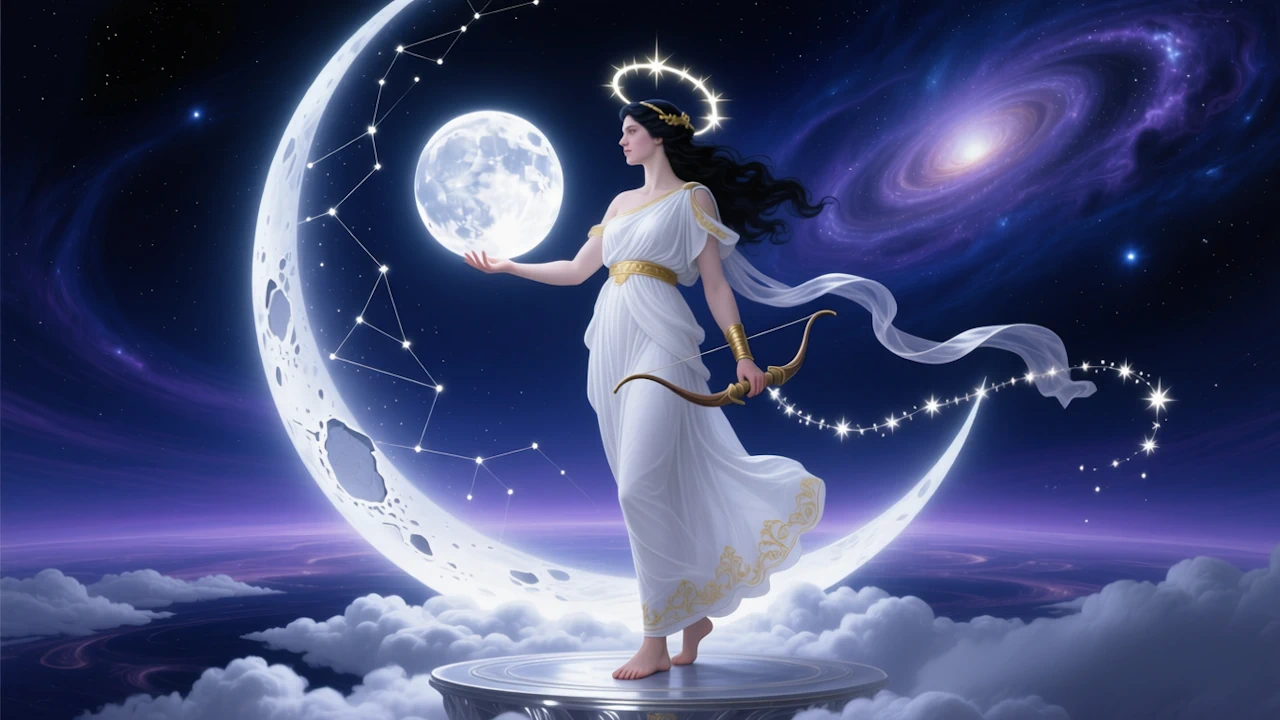
Diana was the Roman goddess of the forest who was associated with the moon and identified with Artemis. Diana is typically depicted as a beautiful young woman, armed with a bow and quiver, and accompanied by a deer or other beast.
5.- Heng-o (or Ch’ang-o)
Heng-o or Ch’ang-o is the great lunar deity, also called the “Moon Fairy” (Yueh-o), in various Chinese mythologies. In Chinese T’ang, the moon is a visual symbol of Yin, a cold white phosphorescent body associated with snow, ice, white silk, silver, and white jade. He lives in a white palace, the “Palace of Generalized Cold,” or the “Basilica of the Generalized Cold Moon.” An associated male deity is the March of the “white soul” of the moon.
6.- Ix Chel
Ix Chel (Lady Rainbow) is the name of the Mayan goddess of the moon, who appears in two forms, a young, sensual woman associated with fertility and sensuality, and a powerful old woman associated with those things and with death and the destruction of the world.
7.- Yah, Khons/Khonsu
Egyptian mythology had a variety of male and female deities associated with aspects of the moon. The personification of the moon was a man—Iah (also spelled Yah)—but the main lunar deities were Khonsu (the new moon) and Thoth (the full moon), also men.
The “man in the moon” was a large white baboon, and the moon was considered the left eye of Horus. The crescent moon was depicted in temple art as a fierce young bull, and the waning moon as a castrated bull. The goddess Isis was sometimes considered a moon goddess.
8.- Mawu (Maou)
Mawu is the Great Mother or goddess of the moon of the Dahomey tribe in Africa. She rode on the mouth of a great serpent to make the world, the mountains, the rivers, and the valleys, made a great fire in the sky to light it, and created all the animals before retiring to her lofty kingdom in the sky.
9.- Mên
Mên is a Phrygian moon god who is also associated with fertility, healing, and punishment. He healed the sick, punished evildoers, and protected the sanctity of graves.
Mên is usually depicted with crescent-shaped moons on his shoulders. He wears a Phrygian cap, carries a pine cone or patera in his outstretched right hand, and rests his left hand on a sword or spear.
10.- Selene or Luna
Selene (Moon, Selenaia, or Mene) was the Greek goddess of the moon, driving a chariot across the heavens pulled by two snow-white horses or occasionally by oxen. She is romantically connected in various stories with Endymion, Zeus, and Pan. Depending on the source, her father may have been Hyperion or Pallas, or even Helios, the sun.
Selene is often equated with Artemis, and her brother or father Helios with Apollo. In some accounts, Selene/Moon is a lunar Titan (since she is female, she could be a Titaness) and the daughter of the Titans Hyperion and Thea. Selene/Moon is the sister of the sun god Helios/Sun, which is how she came to be marked as one of the most important lunar gods.

11.- Sin (Su-En), Nanna
The Sumerian god of the moon was Su-en (or Sin or Nanna), who was the son of Enlil (the Lord of the Air) and Ninlil (the Goddess of Grain). Sin was the husband of the goddess of the reed, Ningal, and the father of Shamash (the sun god), Ishtar (goddess of Venus), and Iskur (god of rain and storms).
It is possible that Nanna, the Sumerian name for the moon god, originally meant only the full moon, while Su-en refers to the crescent moon. Sin is portrayed as an old man with a flowing beard wearing a four-horned headdress with a crescent moon protruding from it.
12.- Tsuki-Yomi
Tsukiyomi or Tsukiyomi-no-Mikoto was the Japanese Shinto god of the moon, born from the right eye of the creator god Izanagi. He was the brother of the sun goddess Amaterasu and the god Susanowo. In some stories, Tsukiyomi killed the goddess of food Ukemochi for serving food from her various orifices, which offended his sister Amaterasu, so the sun and moon are separated from each other.
13.- Alignak (Inuit)
In Inuit legends, Alignak is the god of the moon and time. He controls the tides and presides over both earthquakes and eclipses. In some stories, he is also responsible for returning the souls of the dead to the earth so that they can be reborn. Alignak may appear in ports to protect fishermen from Sedna, the wrathful goddess of the sea.
According to legend, Alignak and his sister became deities after they committed incest and were banished from the earth. Alignak was sent to become the god of the moon, and his sister became a goddess of the sun.
14.- Cerridwen
Cerridwen is, in Celtic mythology, the guardian of the cauldron of knowledge. She is the giver of wisdom and inspiration, and as such is often associated with the moon and the intuitive process. As a goddess of the underworld, she is both Mother and Crone; many modern pagans honor Cerridwen for her close association with the full moon.
15.- Hecate
Hecate was originally worshipped as a mother goddess, but during the Ptolemaic period in Alexandria she was elevated to her position as goddess of ghosts and the spiritual world, thus entering the pantheon of lunar deities. Many contemporary pagans and Wiccans honor Hecate in the guise of the Dark Goddess, although it would be incorrect to refer to her as an aspect of the Harpy.
Due to her connection with both birth and virginity, her role as “dark goddess” is more likely to come from her connection with the spirit world, ghosts, the dark moon, and magic.
16.- Sina
Sina is one of the best-known Polynesian deities. She resides within the moon itself and is the protector of those who travel at night. Originally, she lived on earth, but she grew tired of the way her husband and family treated her.
In Tahiti, the story goes that Sina, or Hina, was simply curious about what it was like on the moon, so she paddled her magical canoe until she got there. Once she arrived, the tranquil beauty of the moon took her breath away, and she decided to stay.
17.- Thoth
Among the moon gods, we find Thoth, an Egyptian god of magic and wisdom, who appears in some legends as the god who weighs the souls of the dead, although many other stories assign this task to Anubis. Because Thoth is a lunar deity, he is often depicted with a crescent moon on his head.
He is closely associated with Seshat, a goddess of writing and wisdom, who is known as the scribe of the divine. Thoth is sometimes called upon for work related to wisdom, magic, and destiny.
Conclusion
For thousands of years, people have looked at the moon and wondered about its divine meaning. It should come as no surprise that many cultures throughout time have had lunar deities, that is, gods who are believed to have the most power within the universe. If you are performing a moon-related ritual, in some Wiccan and Pagan traditions you can choose to call upon one of these deities for assistance. Let’s take a look at some of the most well-known lunar deities.