Kraken is a giant that sleeps at the bottom of the ocean off the coast of Norway. When it wakes up with an empty stomach, it heads toward the surface of the ocean, bringing powerful waves with it. Any ship that sees these waves must flee or face destruction. It is related to another mythological legend , the Cyclops.
Physical Description
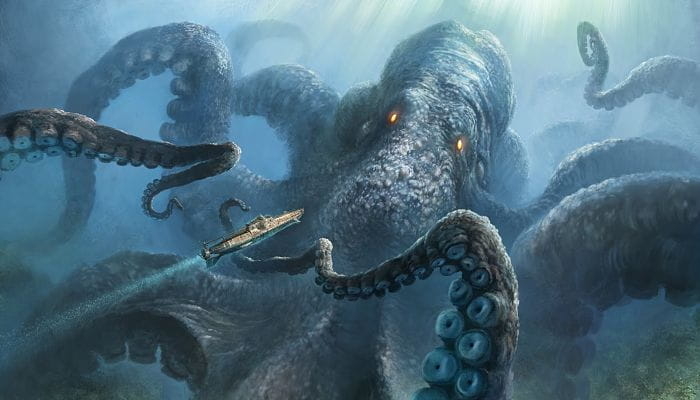
The first descriptions of the Kraken do not provide much information. They focus on the size of the creature, claiming that it is “the largest monster in the sea.” It is so large that it can swallow ships and whales. So large that its body can be mistaken for land, its mouth for a sound, and its teeth for boulders. So large that its movement can create whirlpools.
Despite the lack of details about its appearance, the Kraken’s size was enough to secure it a place in Norse legend. Over time, its appearance developed, giving people a complete picture of this monstrous being.
It has a flat body, which tends to emerge from the water in humps like small islands, and dozens of long, flexible arms (sometimes called horns), which it can pull out of the water to the height of a ship’s mast. Giant circular waves and swarms of frightened fish often appear in front of it. Today, it is generally imagined as a giant octopus, a giant crab, or some combination of the two.
Personality
With its ability to create whirlpools and swallow ships, the Kraken is undoubtedly a dangerous beast, but unlike other sea monsters, it is not particularly interested in hunting humans. Most sailors who have fallen into the Kraken’s belly simply did not get out of the way quickly enough.
In fact, the Kraken is a rather lazy creature. It spends most of its time sleeping at the bottom of the ocean. Even when it rises from the ocean floor to hunt, its strategies are passive.
Of course, there are some stories of ships being attacked by the Kraken, usually because they disturbed it. In these cases, it can be fierce and ruthless, tearing the ship to shreds without regard for human life.
Special abilities
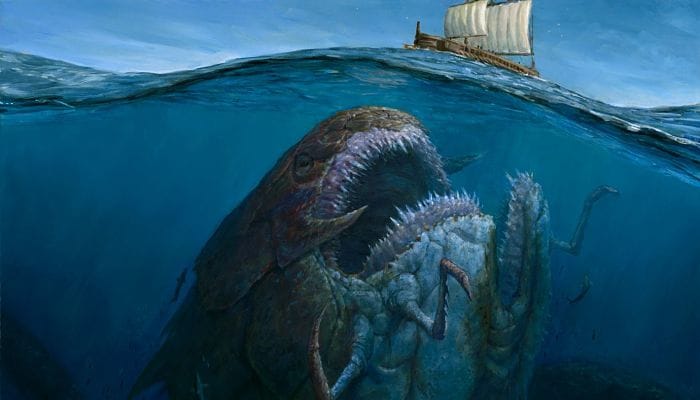
The Kraken may be lazy, but with its size, it couldn’t help but be powerful. Perhaps the most interesting thing about this beast is its unique hunting strategy. It feeds on fish—thousands and thousands of fish—but instead of swimming around the ocean, fishing one by one, it has devised a way to make dinner come to it.
After the Kraken digests a round of fish—which can last up to three months—it recycles the waste, vomiting so much vomit or excrement that the water around it is “murky and cloudy.” It may sound disgusting, but
“It is said that this sludge is very pleasant to the smell or taste of other fish, and they gather from all around it and stay directly above the Kraken. Then it opens its arms, grabs and swallows its guests, and through digestion, turns them into bait for other fish of the same type.”
This hunting method is so effective that ancient fishermen in Norse mythology sought out the giant who dwells at the bottom of the ocean, braving his wrath to enter the abundance of fish that swarmed above him. He also has other abilities, though none of them are as practical as his hunting strategy. When he moves, he can create whirlpools that drag ships to a watery grave. It can also make vocal calls that cause underwater earthquakes.
Origin
The Kraken was first described in 1180 by none other than the king of Norway. Over the decades, the legend of the beast grew larger and larger, and the heroes of some of Norway’s earliest epic tales, such as Orvar-Oddr, had close encounters with the monster.
By the mid-13th century, naturalists had begun to investigate the legend. The Konungs Skuggsja elaborated on its appearance and feeding habits. Even in the 18th century, prominent scientists such as Carl Linnaeus included the Kraken in their classification of sea creatures.
Modern appearances
In the early 18th century, the Kraken began to be relegated to works of fiction. It found its place in poems by Alfred Tennyson and in Herman Melville’s Moby Dick, Jules Verne’s Twenty Thousand Leagues Under the Sea, and HP Lovecraft’s Call of Cthulu. Today, it remains one of the most popular sea monsters, appearing in films such as Pirates of the Caribbean, Clash of the Titans, and Game of Thrones.
Explanation
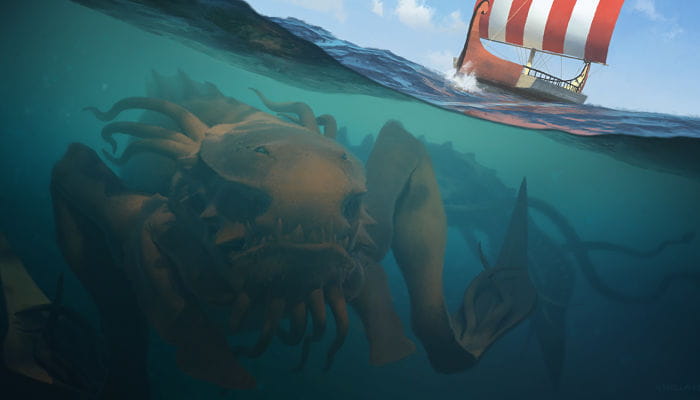
While science has dismissed the idea of a mile-long monster lurking at the bottom of the ocean, it has discovered a sensational Kraken-like creature: the giant squid. The giant squid, which lives in the waters off the coast of Norway, may have been encountered by early sailors. Giant squids can grow up to forty-two feet, the length of seven or eight men.
Like the Kraken, they are bottom dwellers that feed mainly on fish, although sperm whales often bear scars from their toothed tentacles. They are also capable of squirting dark ink, similar to the “muddy” substance said to be used by the Kraken to attract fish.

