Kitsune, these legendary foxes have been delighting the Japanese for centuries, whether celebrating a wedding with “foxfire” lanterns or making the village fool run naked through the streets and give away all his money. But Kitsune aren’t all fun and games—they can be incredibly wise and incredibly dangerous too!
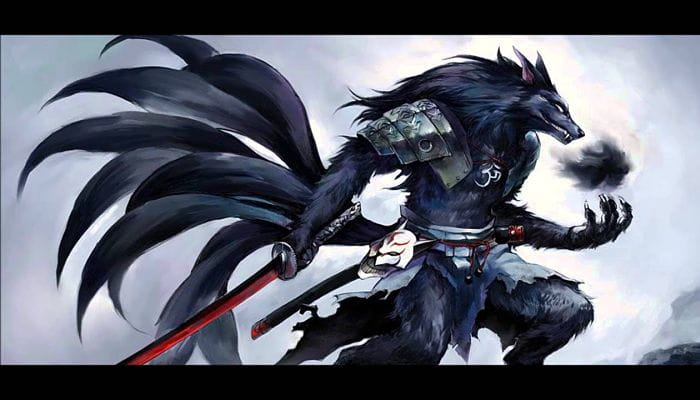
Physical Description
Newborn Kitsunes could easily blend in with a litter of ordinary foxes. They must earn their magical appearance—along with their magical powers—over time. For example, every hundred years, a Kitsune grows a new tail. They can have up to nine tails in total. In their later years, their red fur may begin to turn golden, and then, eventually, white. Part of Japanese mythology as Kappa
When a Kitsune reaches the age of 100, it can begin to change shape, a trick that makes it very difficult to describe. These magical foxes love to take human form. They tend to seek forms that inspire the utmost respect: an elegant young woman or a wise old priest. If they are in a mischievous mood, they may also impersonate humans they have seen before:a prince who can command an army or an enemy who needs to be humiliated. Fortunately, the fox disguise is rarely perfect. If you catch them off guard, you might catch a glimpse of their bottle-brush tail!
Some of the oldest and most powerful Kitsune can also take on other forms. They have been known to appear as impossibly tall trees and second moons in the sky. Some of them can even disappear!
But no matter what form a Kitsune takes, there will always be a gift. They must keep their hoshi no tama, a glowing ball or iridescent gem, with them at all times. The ball contains its soul, and without it, it will become powerless and die. In human form, Kitsunes usually carry their hoshi no tamas as amulets, but in fox form, they carry the magic balls in their mouths or attach them to their tails.
Personality
No two Kitsune are exactly alike, and they are all complex characters! Their high intelligence and boundless creativity make them difficult to predict. Still, they can be divided into two groups: the zenko and the yako.
Zenko are good foxes who serve Inari, the goddess of rice and prosperity. Zenko often appear as priests, bringing wisdom to humans. They can also carry messages to rulers or become guardians of specific households, bringing wealth and happiness to their families. Finally, they resolve disputes between humans and evil foxes, usually siding with humans!
Yako are evil foxes. While zenko foxes can be mischievous, yako foxes can be downright destructive. They ruin reputations, steal valuables, and even lure travelers into deadly traps. Most of the time, yakos attack arrogant or lazy people, but they are also known to harass innocent people.
Many Kitsune, both zenko and yako, also seem to have a romantic streak. Disguised as beautiful young women, they often marry humans. Most Kitsune prove to be loving and loyal wives, although the marriage usually ends when the Kitsune are driven away.
A few Kitsune can seduce men, only to rob them or place them in humiliating positions after they have fallen asleep. When two Kitsune marry, they organize elaborate wedding celebrations, which may include conjuring magical “fox fire” lanterns or calling rain from a clear blue sky.
Special abilities of Kitsune
Kitsune are incredibly magical creatures. Their powers are limited only by their imagination, which, given the vivid imaginations of Kitsune, means they are hardly limited at all!
They specialize in the art of illusion. Shapeshifting is just the first of many abilities in this area. In addition to transforming their bodies, these magical foxes can also transform the world around them. They can make decadent mansions and dreamlike gardens out of a graveyard. They can conjure masses of silver and gold, which turn back into grass in the morning. And they can spend years in human form, without being identified as foxes.
Kitsune also have psychic powers. They can take possession of human bodies, usually to humiliate a person who has wronged them by making them run naked through town, give away all their money, or eat large amounts of food until they become obese.
As a less drastic measure, a Kitsune can enter a human’s mind while they sleep to deliver a message through a dream. Kitsune also have other diverse powers. Some can fly. Some can breathe fire. Some can control the weather, and others can see the future.
Cultural Representation
Like many aspects of Japanese culture, Kitsune were inspired by the Chinese, who told stories of magical nine-tailed foxes called huli jing. Kitsune first appeared in Japanese literature in the 8th century, and their legend has not faded since. They can be found as statues around ancient Inari shrines, in calligraphy scrolls by the finest Japanese artists, and, of course, in thousands of folk tales.
The Japanese believed in their magical foxes well into the 18th century. Special tofu recipes were invented as offerings to the foxes that lived around Inari temples. Families kept foxes as pets, believing that foxes would bring them wealth and success. Some families, believed to be descendants of yako foxes, were ostracized by their communities. And many cases of mental illness were described as kitsunetsuki, or possession by foxes.
Modern appearances
The charming Kitsune have not lost their hold on Japanese culture. In fact, their lore has spread throughout the world! As foxes are such adorable creatures, they are most popular in visual entertainment such as comics, anime, and video games. They appear in Naruto, Pokemon, Animal Crossing, Zelda, and Mario.

