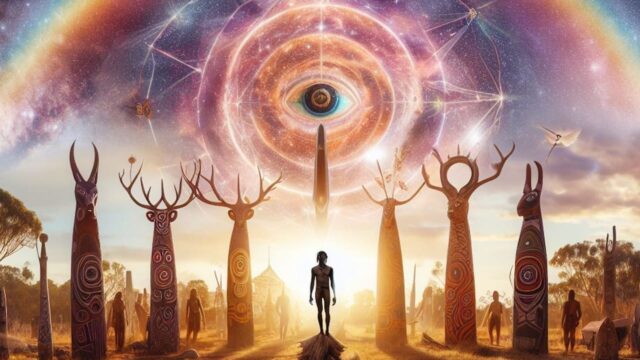
Karma is the law of cause and effect; it is action, whether physical or mental, individual or performed by a group, and every action has a consequence.The Sanskrit meaning is to perform a deed or action. It includes actions we perform not only through our body, but also through speech and the mind.
Changing our karma
Human beings, according to the laws of nature, must pay for all their wrong actions, but when they tune in to God through meditation techniques and remember the perfect image within them, then, realizing their divinity, they do not need to suffer for their past human mistakes.
But if they identify themselves again with their humanity by not forgiving others, then they again subject themselves to be governed by the demanding law of karmic action. It can also be changed by the intervention of a self-realized teacher who is free. This is what happens when the chakras are worked on.
Characteristics
- Some have referred to karma as an echo of the past and also say that it creates the future.
- Common acts such as going to work, good deeds, charity, etc. also define it in a general way.
- However, the revered Dadashri, who has attained self-realization, provides a deeper insight and explains that these actions are actually the fruits of karma bound in one’s previous life. Thus, everything you see externally in your present life is the fruit of your inner intentions in your past life.
- Begin this spiritual journey toward eternal happiness
Theory of Karma
Understanding the theory of karma will help you understand its science and mechanism. But the question will remain:
How to begin this journey toward liberation?
The essential step to begin this spiritual journey toward eternal bliss is to discover your True Self by attending Gnan Vidhi, a 2-hour scientific process of Self-Realization.
In the words of Dadashri:
“Once you enter into the nature of the Self, no new karma will bind you. This happens when the Gnani Purush makes you aware of your own True Self. After that, new karmas do not attach, and old karmas continue to discharge. When all karmas have been discharged, you attain final liberation.”
People from different walks of life, whether seeking solutions to everyday problems or permanent happiness, have gained satisfaction in their search for life after going through the scientific process of Self-Realization called Gnan Vidhi.
Group karma
Karma can also affect a group of people, such as a religion (3), a country, or even a planet, depending on the karma of the majority of the group. A country may be conquered, or have droughts or famine, because that was the general karma of the group, even if a few did not have that karma. If those who do not have that karma have a strong magnetism for the opposite occurrence, they may be spared.
Paramhansa Yogananda gives the example of a plane crash. If enough people on that plane have the karma to crash, the plane will crash even if some do not have the karma to crash. But if one person has enough magnetism to live, they could survive the crash or end up not taking that flight.
How do we free ourselves from karma?

Very few people realize how many of their actions and desires are generated by past karma. They believe they are acting out of free will, but instead they are acting out habits buried deep in their subconscious mind from many past lives. The way out of this cycle is to give up the false notion that one demonstrates freedom by giving free rein to one’s desires.
By tuning into the infinite wisdom behind the karmic law, one accepts God and His guidance from within, rather than being guided by desire. The more one lives guided from within, the greater control one has over the external events of life. As long as one is acting under divine guidance rather than the ego, one does not accumulate more karma, and eventually it dissipates.
Meaning in the Bible
The Bible refers to karma in the book of Galatians when it says, “Be not deceived; God is not mocked: for whatsoever a man soweth, that shall he also reap.” If you sow evil, you will reap evil in the form of suffering. And if you sow goodness, you will reap goodness in the form of inner joy.
Every action, every thought, produces its own corresponding rewards. Human suffering is not a sign of God’s anger with humanity. It is rather a sign of man’s ignorance of divine law. (5) Karma is God’s way of teaching us.
A maze of meaning
As a New Age buzzword, karma is often misunderstood. Some people use it to talk about “atmosphere.” Other times it is assumed to be the same as the human aura. You have probably seen stickers that say My karma ran over your dogma. I am sure it is meant to be humorous, but it adds to the general confusion.
So what does karma really mean?
- “What goes around, comes around.”
- “You reap what you sow.”
- “For every action there is an equal and opposite reaction.”
These are everyday phrases, even clichés, that actually describe it.
An ancient concept?
It is a Sanskrit word meaning “act,” “action,” or “word.” It allows us to progress in the evolution of our soul. As you know, the things we think, say, and do can be positive or negative. In the same way, karma can be positive or negative.
It is a great benefactor, returning to us the energy of all the kind and loving thoughts and actions we send out into the world. It is also our best teacher, holding us accountable for what we do and giving us the opportunity to learn from our mistakes and make amends.
Some people talk about having ‘good karma’ and ‘bad karma’. I’m not a fan of that kind of labeling, because it encourages us to make judgments about situations (our own or other people’s) when we don’t have all the background information. We don’t know what’s going on from the soul’s perspective.
It is important to remember that not everything that happens to us is caused by this cosmic law. Souls are creating new negative energy all the time, of their own free will, and innocent people can get hurt by this. In addition, some souls volunteer (in the heavenly world, before being born on earth) to make sacrifices on behalf of their loved ones. You may never know when someone’s misfortune in life is actually a loving sacrifice, perhaps even for you.
We are generally familiar with the idea that these teachings have long held a place in Eastern religions, but what is commonly overlooked is that Jesus taught about this and reincarnation as well. His Sermon on the Mount is a great lesson in personal responsibility—the very essence of karma.
In the Bible, the apostle Paul explains it when he tells us, “Each one shall bear his own load….Be not deceived; God is not mocked; for whatever a man sows, that he will also reap….Each one shall receive his own reward according to his work.”
So what now?
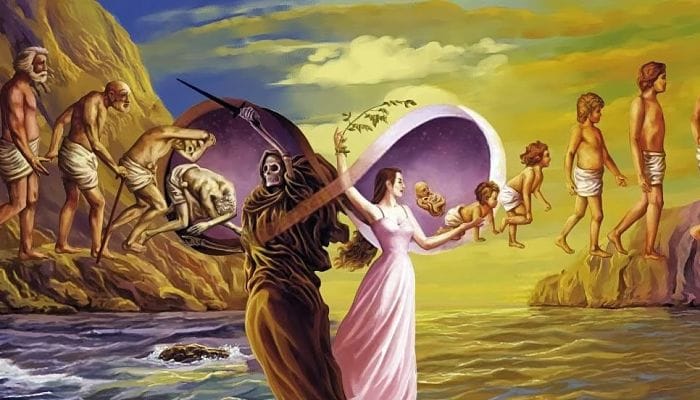
Knowing all this can be a little daunting. We tend to think of all the not-so-nice things we’ve done in our lives and wonder when they’re going to come back to bite us. The truth is, there is grace, and heaven is merciful. We have to be responsible, no doubt about it, but God never gives us more than we can handle.
There is also the return of our positive energy that comes back to us to help us move forward. You have probably always known deep down that doing good deeds was somehow “worth it.” Well, now you know why—you will get a return on your energy investment, and the more you give, the more you will benefit!
It’s worth knowing (or remembering) that we have been given the priceless gift of the violet flame, a spiritual fire that “balances” or repolarizes our negative karma when we invoke it. Through violet flame meditation, we can amend negative thoughts and actions so that the effects don’t have to manifest physically in our lives.
It’s not a one-time deal and it requires effort and dedication, but it’s an awesome way to speed up progress on your spiritual path, as well as make life seem generally more positive!
On a personal note, I eventually realized that I am grateful for the law of karma. It is affirming to know that God respects me as an individual enough not to let me get away with anything that does not make me a better person, and that I am important enough to receive the value of my loving actions.
Conclusions
What is karma? Karma, as a word, has been used very loosely. If you are reading this page, you are probably one of thousands of people who are truly seeking the correct understanding of this misunderstood word—karma.
You may be here to understand how our intentions, motives, desires, and the emotional drive with which we carry out our actions have an effect on our lives and how they relate to the term “karma.”
Would you be surprised to learn that…?
The reason for continuing in the cycle of birth and death is Karma.
- Experiences of pain and pleasure are the results of Karma that has been carried or collected in past lives.
- A negative action is NOT compensated by a positive one; both will yield their results individually.
- After attaining self-knowledge, you can engage in normal activities, remain in a state of happiness, attach no meaning to karma, and eventually attain complete enlightenment.
- One attains final liberation (moksha) only when all Karmas are destroyed.
- Reverend Dadashri, through very simple language, gives us the following key understandings about the theory of Karma:
- The fruits of karma are not punishment or retribution, but simply consequences of our inner intentions.
- The seeds of karma are sown in past lives and bear fruit in this life. Who gives the fruits of these karmas? God? No. Karma means that it ripens in our experiences when the right conditions come together. It is given by nature, which Dadashri refers to as “circumstantial scientific evidence” (Vyavasthit Shakti).
- The key reasons for carrying Karma are the inner intention behind the action and ignorance of the Self.