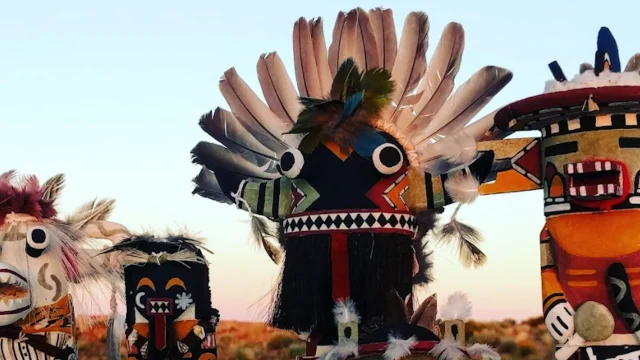
A Kachina is a spiritual being in the religious beliefs of the Pueblo Indians, Native American cultures located in the southwestern United States. In Pueblo culture, Kachina rituals are practiced by the Hopi, Zuni, Hopi-Tewa, and certain Keresan tribes, as well as most Pueblo tribes in New Mexico.
The concept of Kachinas has three different aspects: the supernatural being, the Kachina dancers, and the Kachina dolls, small dolls carved in the likeness of the Kachinas, which are given only to those who are or will be responsible for the respectful care and well-being of the doll, such as a mother, wife, or sister.

1. Overview
Kachinas are spirits or personifications of things in the real world. These spirits are believed to visit Hopi villages during the first half of the year. A Kachina symbolizes anything in the universe or the real world, from a beloved family member to a physical foundation, a site, a talent, a natural anomaly, or a piece of knowledge.
The central theme of Kachinas [religion] is the presence of life in all objects that fill the universe. Everything has an essence or life force, and humans must interact with them or not survive.
2. Origins
The exact origin of the Kachinas is not fully known, but according to one version of the Hopi belief, the Kachinas were beneficial spiritual beings who came with the Hopi from the underworld. The underworld is a concept common to all Pueblo Indians.
It is a place where spirits or shadows live: newborns come from there and the dead return there. The Kachinas wandered with the Hopi throughout the world until they arrived at Casa Grande, where both the Hopi and the Kachinas settled for a time.
With their powerful ceremonies, the Kachinas brought rain for the crops and were generally very helpful and comforting. Unfortunately, all the Kachinas died when the Hopi were attacked by enemies and their souls returned to the underworld.
Since the sacred paraphernalia of the Kachinas was left behind, the Hopi began to impersonate the Kachinas, wearing their masks and costumes and imitating their ceremonies to bring rain, good harvests, and happiness to life.
Another version says that in an early period, the Kachinas danced for the Hopi, bringing them rain and all the blessings of life. But eventually, the Hopi came to take the Kachinas for granted, losing all respect and reverence for them, so the Kachinas finally left and returned to the underworld.
However, before leaving, the Kachinas taught some of their ceremonies to a few faithful young people and taught them how to make the masks and costumes. When the other Hopi realized their loss, they turned with remorse to the Kachinas’ human substitutes, and the ceremonies have continued ever since.
3. Hopi Kachinas
In many ways, the Kachina Cult and its rituals are the most important ceremonial observances in the Hopi religious calendar. For the Hopi, the name refers primarily to the supernatural beings who visit the villages to help the Hopi with their daily activities and act as a link between the gods and mortals.
These spirits are then imitated by men who dress in costumes and masks to perform ceremonial dances throughout the year. The most anticipated ceremony is the Powamuya (bean dance) ceremony. In addition, wooden carvings of these spirits are also made to give to children to help them identify the many Kachinas.
In general, it can be said that the Kachinas represent historical events and things in nature, and are used to educate children about ways of life. Map of Native American tribes in Arizona, located in the Grand Canyon and northern Arizona regions
4. Zuni Kachinas
The Hopi are not the only Pueblo tribe that observes the Kachina Cult in their religious calendar. The Zuni also have a religious solar calendar that is practiced throughout the year. The Zuni Kachina Cult is one of the six major cults of the Zuni. There are a number of Kachinas that represent space and time in the Zuni religion.
One of the most famous and widely known ceremonies is the Shalako Ceremony. There are a number of other ceremonies and rituals; some are public, however, many of them are kept secret. It is difficult to specify the total number of Kachinas in the Zuni religion because the Zuni do not believe in the use or exploitation of their Kachinas for open public economic gain and believe that they should be kept private.
It is believed that some of the ancient Kachina rituals are no longer practiced, but there are new ones that have been introduced. In addition, it is believed that there are hundreds of different Kachina rituals practiced in the Zuni religion. The Zuni Kachina Cult is not constant; it changes with space and time.
It is located at the confluence of the Zuni and Colorado rivers. Although some archaeological research has been conducted, it has not been able to clarify which tribe, Zuni or Hopi, first developed the Kachina Cult. Both the Zuni Kachinas and the Hopi Kachinas are different from each other but have certain similarities and characteristics.
In addition, both Zuni and Hopi Kachinas are highly characterized and detailed, while the Kachinas of the Rio Grande Pueblos appear primitive in their features. The Hopi have developed their cult into a more elaborate ritual and seem to have a greater sense of drama and artistry than the Zuni. On the other hand, the latter have developed a more significant folklore surrounding their Kachinas.
5. Kachina dolls
Kachina dolls are small, brightly painted wooden “dolls” that are miniature representations of the masked imitators. These figurines are not given to children as toys, but as objects to be treasured and studied so that young Hopi can become familiar with the appearance of the Kachinas as part of their religious training.
During Kachina ceremonies, each child receives his or her own doll. The dolls are taken home and hung on the walls or rafters of the house so that the children can see them constantly. The purpose of this is to help the children learn to recognize the different Kachinas.
It is said that the Hopi recognize more than 200 Kachinas, and many more were invented in the latter half of the 19th century. These dolls are very difficult to classify, not only because the Hopi have only a vague idea of their appearance and function, but also because these ideas differ from one table to another and from one village to another.
6. Ceremonial dancers
Many Pueblo Indians, particularly the Hopi and Zuni, have ceremonies in which masked men, called Kachinas, play an important role. Masked members of the tribe dress up as Kachinas for religious ceremonies that take place many times a year.
These ceremonies are social occasions for the people, where friends and relatives can come from neighboring villages to watch the “dance” and participate in the feasts that are always prepared. When a Hopi man puts a mask on his head and wears the appropriate costume and body paint, he believes that he has lost his personal identity and has received the spirit of the Kachinas he is supposed to represent.
In addition to the male Kachinas, there are many female Kachinas called kachin-manas, but women never take on the role of male Kachinas.
7. Clowns
Hopi clowns are an integral part of Hopi Kachina ceremonies, where they participate in sacred rituals as well as unique clown shows, some with direct contact with the audience. The clown’s performance focuses on humor and entertainment, but also monitors the gathered crowd and provides policing activities for both the Kachina performers and the audience.
Mockery is a tool used to warn spectators of behaviors that are not Hopeful, and is usually remembered for a long time by the recipient of the clowns’ attention. Clown characters play a dual role.
Their primary role is to entertain the audience during the long periods of outdoor celebrations and Kachina dances, where they act as jesters or circus clowns. Their more subtle and sacred role is in the ritual performances of the Hopi.
The sacred functions of clowns are relatively private, if not kept secret by the Hopi, and as a result have received less public exposure. Observing the preparations taking place in a Kiva by a number of Pai yakyamu clowns preparing for their ceremonial performance, Alexander Stephen was told, “We Koyala [Koshari] are the fathers of all Kachinas.”
The Hopi have four groups of clowns, some of which are sacred. In addition to the difficulty of identifying and classifying these groups, there are a number of Kachinas whose actions are identified as clowning. Barton Wright’s Hopi Clowns identifies, classifies, and illustrates the wide range of clown characters.