Inca mythology is the historical evolution of a society that spans the Andes mountain range in South America, currently comprising the countries of Colombia, Ecuador, Peru, Bolivia, Chile, and Argentina, with the exception of Venezuela, whose territory was not part of this mythology in ancient times. It has become a story that has crossed borders through its mythological legends.
Origin of Inca Mythology

Its history stems from the Inca people, a pre-Columbian civilization of the 13th century that spread across much of the American continent. Due to their beliefs and rituals, their way of life evolved from pre-Inca times, as they were considered an evolution for their society in economic and administrative aspects.
Therefore, due to the vastness of their territory, their stories and legends became part of history, thus becoming Inca mythology due to the accounts of their experiences and way of life.
Foundations of Inca mythology
Their mythology is based on polytheistic and pantheistic beliefs, as they believed in different gods and forces of nature, considering that every natural entity was a deity. Therefore, in Inca mythology, there was no single God, but rather the universe and God were one and the same.
The different worlds of Inca mythology
Marked in time and space, Inca mythology was divided into cyclical minutes known as periods of chaos and order in the world in which they lived. Their environment was perceived in different ways:
On the one hand, there is the horizontal plane, in which the Incas saw the world in two ways, one was upwards and the other was downwards. These halves were separated from each other, resulting in a four-part division, made up of complementarity, opposition, and reciprocity.
On the other hand, they also had a vertical world that was divided into three planes:
- Hanan Pacha: The heavenly world where only gods could live and people could enter by crossing a bridge made of hair together.
- Kay Pacha: The space of the present and the now, where human beings spend their lives and coexist with gods who control natural elements such as Pachamama, lady of the earth; Mama Sara, lady of fruits and plants; and Pariacaca, lord of the waters.
- Uku Pancha: Known as the world of the dead according to mythology, controlled by Supay, the owner of this world, where unborn children and everything that lies beneath the earth and the sea dwell. In this space, it was believed that people from the present plane could communicate with them through springs and caves. It should be noted that it was not considered a punishment but rather a place of residence, which was also inhabited by the gods Mama Cocha, queen of storms and marine life, and Pachacamac, king of earthquakes, among others.
In conclusion, for Inca mythology, the worldview is the complete representation of all the worlds that inhabit their universe, since they believed that there were different spaces that were intertwined with the earthly world and that there was no difference between natural and spiritual entities.
Highest divinity in Inca mythology
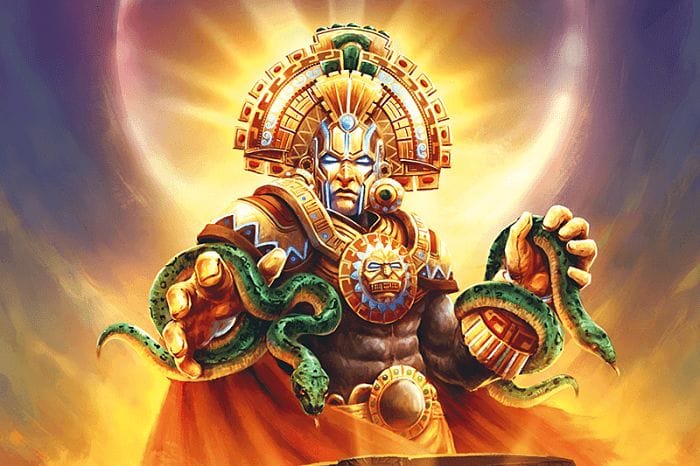
Believing in different gods does not prevent Inca mythology from having one for which they had a predilection, and that is the case of the god Inti, known as the Sun, who was the main god they worshipped because they as a society recognized that the Sun gave energy to their lands where they produced food for their community.
This god also replaced the ancient Viracocha, considered the creator, who was also his father because he did not only rule over his kingdom but also over others through his marriage to his sister Luna or Mama Quilla, who shared the same rank as her brother in the heavenly court.
On the other hand, the most common representation of Inti is in the form of a golden ellipse with rays denoting his power. In fact, in each Inca province there was a temple dedicated to his worship or, as they called it, Quri Kancha (golden temple) or Inti Kancha (temple of the Sun), and a large number of priests were assigned to its care and administration.
Being so popular, he was also used in the “Inti Raymi” celebrations, and in addition to being revered, the inhabitants turned to him to ask for favors and help with their problems or needs because, as the one who brought forth the harvests, he was held in high esteem.
Main gods of Inca mythology
Being a polytheistic culture, they believed in different entities to which they performed various rites in their honor, among which are:
1.-Viracocha: Creator God
Known as the master of the world, he was the first deity recognized by Inca mythology, originating from the ancient Peruvians. He was considered a nomadic god who emerged from the water and created the earth according to legend. He is also known as the god of staffs or rods.
2.-Mama Cocha: Progenitor of the sea.
Mother of water, she is part of Inca mythology because she was considered the essence of the sea and its tides. She was also associated with any source of water, whether rivers or lakes.
She was commemorated with the aim of calming the waters to ensure good fishing and good omens for the people living near the coast, as she was believed to protect the Incas from tidal waves and maritime disasters. She was also the wife of Viracocha and brought balance to the world, as well as representing everything that was feminine.
3.-Mama Quilla: Goddess of the Moon, protector of women.
Daughter of the creator god and wife of the supreme god in Inca mythology, she is the goddess of the sky and women. According to legend, she was the mother of Mama Ocllo and Manco Cápac, known as the legendary founders of all human beings.
Likewise, Inca village women believed she was the goddess of marriage and the cycles that women go through, and she was considered a protector of women. It is worth noting that, as the wife of the sun god, there was a statue of her in her temple where priestesses worshipped her because she was the one who could best understand them and give them the support they sought. In fact, a celebration called Coya Raymi is held in her honor in Inca mythology.
4.-Mama Sara: Provider of food.
Mother of corn and goddess of food, she became the most important goddess because corn is considered one of the most important seeds in Inca culture.
5.-Pachamama: Goddess of the earth and agricultural fertility
Recognized as the mother goddess of the earth, her job is to watch over humanity’s care for the earth and provide fertility to the fields. In short, she is an entity that protects and sustains populations through rituals in which a llama is sacrificed as an offering, as these rituals are meant to be reciprocal, that is, to give back what she has given them.
However, Pachamama also has a negative side, according to stories, because she is an entity that is often hungry, making her very susceptible. If she is not given offerings, she becomes offended and causes illness.
6.-Pachacamac: Ruler of the coast.
The story of this god comes from ancient times. According to legend, he was one of the three brothers who created the earth. Another version says that he was Viracocha, who, according to historians, was his younger brother, but unlike his brother, his greed and evil led him to become the god of the coast and earthquakes and tremors of the earth.
According to legend, he was responsible for bringing the first man and woman into the world, but he did not tell them that they had to eat to survive, so they died of hunger. Therefore, the woman accused him of incompetence, and he provided her with fertility, and she gave birth to two children. He killed the first, and from his death, fruits and vegetables grew. The second managed to escape and avenged the death of his brother and mother, dragging him into the sea where he would be trapped forever.
Secondary gods of Inca mythology
As believers in various gods, the Incas had different deities in whom they placed their faith and hope. Therefore, in the background, there are some who became the most important, these are:
1.-Illapa: God of thunder and lightning.
Also known in Inca mythology as Libiac, he was a celestial being who accompanied the Sun, the supreme god. Llapa was described as a bad-tempered figure with warrior traits who, when he shook his wave, produced an explosion that caused light (lightning), noise, and fire.
2.-Coyllur: Guardian of the stars.
A faithful servant of Mama Quilla, she lived in the sky where she was responsible for moving and positioning the constellations in the form of animals and birds.
3.-Pariacaca: God of rain, fertility, and wild animals.
The lord of the rainstorms that brought good fortune to the settlers’ crops by causing wild fruits and natural grasslands to grow. Due to his connection with nature, he was considered the god of wild animals in Inca mythology.
4.-Supay: Lord of the underworld.
Lord of death, this is how Supay was known in Inca mythology, known as the main demon in this ancient story because he was the personification of evil, as he was always seeking to claim more people for the underworld, which is why the Spanish identified him as the devil after the conquest of America.
Inca Legends
Due to the various deities that existed in Inca mythology, all kinds of stories related to them emerged and have been passed down through the generations. The most recognized in Inca culture are:
The Inca Bridge

This story is based on versions told by ancient inhabitants who recount the legend that centuries ago, a young emperor of the Inca Empire fell seriously ill with a disease so strange that neither doctors nor Inca priestesses could discover what it was or how to cure it. Among the crowd watching over his well-being, they set out in search of a healing plant that was found a great distance from Cuzco, the capital of the empire.
As they set out on their quest, the Inca citizens who accompanied the governor traveled through forests, rivers, and mountains with the goal of finding the plant that would heal their leader. Along the way, they faced various adversities that tested them.
Meanwhile, the young emperor grew weaker and weaker. Those around him were worried that they would not be able to save him, but they did not give up hope. They continued their search until one day they reached the bank of a large mountain river, which separated them from the medicinal plants they needed to save his life. They followed it despite the murky waters, but they came to an abrupt end that prevented them from continuing, as it was difficult to cross due to its strong current.
Faced with this great difficulty, the Incas decided to organize expeditions to determine what course of action to take, but they discovered that it was suicide. That evening, everyone gathered and, with great regret, decided to return to their land, knowing that they had done everything possible to save him. The love that united them made them feel sad about the failure of their mission.
It should be noted that all these events were observed by the god Inti, who was moved by the superhuman efforts of the Inca citizens, who were seeking to heal their ruler, driven by love. For this reason, he spoke to Mama Quilla to help them, and as a result, the next morning they were surprised to find a bridge crossing the river.
Grateful and moved by the work of the gods Inti and Quilla, they crossed the bridge singing and praising them, and continued on their mission. After several days, they reached their destination and were able to save the monarch’s life, who went on to rule the empire for many years.
It is worth noting that this bridge actually exists over the Las Cuevas River, located northeast of the province of Mendoza in Argentina, and can be admired by visitors who can see and touch the sun through it.
The Myth of the Inca Creation
The origins of the creation of the world date back to the time when Viracocha created a world without light and gave life to giants who did not respect him. Annoyed by this situation, he decided to take matters into his own hands and sent a flood that completely transformed the earth. This resulted in the giants disappearing, so the creator god created men similar to himself in stature.
Therefore, eager to appreciate his work, he decided to illuminate the earth with the sun, moon, and stars, and filled the earth with plants, trees, and animals. Later, he decided that there could not be a world without someone to rule it, so he sent Viracochan to impose respect and instruct men on how to live in peace and harmony. He also taught them many other things so that they could develop on their own.
However, men mocked him for his clothing, so he turned them into stone. The survivors tried to flee but were caught by volcanic fire. It was then that they realized they were facing a mythical and powerful being, to whom they owed respect and obedience.
After what happened, Viracochan traveled across the land until he came to a beautiful valley where he created a person named Alcaviza and named that place Cuzco, where he decreed that the Incas would arrive and be respected. It should be noted that this place was where the Inca Empire was later created and developed.

