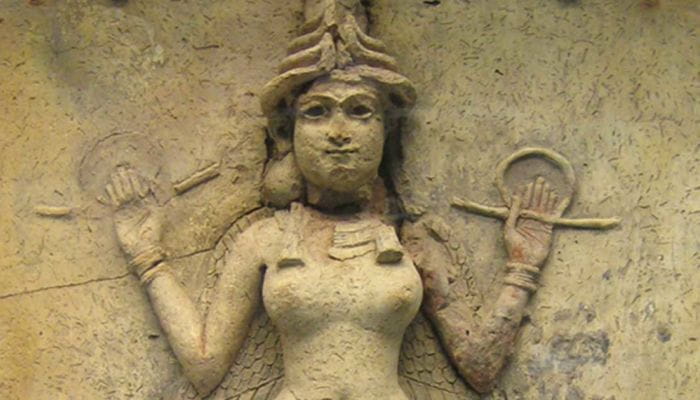
Inanna, also known as Ishtar in Akkadian mythology, is a goddess associated with the morning and evening star, Venus. She is seen as an independent, powerful, and sensual figure, but also as a young woman under patriarchal control. The goddess is also notable for her dual nature—her feminine and masculine traits.
Origin
Inanna was originally worshipped as a vegetation deity, but was later elevated to the status of Queen of Heaven, the most favored goddess in Mesopotamia. In Uruk, she was worshipped as their patron deity, especially in the main center, the temple of Eanna (meaning the House of Heaven). The goddess was connected to Uruk, which dates back to the Uruk period from 4000-3100 BC.
Legends and Stories
Her poems, such as The Descent of Inanna, bring her qualities to rituals and ceremonies in her honor. The sacred wedding of Inanna and Dumuzi was celebrated on the autumn equinox to bring fertility to the land. The king and the priestess would reenact the sexual union of the god and goddess, either symbolically or perhaps through actual sexual intercourse.
Inanna and the Huluppu Tree
In this early creation legend from the epic poem Gilgamesh, Enkidu, and the underworld, Inanna is depicted as a young girl. The goddess sees a Huluppu tree on the banks of the Euphrates River and wants to create a throne from the majestic tree.
She replants it in her own garden, but later discovers that the tree is full of evil entities: a snake, Lilitu (a female demon believed to be an early version of Lilith in Jewish mythology), and a Zu bird.
Inanna is distressed and enlists the help of her brother, Gilgamesh. He kills the snake, sending the other two creatures fleeing. He and his friends cut down the tree and carve it into a throne and a bed for her.
Enki
In the story of Inanna and Enki, the goddess steals the meh, the rules of civilization, from her father Enki. She gets the god Enki drunk in a drinking contest and runs away with the meh. She takes them to her city, Uruk. The meh was a powerful tool and included all aspects of humanity, such as law, prostitution, victory, truth, and writing. With the meh in her possession, her influence grew and she became more powerful than ever.
Inanna and Sukaletuda
In this celestial myth, a gardener, Sukaletuda, is the antagonist. He is a terrible gardener, and all the plants he cares about seem to perish. The only plant that survives is a large, shady poplar tree. Inanna sees the exquisite tree and decides to take a nap under it.
The gardener is impressed by the magnificent goddess. He strips her naked while she sleeps and has sex with her. When Inanna wakes up, she realizes what has happened and goes in search of the perpetrator. She curses the earth with plagues so that people will reveal his villainous character. With the help of Enki, she finally finds the gardener, who is spreading himself across the sky, following the course of Venus. Sukaletuda defends his case, but the goddess is determined that his punishment should be death.
Family
Inanna is an important figure in Sumerian mythology. Along with Enki, Ninhursag, Nanna, Anu, Enlil, and Utu, she is one of the seven divine powers that formed the basis of many of the gods that followed. Her parents are said to be Enki or Nanna and Ningal. The goddess also has a sister named Ereskigal and a husband, Dumuzi.
Appearance
In iconography, she is shown as an entrance post or bundle of reeds, representing abundance and fertility. She is often depicted as a naked woman in her human form. As a goddess of war, she is seen wearing a tunic with weapons on her shoulders and combat armor. She is also shown alongside a lion or riding a lion, a reflection of her bravery.
Modern influence
Before the reign of King Hammurabi of Babylon, between 1792 and 1750 BC, women were considered equal. Inanna is an excellent example of this in the Sumerian pantheon. She was known as Ishtar in the Assyrian and Neo-Assyrian eras and managed to withstand the rise of patriarchy, not being replaced by a god as many other goddesses were. This has led her to become an icon of modern feminism.

