Hecatonchires: A story never told. Like mortals, the gods could take each other as husband and wife and give birth to children. Sometimes, however, a child could be born into the world in a terrible and deformed form and be seen as a “monster” by others, even by its own parents. Such was the case with the Hecatonchires.
Mortals can see the helplessness of a newborn baby simply by the way the child cannot control its limbs or facial expressions; they see these movements as endearing, even beautiful. Something about the helplessness of the baby is part of what makes us want to care for and nurture it. And gods are no exception in life.
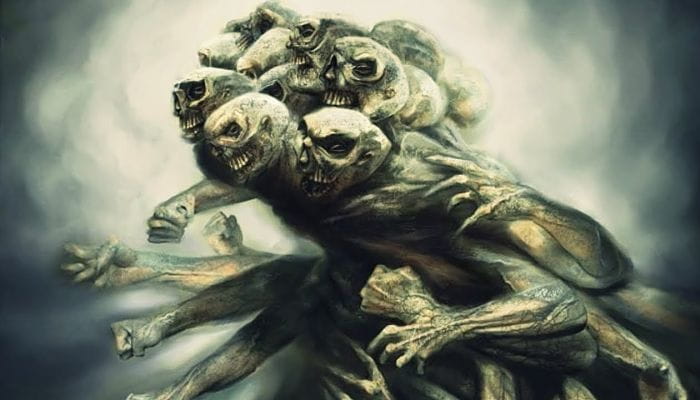
And like mortals, they too are capable of seeing monstrosity when it is born, as was the case with the Hecatonchires. Imagine not a normal baby with two trembling arms, but one with 100 trembling, shaking, and incomparable limbs. Add to this 50 wailing heads with open mouths, producing furious cries that shook Olympus itself.
Imagine what would normally have been seen as adorable helplessness magnified and increased to a level never before seen, and realize the danger such a creature would pose not only to others but also to itself.
Origin
With great pain, Gaia brought into the world a trio of such horrors. The three newborns screamed and cried as had never been heard before in the heavens or on Earth. With their 100 hands and arms, and 50 heads, they would never be as graceful and divine as her previous children.
Such a terrifying sight, born of a mere mortal, would have been enough for them to throw the child into the sea to be worn away by the waves. However, the gods had their own ways of dealing with this kind of tragedy at birth. The gods, being immortal, could not be killed. But they could be locked away or imprisoned somewhere where they would never be seen or heard again, either by mortals or by the gods.
Family of the Hecatonchires
Before the tragedy of the Hecatonchires, Uranus and Gaia had been blessed with six sets of twins, each with their own natural attributes and grace, and each totally worthy of the gods. Uranus could only give this new triad of creatures a name that meant “the hundred hands,” the Hecatonchires. Gaia gave them proper names: Briareus, the Vigorous; Cottus, the Furious; Gyes, the Large-Limbed.
Uranus immediately tried to push these three forms back into Gaia’s womb. As if her pain in childbirth were not enough, this new pain of having her offspring pushed back into her drove her to new limits, and she screamed. Uranus was deeply conflicted.
He could not bear to see Gaia in such pain, but at the same time he could not bear to look at or listen to these horrors. Gaia gave birth to them again, and for a few seconds, the 50 twisted faces of each baby remained motionless and silent. She looked at them with love. To her, they were simply her children, and she loved them as much as she loved the others before them.
Story
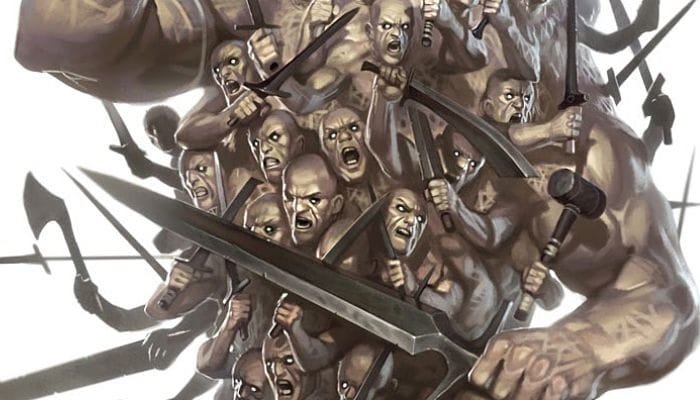
The Hecatonchires stood still. Uranus snatched them furiously from Gaia’s clutches. “I will not accept these beasts! We are gods! We are perfection! These creatures can NEVER be part of the heavens, they are a threat to us all,” he shouted.
Gaia begged him to reconsider, but there was no convincing him. As they left their mother’s arms, the Hecatonchires became enraged and cried even louder than before, waving their many fists and thrashing about. The other gods covered their ears. “Uranus! We can’t stand this noise any longer! You must free us from this torment,” they cried.
One by one, Uranus held the Hecatonchires over the mouth of the Tartarus Abyss. And one by one, they fell. Falling deeper and deeper, their cries and wails diminished as they fell further and further into the darkness. The gods breathed a collective sigh of relief.
Time passed, but not in the same way mortals perceive it. At first, all the Hecatonchires could do was thrash about helplessly in the darkness. They could not control their limbs or their vicious rage and fury. They could not feed on the love of the mother from whom they had been torn, but instead fed on their violence and anger, becoming more monstrous with every passing minute.
But a minute for a god is not the same as a minute for a mortal. The children grew very quickly, deep within their dark prison with its high bronze walls. Finally, one day, they heard a voice at the mouth of the pit calling to them.
Freedom and betrayal
“Brother! Free us!” cried the 150 heads in unison. It was the first time they had ever spoken together, the first time they had ever worked as a collective mind. The idea of freedom drove them to focus and silence their violent thoughts.
At the mouth of the pit stood their brother, Kronos. He had made a vow to their mother to free his brothers, but they were so far down in the pit. He could not see them, and could only hear their voices. The Hecatonchires were aware that they could not be seen, and worked even harder to disguise their monstrous forms. With great effort, they spoke in unison, slowly and softly.
“Free us, brother. We are suffering greatly. We are so distressed. We have not seen the light since our birth. Free us, and you will be rewarded. Free us, and you will be glorified.”
Kronos knew what he had to do. Quickly, he stabbed his father, Uranus, with a sickle, castrating him. He took the key to Uranus’s door, watched him slink away in pain and defeat, and then returned to the pit to free his long-lost brothers.
The door flew open. Out of the pit burst the three monsters. They had learned to control their voices, but they had not yet mastered the use of their limbs. They waved their fists wildly, twisting and turning in a macabre dance of death. Kronos’ mouth gaped at these incredible creatures.
Were these his brothers? NO! It couldn’t be! He had never seen them before, and they had spoken to him so gently. What deception was this? Soon the danger became obvious to him, and he knew: for heaven’s sake, he could not fulfill the promise he had made to his mother. The Hecatonchires were so strong that they beat him savagely with their limbs and fought as he tried to cage them again. But one by one, he was able to capture them. And one by one, they fell back into darkness and despair. One last cry in unison as they fell, but this time a moan of despair instead of a whisper of victory.
Redemption

“Betrayed!!! We are betrayed,” they lamented. “If only we could control our limbs!” However, they would have to learn to do more than that to win their freedom. Ultimately, they would have to master their rage. No matter how hard they tried, for a time all they could do was pound their hands against the bronze walls of their prison.
Their first attempts were a collection of confused and random movements as they pounded their fists against the walls and each other. Then they began to focus. They moved 20 limbs at a time. Then 10. Then 5. With nothing but time on their many hands, they practiced agonizingly. Eventually, they mastered the fluid movement of several limbs at once.
They had to work to the point where they could move each limb independently, and they had begun to focus heavily on this effort. One arm. Up and down. Left and right. Side to side. Their concentration brought control, not only of their limbs, but also of their rage.
Eventually, another voice echoed at the entrance to the pit. It was Zeus, and for a moment the Hecatonchires thought they would lose all their progress as their fury reappeared. Unlike their father Kronos, Zeus had been told about these monsters in the pit and how out of control they were.
“Brothers! I seek your help in battle, and for your services, I will set you free. But first, you must prove that you have mastered the use of your limbs as well as your rage. Save your rage for the next battle. I give you three tasks to prove yourselves worthy of your freedom.”
“First,” he said, “you must fight and defeat the dragon, Campe, who guards your prison.” “Second, you must throw a rock from the entrance of the pit to the highest point of Olympus,” Zeus declared, pointing to the sky. “And third, you must locate and aid the Cyclopes within Tartarus and help them forge powerful weapons to defeat our father, Kronos.”
Cottus, “The Furious,” stepped forward as Campe approached him, breathing fire in a great swirling flame. Using 30 of his limbs, Cottus tore a piece of bronze from the wall and shielded himself from the fire. He leaped forward, striking the dragon with 30 limbs and grabbing it by the neck with the remaining 40.
With ease, he flipped the dragon onto its back, then took the bronze shield and thrust it into the dragon’s throat. The dragon gasped, unable to breathe, then shook, trembled, and succumbed to death.
Gyes, “The Large-Limbed One,” lowered his hand and, with all the strength of his many arms, lifted the largest rock he could find. He raised the stone to his chin and, with the grace of an Olympic discus thrower, sent the enormous rock flying through the air. It rose until the Hecatonchires could no longer see it, where it came to rest on the highest peak of Olympus. Briareus, “The Vigorous,” had mastered the use of his limbs better than any of them.
Zeus threw a hammer, ingots of divine metal, and an anvil into the pit. Briareus grabbed them and quickly found his other brothers, the Cyclopes, who had not been noticed by the Hecatonchires because they had previously been so blinded by their own anger and their intense work to control their own bodies. Clang! Clang! Soon, lightning bolts were created, as a blacksmith would forge a powerful sword, ready for Zeus to launch into battle.
Then came a huge trident that would help Poseidon summon the power of the sea. And finally, with the memory of betrayal fresh in his mind, Briareus helped forge a helmet of darkness for Hades, to give the gods the covert advantage of being hidden from Kronos’ eyes in the coming battle. The earth shook with the efforts of the Hecatonchires and the Cyclopes as they worked together on this final task.
Zeus beamed down on the Hecatonchires, admiring the craftsmanship and power of the weapons presented to him. He also understood that their anger was sufficiently well controlled that they could work not only with each other, but also with others. “My brothers! You have done well! I release you from your prison. Let us emerge as allies and restore the glory of the gods in the greatest battle of all time,” Zeus shouted.
The Hecatonchires emerged from the pit once more. Only this time, it was not with a wild and uncontrolled dance, but with astonishing precision and mastery of their limbs, their wills, and their voices. They were no longer ruled by their own anger and had freed themselves not only from the confines of their prison, but also from their own violent nature.
Current influence
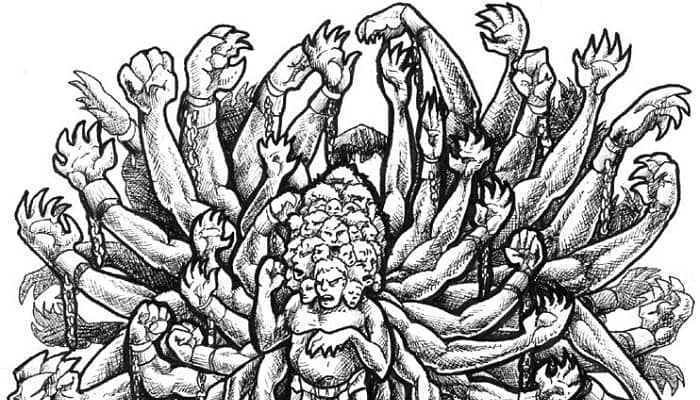
The Hecatonchires threw 300 stones at a time at the Titans who were allied with Kronos. Very soon, they gave Zeus his victory and were rewarded not only for their victory in battle, but also for their victory over their own savagery and disability. Briareus would go on to negotiate a dispute between Poseidon and Helios, restoring order between the sea and the sun.
Poseidon offered his daughter to Briareus in marriage and gave him a palace under the Aegean Sea. Briareus would later rescue Zeus from a coup organized by Poseidon, Hera, and Athena; his mere presence alongside Zeus was enough to prevent a overthrow.
Cottus and Gyes became the guards of Tartarus, because they knew the prison of the gods better than anyone else. They were also granted palaces under the name of Oceanus, the source of water that surrounds the earth. And to this day, when an earthquake occurs, those who still worship the gods believe that it is caused by the many members of the Hecatonchires.