Guan Yin. The goddess of compassion. Of all the goddesses, she is highly revered and loved throughout the world. Guan Yin has countless stories and innumerable forms.
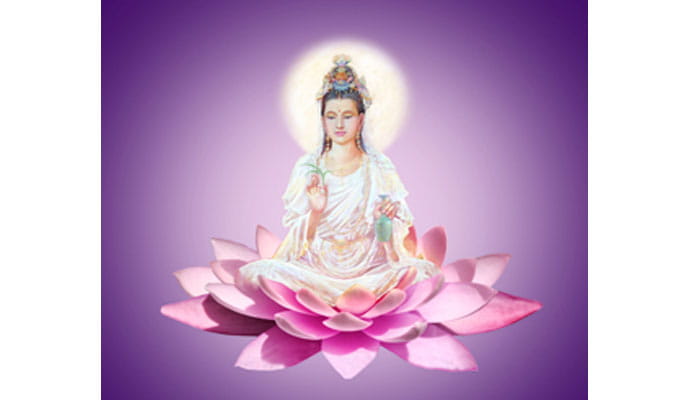
1. Myths and Legends of Guan Yin
As you would expect from a goddess who features in the mythology of so many different countries, there are a great many varied stories that we could retell about Guan Yin.
Guan Yin: She who sees and hears the cries of the world
As an archetype, the goddess Guan Yin is unmatched. Centuries later, we find echoes of her myths in folk tales and literature, works as enduring as Cinderella, Snow White, and even Shakespeare’s King Lear.
The princess who became the goddess Guan Yin. The villagers knew immediately that something phenomenal had happened. At the very moment the Queen had given birth, the earth shook beneath their feet as fragrant flowers sprouted through the winter snow that covered the hillsides. The king and queen, however, were unimpressed.
They had asked for a boy, wanting a son who could consolidate their power and wealth. What use was another daughter? Especially one like Miao-Shan who was so kind and pure? Finally, they decided to marry her off to a rich man. But Miao-Shan refused and told them she would only do so on three conditions. She would only agree to the marriage if:
- Alleviating suffering in old age
- Alleviating the pain of the sick, and
- Comfort the dying and the afflicted.
She begged to be allowed to become a nun instead. But her father became enraged and forced her to do all the household chores in her home for her refusal. To make matters worse, her mother and two sisters mocked her mercilessly as she slaved away at her chores.
At night, while the others slept, Miao-Shan stoked the fires, swept the floors, and chopped all the vegetables for the next day’s meals without complaint. The animals living in the palace felt sorry for the poor princess who was so kind and began to help her with her chores so she could get some sleep.
Her father, enraged that she could do so much and still be so rested, finally agreed to let her go to the temple to become a nun.
But, still angry at her insistence on helping the unfortunate, he ordered the nuns to treat her so badly that she would become discouraged and return home punished and willing to submit to his authority.
2. Poems to Guan Yin
“The work of women,” all the Buddhas agreed. “Who but a kind mother could ever dream of offering unlimited love and comfort to all people, alleviating the inevitable pains of human life?”
After all, man had failed and now lay shattered at his feet. Carefully, they began to reshape the pieces of the Indian bodhisattva named Avalokitesvara, who was known as the Merciful Lord of Enlightenment.
He had once chosen to remain on earth to alleviate the suffering of humanity rather than partake in the pleasures of Nirvana that he had earned.
Now he is reborn as the goddess Guan Yin and is ready to begin his work again, this time in a female form better suited to the task.
And as part of this spectacular makeover from god to goddess, the Buddhas equipped her with a thousand arms (best for extending compassion to those around her throughout the world) and placed eyes in the palms of her hands so she could see anyone who might be in need.
3. Guan Yin: Names and symbols of Asian goddesses
The nuns put Miao-Shan in charge of food supplies, managing the garden and collecting water from the distant stream. They thought this would be daunting as it was the middle of winter. To everyone’s surprise, crops appeared in the garden and a stream sprang up just outside the kitchen door.
When her father heard of these miracles, he decided to end her life and sent one of his henchmen to kill her. When Miao-Shan knelt down to bow her head to the axe, she meekly met the henchman’s eye and said, “You need not worry about what you have to do. You have been forgiven.”
Shaken, the henchman thrust his weapon against a nearby rock and the axe broke into a thousand pieces. Then clouds descended from the hillside and carried the young nun to safety on a nearby island where she continued her religious study, prayer, and meditation while living alone.
A few years later, the king fell ill. His doctors said he would soon die. When his condition worsened, a traveling monk arrived (some versions of the myth say he was actually Guan Yin in disguise). He told the king that he knew of a cure, a medicine made from the eyes and arms of someone who was full of love and forgiveness.
The king called his other two daughters to his side, asking them to provide this gift of life. They, of course, refused. Then the monk told him that he knew of someone who he was sure would make the sacrifice willingly, so the king sent his messenger to make the request. Miao-Shan took out her eyes and cut off her arms, telling the messenger to hurry and take them to the king so that he could be healed quickly.
The monk prepared the medicine and gave it to the king, who was quickly healed. He tried to thank the monk, but the monk refused, saying, “It is the one who made the sacrifice whom you should thank.” So the king and his wife made the journey to the island, and when they realized that it was their daughter who had given up so much, Miao-Shan told them, “Knowing my father’s love, I was honored to be able to repay him with my arms and eyes.” Just then, the clouds descended.
When the mist cleared, Miao-Shan was no longer there. The earth began to shake again, and thousands of flowers floated down from the sky. The royal family looked up and saw the goddess Guan Yin in the sky, manifesting her thousand arms and eyes. To honor their daughter, who was now known as the goddess Guan Yin, they built a shrine on the site of her ascension and called it Fragrant Mountain.

