Today, let’s look at Greek symbolism and a total of 9 historical symbols that evoke legends and myths from this ancient culture.
Greek culture and mythology are full of symbols, many of which originated in ancient times. This Greek symbolism has spread throughout the world and is used in fashion, jewelry, and home décor. Due to their widespread nature, they are synonymous with Greek culture.
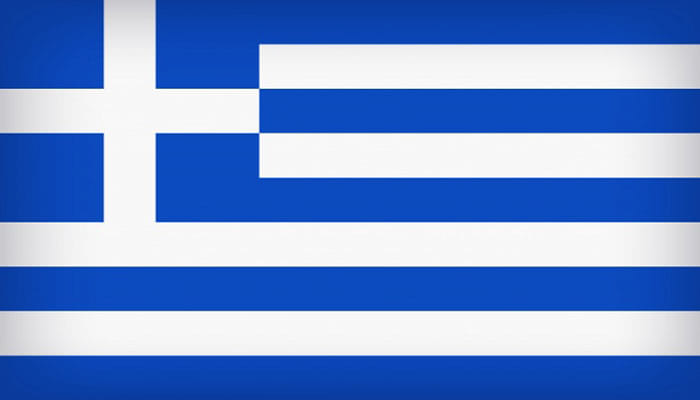
2. Greek key
The Greek key has been represented in fashion, namely used as a motif for the Italian high fashion brand Versace. This Greek symbol is also known as the meander motif, which takes its name from the Meander River in ancient Greece (now Turkey). The meander was characterized by a very complicated path.
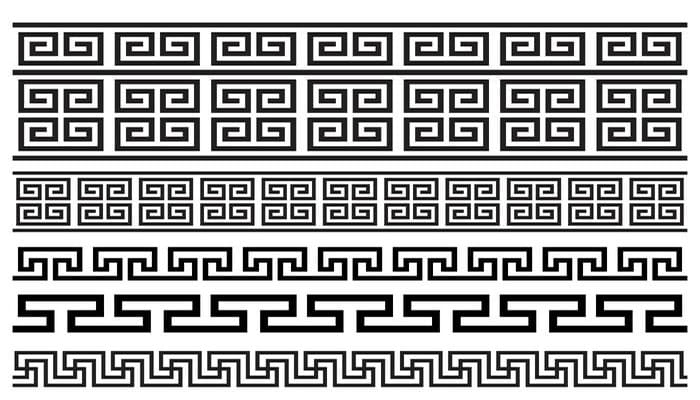
It became one of the most important Greek symbols of ancient Greece within Greek mythology, symbolizing infinityas in Wiccan symbols or the eternal flow of things. Many temples and objects were decorated with this motif. The Greek key also symbolizes the bonds of friendship, love, and devotion, which is why it is often given as a wedding gift.
In Greek symbolism, it can also represent the four cardinal points, the four seasons, and waves.
3. Greek evil eye
In Greek symbolism, the “Greek evil eye,” also known as the mati, is a Greek symbol beloved by the people of this country. More recently represented in the world of fashion in jewelry and accessories, the evil eye dates back to the classical era in ancient Greece.
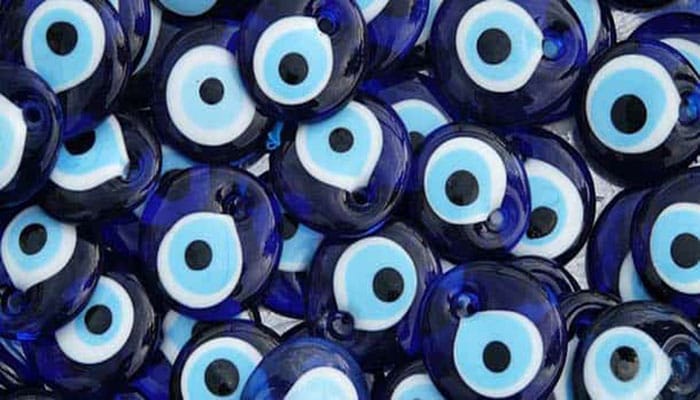
In Greek mythology, the evil eye is believed to be a curse given by a glare with negative intentions. Any negative emotion can cause the evil eye curse. Within Greek symbolism, it is also believed that the curse itself causes bad things to happen to the person who received it.
In some parts of Greece, it is believed that those with blue or green eyes are particularly capable of casting the curse, which is one of the main reasons why evil eye talismans are depicted as a blue eye.
With this Greek symbol, it is said that wearing a special spell for the evil eye helps prevent the curse from happening, so it could be considered fashionable, especially for Greeks.
4. Lambda
As the eleventh letter of the Greek symbols on our list. It is written as Λ in uppercase and λ in lowercase. The Greek symbol lambda is used to denote the von Mangoldt function in mathematics, while it can also be seen in areas such as physics, engineering, statistics, and even astronomy.
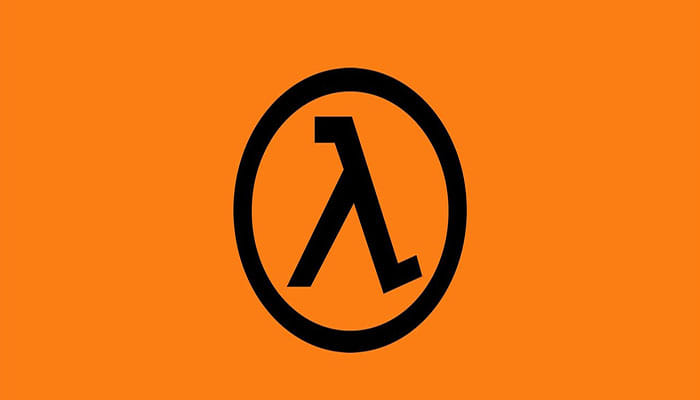
On an interesting side note, the uppercase Greek symbol lambda (Λ) was used as the Greek symbol for the Spartans, the renowned warriors of antiquity.
As we know in Greek symbolism, Lambda is the letter of the Greek alphabet, used to represent the sound ‘l’ in ancient and modern Greek. In the Greek number system, it has a value of 30. Letters derived from it include the Roman L and the Cyrillic Л. It is used as shorthand for wavelength.
In the early Greek alphabets, the shape and orientation of lambda varied. Most variants consisted of two straight lines, one longer than the other, connected at their ends. The angle can be at the top left, bottom left (Western alphabets) or top (Eastern alphabets).
Other variants of this Greek symbol had a vertical line with a horizontal or slanted stroke running to the right. With the general adoption of the Ionic alphabet, Greek established itself at an angle at the top; the Romans placed the angle in the lower left corner.
5. Eagle
The Greek symbol for the eagle is often used, for example, in coats of arms and flags. In other designs, the Greek symbol is used in the United States as a large seal for official documents and passports and in the German coat of arms. The eagle is known for different symbolic values.
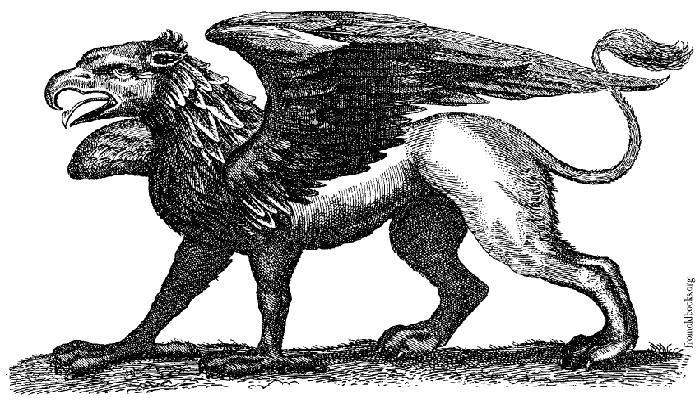
The most important is“The King of Birds,”which means power and victory and is used in Roman and Greek insignia. The ancient Egyptians, Indians, and Aztecs also used the eagle to express symbolic value. Today, the eagle is used on a large number of flags, including the German and Egyptian flags.
The first use of the eagle as a symbol dates back to ancient cultures several thousand years before Christ. Probably the ancient Egyptians or even the ancient Chinese dynasty.
6. Symbol of cornucopia
The cornucopia, also known as the horn of plenty, is a Greek symbol of harvest abundance, prosperity, and nutrition. It is represented as a spiral-shaped basket filled with grains and fruits produced by the generous Earth.

The Greek symbol of the cornucopia dates back to Greek mythology when the god Zeus was fed by a goat, Amalthea, with her milk. Later, Zeus rewarded Amalthea by placing her in the sky as a constellation (Capricorn) and gave her horn to his nurses, assuring them of an endless supply of everything they desired from him.
7. Hercules’ knot
In Greek symbolism, this emblem is known as the Hercules knot, Heracles knot, love knot, and marriage knot. The Hercules knot is a Greek symbol of marriage representing eternal love and commitment. This knot, made with two intertwined ropes, is considered to represent the legendary fertility of the god Hercules.
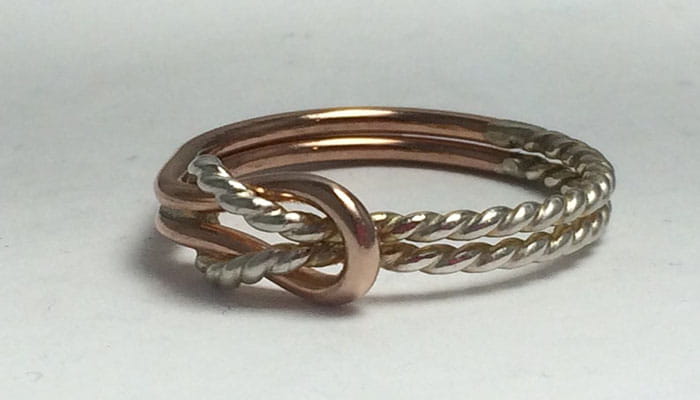
Although initially used in ancient Egypt as a healing charm, the knot became more popular among the ancient Greeks and Romans as a token of love and a protective amulet. It was incorporated into the protective sash of the bride, which the groom ceremonially untied.
The Hercules knot is believed to be the origin of “tying the knot,” a phrase meaning to get married.
8. Caduceus
The caduceus is an ancient Greek symbol of commerce and trade, and is associated with negotiation and eloquence. This Greek symbolism is also associated with Hermes, the swift and cunning Greek god who is an emissary of the gods, conductor of souls in the afterlife, and protector of travelers, merchants, and shepherds.
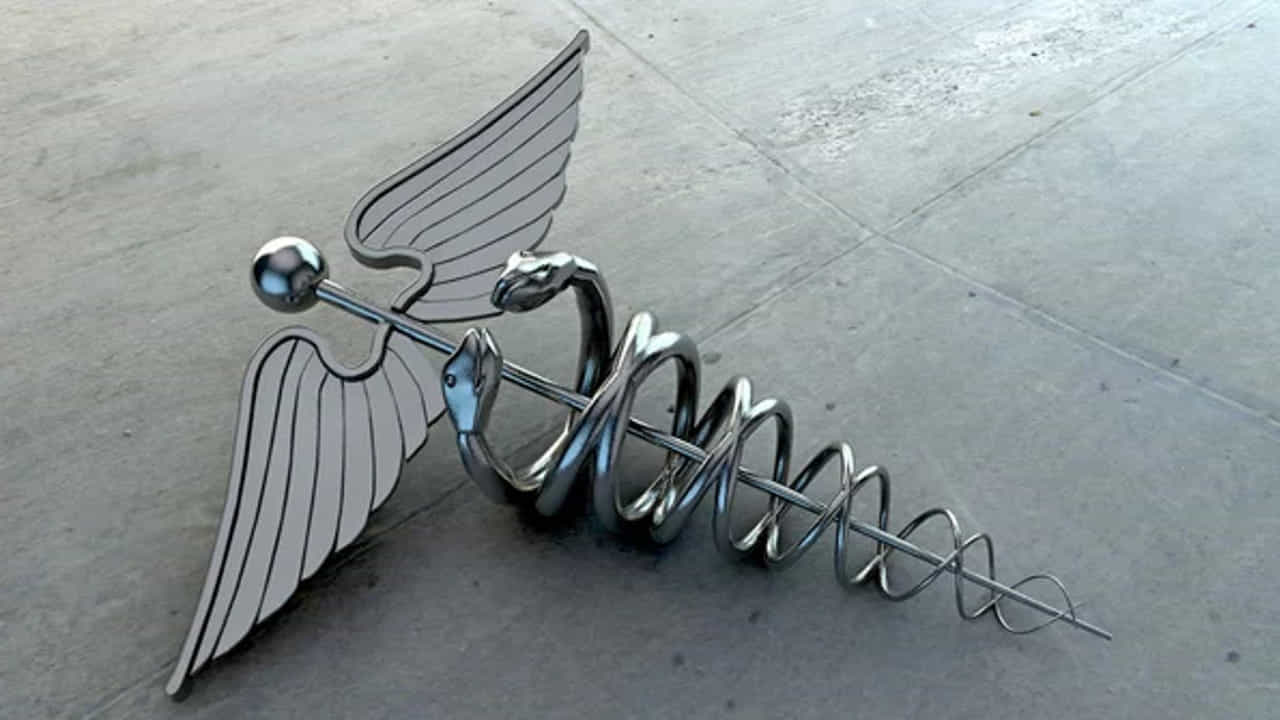
The caduceus also symbolizes wisdom and spiritual awakening in the Hermetic tradition. This Greek symbol features a winged staff with two intertwined snakes around it. It has sometimes been mistakenly used as a Greek symbol of medicine instead of the Rod of Asclepius, which has a single snake and no wings.
9. The Minotaur
In Greek mythology, the Minotaur was a creature that was part man and part bull. It lived in the center of the Labyrinth, which was an elaborate maze-like structure built for King Minos of Crete and designed by the architect Daedalus and his son Icarus, who were ordered to build it to contain the Minotaur.
The historic site of Knossos is generally identified as the site of the labyrinth. Theseus eventually killed the Minotaur.