Ancient Greece is a time full of myths and legends that the inhabitants firmly believed in, which is why this anthology also includes the Greek Giants, beings whose size frightened anyone who saw them.
Origin of the Term Giant
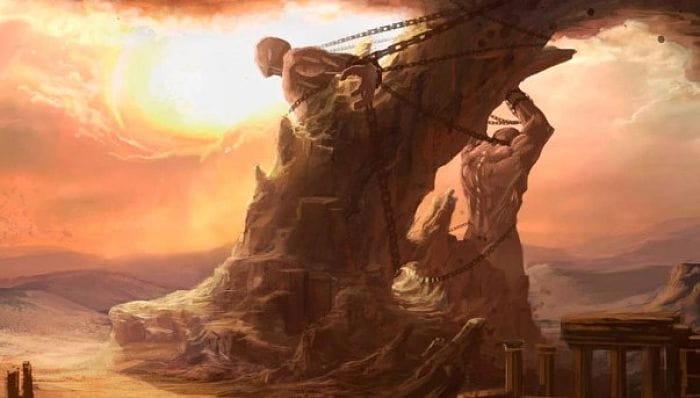
In history, the giants of Greek mythology are beings characterized by their great height and superhuman strength.
They are usually described as beings that look human but have snakes instead of legs.
Homer’s Concept of Giants
Homer describes them as a race of men who surpass the typical features of humans, being created in gigantic proportions, which is why they were classified as savages.
He also believed that they were ruled by Eurymedon, who lived on the island of Trinacia, although this version also states that Eurymedon killed them because of their audacity towards the gods.
However, Homer describes them as Phaeacians, Cyclopes, and Laestrygonians, one of the races that ruled without regard for the gods, which led to their destruction (except for the first ones) due to their authoritarian insolence. It should be noted that neither he nor Hesiod had any further information about the battle of the Giants against the gods.
Giants in Greek mythology
The myths that arose around these beings are that they were born from similar physical phenomena in nature, such as volcanic eruptions, as in the story of the Cyclops.
However, the giants of Greek mythology are not mentioned much, and they appear only in the episode of the Gigantomachy (War with the Giants), in which they recount how they faced the gods of Mount Olympus.
With the help of Heracles, they were defeated, although according to some authors, these events seem to be a replica of the revolt of the Greek gods against the Titans, the Titanomachy.
Main Greek Giants
There are various versions of the story of the main giants, the most common of which is that they were divine beings born from the blood of Uranus, which was spilled on the earth, and their mother was Gaia.
To be more precise about their birth, authors believe that Gaia, outraged by what had happened to her previous children, the Titans, gave birth to the Giants on her own, so that they would be monstrous beings who could not be conquered, with fearsome faces and dragon tails.
This happened after Cronus castrated Uranus and his blood fell on Gaia. Although for Hyginus, they were her children, but with Tartarus, god of the underworld.
Unlike their predecessors, these beings did not remain in their mother’s womb but wandered the earth until they were killed.
Therefore, the main giants of Greek mythology are:
1) Agrius and Toante
Two giants who were fathered by Uranus and Gaia and defeated and killed by the Moirai, thanks to the bronze maces they wielded.
2) Alcyoneus
A giant in Greek mythology known for his enormous strength compared to that of Hercules, known for defeating Hades, the god of the underworld.
Appearance of Alcyone
His appearance is said to have been frightening, with long hair, an unkempt beard, and feet with scales like a snake’s and large claws.
Legend
His death is one of the best-known stories about this character, as during a battle he was wounded by one of Heracles’ arrows. After falling to the ground, he got up because he was immortal as long as he did not leave the confines of his homeland, Palene.
Athena, interested in seeing the mission fulfilled, told Heracles about this, so he pretended to flee so that Alcyoneus would follow him until he left the territory where he was immortal, whereupon he died from the arrow that was stuck in him.
3) Alpo
Originally from Sicily, he was killed by Dionysus during the Gigantomachy.
He is also thought to be the son of Gaia with the blood of Uranus. He is known for rising up against the gods, as he believed that the prophecy that they would only win if no mortal helped the gods would come true.
However, his participation in the battle was remarkable, as he single-handedly threw giant rocks and mountains at the gods who were blocking his advance, but Dionysus stopped him by stabbing him in the throat with his thyrsus, mortally wounding him and causing him to fall into the sea.
This resulted in him creating a wave so large that it surpassed the mountain where his brother Typhon was buried, but it also managed to appease the fiery peaks of Mount Etna for a time.
Appearance and Personality
The most famous representation is that of Nono, who describes him as being as tall as the sun, which bothered the moon and the stars, and his hair was made up of 100 snakes.
His personality was that of a hermit and a malevolent being who liked to eat anyone who entered or came near his lair.
4) Clitio
He is known to be related to Eurytus, king of Ecalia, and Antiope, queen of the Amazons, who are said to be his parents, along with Iphitus, who is his brother.
He was one of the giants of Greek mythology who was recognized not for his evil but for being a hero who ultimately rebelled against the gods, according to stories. However, he was killed by Hecate with torches.
Clitio and his abilities
Classified as a hero for his participation in an episode of mythology where he helped others, he is described as having a challenging character, but only with the gods, which is why he appears as the villain in the stories. However, he is recognized for his abilities, which set him apart from others:
1) Excellent fighter
He is credited with great skill in battle because he was very energetic and skilled with weapons. Stories mention that one day at Hades’ house, he was able to fight several opponents at once without faltering until the goddess Hecate arrived.
2) Thief of magic
Clitio is capable of stealing magic from those he fights. An example of this was when he faced Leo, using his fire to pass through his cloak of black mist.
3) Half-immortal
Like most giants, Clitio can be defeated and killed when a god and a demigod fight together against him, because he always wears his armor made in the underworld, which makes him immune to other types of attacks, as his skin regenerates quickly.
Appearance of Clitio
He is depicted to followers of Greek mythology as a being wearing a robe made of shadows, measuring 6 meters tall.
He has ash-colored dragon legs, accompanied by long, braided hair that acts as a “cloak of darkness.”
It is said that seeing him completely is difficult because his cloak protected him entirely, and only his large blue eyes could be seen.
Accompanying this, he was dressed in protective black armor made from Iron from the Underworld, and he carried a black sword made from the same material that was five times larger than the sword of Nico, the Greek demigod king of ghosts.
5) Damasen
Giant Son of Gaia and Tartarus, who was the antithesis of Ares, the god of war and revolt, in the Gigantomachy.
He was a peaceful and calm being who did not fight in the battle against the gods and giants of Greek mythology.
The story of his life revolves around his love of spending time with humans as a farmer and walking through the fields of Meonia, while tending his flock and gathering herbs.
His parents disowned and cursed him for this, resulting in the appearance of a Meonian dragon who killed a mortal shepherd who was a friend of Damasén. In revenge, the dragon sought him out and killed him by impaling him on a tree.
Being such a good myth, he did not want to terrify mortals and made the roots of the tree grow to trap the drakon in the ground. However, his enraged mother swallowed Damasén through a hole in the ground and exiled him to his father’s stomach.
However, some time later, he was allowed to live in freedom and return to his farming activities, but with the detail that every day, the drakon came back to life to attack him, this becoming his eternal punishment.
Appearance of Damasén
Damasén is described as a 6-meter-tall giant with the upper body of a human but the legs of a reptile with dinosaur-like scales.
He wore a simple shirt sewn from sheepskins and leather with green stains. His skin was cherry red, while his beard and hair were reddish brown, the latter braided with grass, leaves, and marsh flowers.
An interesting fact about how he was perceived is that, as Annabeth says, Damasén was a giant who did not seem hostile when you saw him, but he did show sadness and bitterness, even commenting that that was all he could think about.
6) Ephialtes
There is confusion as to who his parents are. In one of the official lists of Greek mythology, he is listed as the son of Gaia and the blood of Uranus, but in another he is the son of Gaia and Tartarus.
He is also a giant with the same physical characteristics as the others, so there are no specific details about him.
However, he is recognized as one of the protagonists of the Gigantomachy, in his battle against the gods of Olympus, but he is notable for his tragic death.
He died at the hands of Apollo and Heracles, when one shot an arrow into his left eye and the other into his right.
7) Enceladus
A giant defeated in the fight against Olympus, who was struck down by Zeus’ lightning bolts and then buried by Athena, who threw Mount Etna at him. According to the poet Lucilius, the volcano produced flames that were thought to be his form of breathing, and its eruptions came out of the wounded side of this mythological being.
What did he look like and what was his personality?
He is described as a giant of a smaller stature than is common among these mythological beings, but regardless of this, he claims to be the smartest.
His upper half is human, and he has green dragon legs and claws instead of feet, along with white marble eyes. This is accompanied by bronze armor with a fire design. His hair is dreadlocked and decorated with bones believed to be from a demigod who was his victim.
His favorite weapon is a spear the size of a flagpole.
On the other hand, he has an arrogant personality but likes to send others to do his dirty work.
8) Mimas
Buried by Hephaestus under a large amount of molten iron where he was trapped, but versions of his death vary; some say it was Ares or Zeus himself.
It is also believed that the island of Procida is where his body rests.
9) Polybotes
Another of the giants who fought against Olympus in Greek mythology.
He faced Poseidon head-on, who pursued him to the island of Kos, where the god tore off a piece of the island and threw it on top of Polybotes, burying him. This piece of land is now known as the islet of Nisiros.
10) Porphyrion
Created to destroy Zeus, Porphyrius is another of Gaia’s sons, also known as the king of the giants, who rebelled against the gods by attempting to throw the island of Delos at them.
However, Zeus tried to weaken him by making him fall in love with his wife Hera, but he reacted violently and managed to tear the goddess’s robe.
This served the god well, who struck him down with one of his lightning bolts so that Heracles (Alcides) could pierce him with one of his arrows poisoned with the blood of the hydra.
11) Eurymedon
He is thought to have been the ancient king of the giants, the new son of Gaia, who were created to avenge their brothers imprisoned by Zeus.
12) Athos
An original member of the Gigantomachy, he is known for creating the Aegean Sea when he threw a rock at Poseidon, but it fell and gave rise to the peninsula.
His story ended when he faced Zeus with rocks and mountains, but Zeus defeated him near Macedonia, turning him into a mountain in the area. In fact, it is believed that there was a temple dedicated to Zeus on top of Mount Athos.
13) Anax
A giant also known as Anactoria who ruled the country until he was succeeded by his son Asterios, who lost the city to Miletus, who named the country after himself.
Anax is thought to have been 10 cubits tall and was buried on the small island of Lade when he died.
14) Damisus
The fastest giant, despite his reptilian legs, who was killed by Zeus and Heracles, and whose body was later buried in Palene, where the most famous of the centaurs, Chiron, brother of the god, lived.
However, the centaur, who was charged with educating Achilles, one day exhumed his body to remove the astragalus from his foot and implant it in Achilles’ heel after his mother, the goddess Thetis, burned it and managed to injure the astragalus of his foot, implanting it in Achilles’ heel.
Purpose of the Main Giants
The strongest versions indicate that Gaia created these giants with the aim of rebelling against the gods, encouraging them on many occasions, and for this reason she designed them so that each one would destroy a specific god.
Secondary Greek Giants in mythology
Various authors agree on the participation of the previous giants of Greek mythology, but with the arrival of this new generation, there are many doubts about their origin and purpose in ancient Greece, since they were giants only in size and strength. These are:
1) Agrio and Orio
Giants born from the relationship between Polypheus and a bear, which was a punishment from Aphrodite but ordered by Artemis.
They were characterized like the rest of the giants for not honoring the power of the gods and liked to eat humans until Hermes transformed them into birds.
2) The Aloadae
Twin brothers born of the seduction of Poseidon and Iphimedea, wife of Aloeo, who became pregnant when she poured a little river water on her lap.
Their names are Oto and Efialtes, both of whom did not appreciate the gods and tried to fight them many times, the first time at the age of 9 when they threatened to climb to heaven by placing Mount Ossa on top of Mount Olympus and Mount Pelion on top of Mount Ossa.
Strong and aggressive, the Aloadae were initially said to have been killed by Apollo, but another version says that they killed each other by throwing spears at each other to stop a deer that was Artemis, because they both wanted to sleep with her.
Myths about the Aloadae
There are three myths surrounding these giants:
- They were suffering a punishment from hell, in which they had to be tied with snakes to a column on which an owl perched, always with its back turned.
- It is believed that in the cities of Naxos and Boeotian Ascra, they were revered founders for teaching culture to humanity.
- Efialtes, translated from Greek, means nightmare, which is why the giant was thought to be the demon of nightmares.
3) Antiphates
Another son of Poseidon, but this time with Gaia, in mythology he is thought to have been the king of the Laestrygonians, a group of man-eating giants from Sicily whom Odysseus encountered on one of his voyages. Amphipatris and his people attacked his ship, and he was only able to escape in a sailboat.
4)Antaeus
Also the son of Poseidon and Gaia, he lived on the island of Irasa beyond the Strait of Gibraltar, in the deserts of Libya.
Antaeus had a defiant personality and liked to kill anyone who happened to pass through his domain, because his goal was to build a temple for his father out of human skulls.
His most characteristic trait was that he always won his battles because he had the gift of recovering just by touching the ground, as his mother Gaia gave him strength.
So one day he challenged Heracles, who knocked him down three times, but he kept getting up. However, Heracles realized this and lifted him into the air, where he suffocated.
Interesting fact
He is recognized as the founder of the Tower of Hercules, where he fought against Heracles and buried him, later building the lighthouse of La Coruña, the only lighthouse still in operation in the world and a World Heritage Site.
It is worth noting that the city has a coat of arms with a lighthouse and bones underneath it, representing Antaeus.
5) Argos Panoptes
A giant who worked as a watchman because he had a hundred eyes that allowed him to see every aspect of his surroundings, regardless of whether some of his eyes were asleep because others were open.
His parents are not known for certain, although the most widely accepted version is that he was the son of Agenor, son of Inachus, son of Arestory Miceneo of Yaso, king of Argos, and the nymph Ismene, daughter of Asopus.
He honored the goddess Hera, of whom he was a faithful servant, and is credited with the death of the chthonic monster Echidna, who had a serpent’s tail while sleeping in her cave.
His end came because of his loyalty to Hera, who ordered him to hide a white heifer belonging to Zeus, which was actually a nymph named Io, one of the many with whom Zeus mated to establish a new order.
Zeus sent Hermes to rescue her, who disguised himself as a shepherd, put the giant to sleep, and beheaded him with a sword shaped like a crescent moon, according to some versions.
To honor him for being a worker who honored Hera so much, he was commemorated by having his 100 eyes kept and displayed on the tails of peacocks.
6) Cacus
His father is Hephaestus, and he is one of the giants of Greek mythology who was different, as he was half man, half satyr. His special ability was to vomit whirlwinds of flames and smoke.
According to mythical writings, he lived on Mount Aventine, where he placed the heads of the humans he had eaten at the entrance. He was killed by Heracles, as Geryon had stolen some of his oxen, which is why it is believed that he murdered him.
7) Geryon
A monstrous giant, son of Chrysaor and Callirrhoe, who stood out for being made up of three complete human bodies joined at the waist with their heads and arms.
He is said to have lived on the island of Erytheia in the Gadeira archipelago, beyond the Pillars of Hercules in the western Mediterranean. He was accompanied by a two-headed dog named Ortros in a cattle shed alongside a shepherd named Eurytion.
He was invincible in battle and possessed great wisdom, which came to an end when Heracles, fulfilling one of his 12 labors, stole his cattle and killed him with a poisoned arrow in the ensuing fight.
Legend of Geryon
Thanks to Pata Pompeyo Trogo and Marco Juniano Justino, it is believed that Geryon was not a three-bodied giant, but rather three brothers who lived in such harmony that they seemed to be one. They decided to attack Hercules in order to recover their cattle.
8) Orion
A beautiful giant who had the ability to walk on water because his parents were Poseidon and Euriale, one of the Gorgons.
He was also so large that he could dive into the deepest seas. He fell in love with Merope, daughter of Enopion, king of Chios, and wanted to marry her, but her father would not allow it. In desperation, he tried to kidnap her, but as punishment, the king asked Dionysus for help in putting him to sleep and blinding him.
Orion regained his sight by allowing the sun’s rays to shine directly into his eyes. He then began to work with Artemis, who took great care of him.
There are two versions of how he died:
- As he was protected by Artemis, he was considered invincible and claimed that none of the great beasts and monsters frightened him and that he could destroy them. Gaia, hurt by his words, sent a scorpion that killed him.
- Another legend tells that Apollo, angry because his sister loved the giant Orion, challenged her to hit a small figure that was far away with her arrow, specifically on the island of Ortigia, in the middle of the sea.
Artemis was so skilled that she hit the target, but it turned out to be Orion who died. Heartbroken, she asked Zeus to move him to the sky and turn him into a constellation.
9) Talos
There is no concrete information about who his parents were, but he was a bronze giant who patrolled the island of Crete on Zeus’ orders, guarding it from pirates and foreigners without the king’s permission.
The way he tortured intruders was unique because he set himself on fire and hugged them until they were burned to death.
He was killed by the witch Medea when the Argonauts tried to enter the island, as his only weak point was a single tiny vein running from his neck to his ankle.