Mythical creatures, by their very nature, do not really exist outside the stories told about them. Lately, I have been exploring their realm in depth, from the primordial demons of the distant past to the crypts of today, encountering all manner of creatures and beings. One such creature is the Gashadokuro, a Japanese supernatural being whose story proved strangely elusive for a giant demon skeleton.
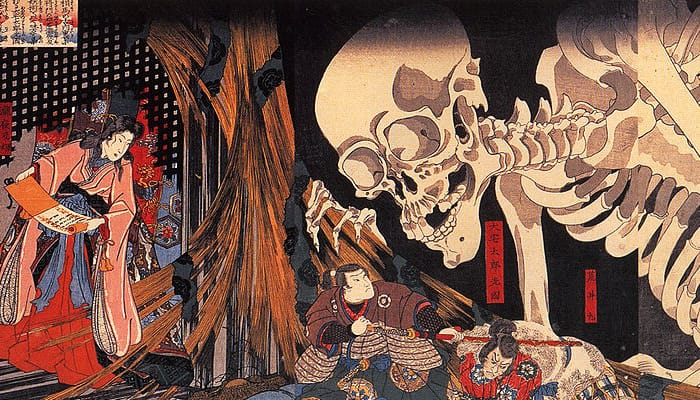
Utagawa Kuniyoshi, “Souma no furudairi” also known as “Takiyasha the Witch and the Skeleton Ghost.” Gashadokuro, literally “hungry skeleton,” also known as Odokuro, literally “giant skeleton,” are mythical creatures in Japanese mythology.
1. Description
Description of the Gashadokuro (a giant skeleton formed from the bones and grudges of unburied corpses, which roams at night and devours any human it finds)
Gashadokuro are demonic souls that transform into giant skeletons and are thirty times larger than any ordinary person. It is said that they were created from the piled-up bones of warriors who died of starvation, hunger, or in combat, without being buried.
These yōkai roam after midnight, grabbing lone travelers and biting their heads to drink their spattered blood. There is a way to tell when they are approaching, as the victim will hear a loud buzzing sound in their ear. Gashadokuro are said to possess the powers of invisibility and indestructibility, although Shinto amulets are said to protect against them.
2. In modern culture
The Gashadokuro is a yōkai that first appeared in print in the second half of the 20th century. It was created by authors of shonen magazines published between 1960 and 1970 and illustrated the yokai encyclopedias Bizarre Thriller Complete Works 2: Monsters of the World (Akita Shoten, 1968) by Shigeaki Yamauchi, which compiled articles on yōkai by Saitō Ryokuuu. At the same time, it was also collected by Shigeru Mizuki and Sato Aribumi, and since its introduction, Gashadokuro became more widely known from 1980 onwards.
Illustrations and Engravings
The illustration in the Illustrated Encyclopedia of Arabumi of Yōkai and Mizuki’s illustration base the appearance of the Gashadokuro on the giant skeleton in Utagawa Kuniyoshi’s ukiyo-e, Takiyasha the Witch and the Skeleton Ghost. It has no direct connection to Gashadokuro, but is said to have influenced modern depictions.
Kuniyoshi’s print was commissioned in the Edo period by Santo Kyoden for a yomihon, depicting a scene in which Taira no Masakado’s daughter, Takiyasha hime, summons a skeleton yōkai to attack the samurai Ooya Tarou Mitsukuni. Although originally depicted as many life-size skeletons, Kuniyoshi depicted them as a single giant skeleton, as is characteristic of his work.
3. Similarities with the yōkai
In the entry for Gashadokuro in Mizuki’s book, a related tale from the Nihon Ryōiki is presented. It tells of a man in the province of Bingo (Hiroshima Prefecture) who is in a field at night and, hearing a bloodcurdling moan, says, “My eye hurts,” and finds a skeleton with a bamboo shoot growing out of its eye socket. “My eye hurts,” he finds a skeleton with a bamboo shoot growing out of its eye socket.
He removes the bamboo shoot and offers the skeleton some boiled rice, upon which the skeleton tells him the story of his murder and his personal history, and rewards him for his kindness. Although this story has been mixed with that of the gashadokuro, they are not actually related, as the gashadokuro originated in the second half of the 20th century.
4. Mythology
Japan is home to some very strange spirits, to say the least. Not long ago, I published a post about a strange race of spirits that haunt bathrooms in Japan. Last night, I was snooping around, looking for more Japanese demons and goblins when I came across the Gashadokuro ( also known as the Odokuro).
The Tale of the Gashadokuro
They arise from the gathered bones of people who died as a result of starvation or war. Due to the terrible deaths that gave them life, the Gashadokuro are filled with rage and a thirst for blood that can only be quenched by drinking the blood of the living.
They roam the countryside at night, searching for human prey. When they find an unsuspecting traveler along the way, the Gashadokuro stalk them silently (though I don’t understand how a 90-foot skeleton can be stealthy) and when the time is right, they grab their victim with a skeletal hand and proceed to rip off their head. The Gashadokuro then sucks the body dry of blood. Imagine it’s something like the way humans eat crabs or lobsters.
So how can a poor traveler avoid becoming a human crab? Unfortunately, I haven’t found any way to fight the Gashadokuro. The only way I’ve seen to avoid becoming a midnight snack is to run like hell as soon as you hear a strange buzzing in your ears, which is the only warning the Gashadokuro gives before striking. Presumably, then, people like me who have buzzing in their ears almost constantly are in a lot of trouble.
Another Gashadokuro Horror Story
The Gashadokuro also go around making a “gachi gachi” sound and grinding their teeth, so presumably you can hear that too. Plus, you know, a ninety-foot skeleton is bound to stick out like a sore thumb no matter how dark it is outside. So if you find yourself stranded in Japan in the middle of the night (because that happens to all of us at one time or another), keep your eyes peeled and your ears open, and you might just survive the night.
5. Other origins and legends
Stories are told that it wasn’t actually about a giant, people-eating skeleton, but about a simple old haunted “dokuro,” or skull, with a bamboo shoot growing out of its eye socket. A man walking through a field at night hears “My eye hurts,” finds the skull of a murdered child, removes the bamboo shoot, and in gratitude invites it to a New Year’s party at his parents’ house.
6. The Not-So-Ancient Origins
The giant skeleton in the closet: the Gashadokuro is a myth built on a myth. As far as we can tell, it was created in the late 20th century, sometime in the 1970s or 1980s, by manga authors. It seems that it first appeared in a 1968 book by Shigeaki Yamauchi, and was later picked up by other manga authors, making it more widely known.
Apparently, Kuniyoshi’s giant skeleton was, in the original story, many normal-sized skeletons summoned by the witch Takiyasha. Kuniyoshi simply decided to depict this as a giant skeleton, which looks much better. Later illustrations were modeled after it, including Shigeru Mizuki’s.
In the end, the gashadokuro is no more or less “real” than its older siblings, nor is the story of its creation inaccurate (after all, it really is the sum of a hundred regular evil skeletons, conceptually).
The Gashadokuro isn’t even the first mythical creature born from a mistranslated description or a bad illustration.