Gabriel is one of the angels known as a messenger. He delivers messages to God’s people. He is mentioned in both the Old and New Testaments, along with several other religious texts.
Purpose
The main purpose is to deliver messages. In the Catholic religion, he is known as the patron saint of messengers, telecommunications workers, and postal workers. September 29 is his feast day, also celebrated with Michael and Raphael.
He is said to help people remain open and honest and to always seek the truth, both in themselves and in others. He helps guide through intuition. He also protects children.
One of Gabriel’s possible future purposes is to sound the trumpet to signal the return of Jesus to Earth. However, there is speculation about this, as several people have been designated for this task. Different passages in the Bible point to different people.
Origins
Depending on the religious text you look at, this messenger of God is one of several other archangels. According to Jewish tradition, there are seven archangels in total, with Gabriel being second in rank. In the Bible, only Michael and Gabriel are mentioned of the seven listed in the Jewish text. But only Michael is directly called an archangel.
Legends and Stories
There are not many stories about Gabriel in religious texts. But from those we have, we get a clear understanding of why he is known as a messenger.
Gabriel and David
In the Book of Daniel, we find Daniel saying that the 70-year period of Israel’s captivity is coming to an end. The Jews will be able to return to their own land in time. Daniel prays hopefully for himself and his people. His prayer is answered, but not as expected. God sends his messenger to Daniel, who helps him interpret and understand his visions.
With this new understanding, Daniel is able to see that the future is bright. God wanted Daniel to understand that Israel’s future was part of God’s promise to restore the Jews. He wanted Daniel to understand that Israel’s return was not a sign of the coming of the kingdom, but a step toward the rebuilding of the temple and the fulfillment of God’s plan. He appears to Daniel a total of three times to help him with his visions.
Gabriel and the Virgin Mary
God sent Gabriel to Nazareth, a town in Galilee. He was to find a virgin named Mary, who had been promised in marriage to a man named Joseph, a descendant of David. He found Mary and told her that she was highly favored by the Lord.
At first, Mary was troubled by the words of this angel who appeared to her out of nowhere. She did not know whether the angel had come to bring her good news or bad. The heavenly messenger reassured Mary, telling her not to worry. Again, he told her how special she was in God’s eyes and that she would give birth to a son. She was to name the child Jesus. The baby was to be the Son of God.
Once again, Mary was confused. She asked Gabriel how this could be possible. She was not pregnant and was a virgin, saving herself for her upcoming marriage to Joseph. Gabriel again addressed her concerns, telling her that the Holy Spirit would come upon her and that God would overshadow her. Gabriel told Mary that nothing was impossible with God.
Mary proclaimed herself the servant of the Lord and accepted Gabriel’s message. Gabriel then left. Mary became pregnant and gave birth to Jesus in the Christmas story known to many.
Family
Angels do not have families in the traditional sense. But they are all considered children of God.
Appearance
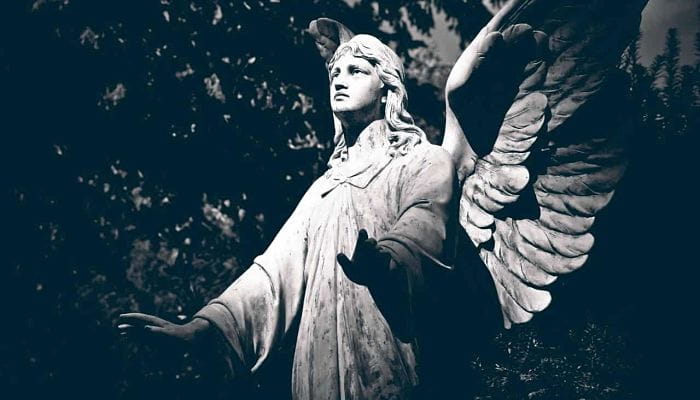
In artistic representations, angels are often shown dressed in white or blue. They often carry a white lily. Other times, they hold a trumpet, a shining lantern, a branch from Paradise, or a scroll. They are often shown in a scene depicting the Annunciation.
Symbolism
The most common symbol associated with angels is the white lily. The flower represents purity and truth. Another symbol of the archangel is a bird’s feather and ink. This symbolizes their primary purpose of serving as messengers of God.
