In Greek mythology, Echipa was a monster, half woman and half snake, who lived alone in a cave. She was the companion of the fearsome monster Typhon and was the mother of monsters, including many of the most famous monsters in Greek mythology.
Equipna is a somewhat dark monster, but nevertheless fearsome in Greek mythology. Homer’s The Iliad and Hesiod’s poem Theogony are some of the oldest writings that feature her, and therefore have had a major influence on the shaping of the modern narrative of Echidna. Apart from what is established in The Iliad, Theogony, and later texts by other authors, not much is known about Echidna.
1. The origins of Echidna
Because she is absent from most ancient texts, the origin story of Echidna is quite obscure. However, most authors seem to agree that her father was probably the sea god Phorcys. It was said that Echidna was born and spent most of her life in the same cave, leaving only to gather and devour unsuspecting travelers.
2. Genealogy
Equipna’s family tree varies depending on the author. The oldest genealogy related to Equidna, Hesiod’s Theogony (c. 8th century BC), is unclear on several points. According to Hesiod, Echidna was born of a “she” whom Hesiod probably intended to be the sea goddess Ceto, making Echidna’s probable father the sea god Phorcys; however, the “she” could refer to the Oceanid Callirhoe, which would make Medusa’s offspring, Chrysaor, Echidna’s father. The mythographer Pherecydes of Leros (5th century BC) has Equipna as the daughter of Phorcys, without naming a mother.
Other authors give Equipna different parents. According to the geographer Pausanias (2nd century AD), Epimenides (7th or 6th century BC) had Equipna as the daughter of Oceanid Styx (goddess of the river Styx) and a Peiras (otherwise unknown to Pausanias), while for the mythographer Apollodorus (1st or 2nd century AD), Equipna was the daughter of Tartarus and Gaia. In one account, from the Orphic tradition, Equipna was the daughter of Phanes (the Orphic father of all the gods).
3. Description
Equipna, according to Hesiod, was a maiden who was half beautiful and half a fearsome serpent. Hesiod described “the fierce goddess Equipna” as a “monster, irresistible” who ate flesh, who was not like “mortal men” or “eternal gods,” but was “half nymph with eyes that looked and pretty cheeks, and again a huge, great, and dreadful serpent with mottled skin,” who “does not die or grow old all her days.”
Hesiod’s apparent association of eating raw meat with half of Equippe’s serpent suggests that he may have assumed that half of Equippe’s serpent ended up as a serpent’s head, which makes her an inhabitant of the underworld and gives Equippe a hundred heads (probably serpent heads).
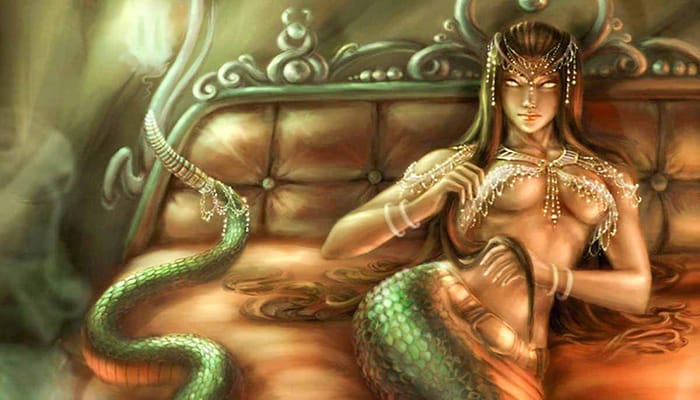
In the Orphic account (mentioned above), Equipa is described as having the head of a beautiful woman with long hair and a serpent’s body from the neck down. Nonnus, in his Dionysiaca, describes Equipa as “horrible,” with “horrible poison.”
4. Descendants
According to Hesiod’s Theogony, “the terrible and lawless Typhon”fell in love with Echidna, the lady with the slanting eyes, and gave birth to fierce offspring. First was Orthrus, the two-headed dog that guarded Geryon’s cattle; second was Cerberus, the multi-headed dog that guarded the gates of Hades; and third was the Lernaean Hydra, the many-headed serpent that, when one of its heads was cut off, grew two more.
The Theogony mentions a second “ambiguous” mother of the Chimera (a fire-breathing beast that was part lion, part goat, and had a tail with a snake’s head), which may refer to Equipa, although it may refer to the Hydra or even Ceto. Hesiod then names two more descendants of Equipa, the Sphinx, a monster with the head of a woman and the body of a winged lion, and the Nemean lion, killed by Heracles as his first labor.
According to Hesiod, these two were the offspring of Echidna’s son Orthrus and another ambiguous “she,” read on several occasions as the Chimera, Echidna herself, or even Ceto. In any case, the lyric poet Lasus of Hermione (6th century BC) has Echidna and Typhon as the parents of the Sphinx, while the playwright Euripides (5th century BC) has Echidna as its mother, without mentioning a father.
Although he mentions Cerberus and “other monsters” as descendants of Echidna and Typhon, the mythographer Acusilaus (6th century BC) adds the Caucasian eagle that ate Prometheus’ liver. Pherecydes also names Prometheus’ eagle and adds Ladon (although Pherecydes does not use this name), the dragon that guarded the golden apples in the Garden of the Hesperides.
5. Death
Although Hesiod believed Equipna to be immortal and ageless, according to Apollodorus, Equipna continued to take advantage of unfortunate “passers-by” until she was finally killed in her sleep by Argus Panoptes, the hundred-eyed giant who served Hera.
6. The Scythian Echidna
Since the 5th century BC, the historian Herodotus has told us of a creature which, although Herodotus does not name Equipa, is called Echidna (“viper”) and resembles Hesiod’s Equipa in several respects. She was half snake, half woman, lived in a cave, and was known as a mother figure, in this case as the progenitor of the Scythians (rather than monsters).
According to Herodotus, the Greeks living in Pontus, a region on the southern coast of the Black Sea, told the story of an encounter between Heracles and this serpentine creature. Heracles was driving Geryon’s cattle through what would later become Scythia when one morning he woke up and discovered that his horses had disappeared.
While searching for them, “he found in a cave a double-formed creature that was half maiden and half serpent; above the hips, she was a woman, below them a serpent.” She had the horses and promised to return them if Heracles had sex with her. Heracles agreed, and she bore him three sons: Agathyrsus, Gelonus, and Scourges.
She asked Heracles what she should do with her children: “Shall I keep them here (since I am the queen of this country), or shall I send them away?” And Heracles gave her a bow and a belt, and told her that when the children grew up, whoever drew the bow and wore the belt would keep them, and he would banish the others. The youngest son, Scythes, fulfilled the requirements and became the founder and eponym of the Scythians.
7. The viper in the Acts of Philip
A creature possibly related to the Hesiodic Equipna is the “Viper” (Equipna) thrown into the abyss by the apostle Philip in the apocryphal Acts of Philip. Called “she dragon” (drakaina) and “the mother of serpents,” this Equipna ruled over many other monstrous dragons and serpents and lived in a closed temple, where she was worshipped by the people of that land. She, along with her temple and priests, was swallowed by a hole in the ground that opened beneath her as a result of Philip’s curse.
8. Delphyne
Equipna was perhaps associated with the monster slain by Apollo at Delphi. Although that monster is said to be the male serpent Python, in the oldest account of this story, the Homeric Hymn to Apollo, the god kills an unnamed serpent (drakaina), later called Delphyne, who had been the foster mother of Typhon.
Equipna and Delphyne share several similarities. Both were half-human, half-serpent, and both were a “plague” on men. And both were closely connected to Typhon and associated with the Coriacian cave.
9. Iconography
No ancient representations of Equipna survive. According to Pausanias, Equipna was depicted, together with Typhon, in the 6th century BC, in the Doric-Ionic temple complex at Amyclae, known as the throne of Apollo, designed by Bathycles of Magnesia. Pausanias identifies two figures standing on the left as Equipna and Typhon, with Tritons standing on the right, without further details regarding these figures.
10. The life and death of Equipna
Most stories about Equipna deal with other more prominent mythological figures. There are no stories about Equipna’s own deeds. She existed mainly as a background character, a companion, or an antagonist. She is best known for her romantic relationship with the hideous giant Typhon and as the mother of his many monstrous children.
Some of these children became the most notorious and deadly monsters in Greek mythology. Although the identities of her children may vary depending on the author, most agree that she was at least the mother of Orthrus, Cerberus, and Hydra. Some authors also credit her as the mother of the CHIMERA, the Nemean Lion, Ladon, and the Caucasian Eagle that tore out Prometheus’ liver.
According to Hesiod, Equipa did not age or die a natural death “all her days.” Despite this, her immortality should not be confused with invincibility. The goddess Hera recognized the danger that Echipa posed to unsuspecting travelers and sent the hundred-eyed giant Argus Panoptes to kill her. Argus sneaked into Echipa’s cave and killed her while she slept.
Homer’s Iliad implies another fate: Typhon and Equipna, tired of being marginalized and outraged by the death of their children, waged war against the Olympians. To punish them for their rebellion, Zeus banished the couple underground.
The authors Callisthenes, Nonnus, and Pindar further specify that the two were imprisoned beneath the volcano Etna and have been spewing fire from the earth ever since.
11. Facts about Equipna
The Echidna, an Australian mammal, was named after the Echidna of Greek mythology. This is because it exhibits qualities of both reptiles and mammals.
There are no confirmed ancient artistic representations of Equipna. The most widely accepted image of her is based on Hesiod’s description of a beautiful snake living in a cave, but authors such as Aristophanes contradict this and describe her as a hideous beast with a hundred heads living in the underworld.
One theory about Equipna’s genealogy places her as the daughter of Tartarus and Gaia, which would make her and her lover the brothers Typhon.
Most authors believe that Equippone’s mother was an Oceanid, or a sea nymph.
Equipna’s murderer, Argus Panoptes, was a sworn servant of Hera. The command to kill Equipna was simply a secondary task. His main duty was to protect Zeus’ lover and ensure that Zeus stayed away from her.
In Ovid’s Metamorphoses, it is said that Equipna is capable of producing a poisonous venom with the power to induce madness.
Due to Equipa’s taste for raw human flesh, Daniel Ogden, professor of Ancient History at the University of Exeter, suggests that she may have had the head of a snake to more easily devour her prey. This contradicts the generally accepted image of Equipa, who is usually portrayed as having the head and torso of a beautiful woman but the tail of a snake.
The Homeric hymns (a series of anonymous writings in the style of Homer) equate Echidna with the dolphin Python, a snake sent by Gaia to protect the Oracle of Delphi. In this account, Python is born from the rotten mud left behind after the Great Flood and is killed by the god Apollo.