Durga, identified as Adi Parashakti, is a primary and popular form of the Hindu goddess. She is the warrior goddess, whose mythology centers on fighting the evils and demonic forces that threaten peace, prosperity, and the dharma of good. She is the fierce form of the protective mother goddess, ready to unleash her wrath against evil, violence for liberation, and destruction to empower creation.
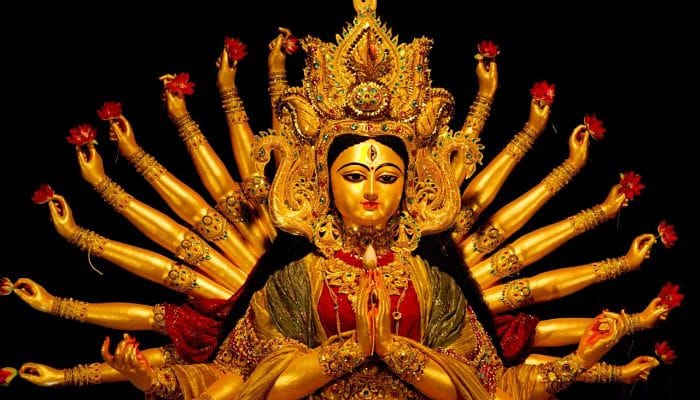
Physical Description
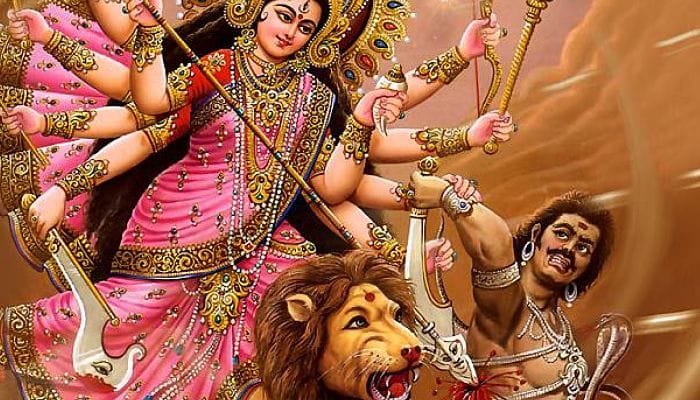
Durga is depicted in the Hindu pantheon as a goddess riding a lion or a tiger, with many arms each carrying a weapon, often defeating Mahishasura (lit. demon buffalo). The three main forms of worship of Durga are Maha Durga, Chandika, and Aparajita.
Of these, Chandika has two forms called Chandi, which is the combined form and power of Saraswati, Lakshmi, and Parvati, and Chamunda, which is a form of Kali created by the goddess to kill the demons Chanda and Munda. Maha Durga has three forms: Ugrachanda, Bhadrakali, and Katyayani. Bhadrakali Durga is also worshipped in the form of her nine epithets called Navadurga.
She is a central deity in the Shaktist tradition of Hinduism, where she is equated with the concept of ultimate reality called Brahman. One of the most important texts of Shaktism is Devi Mahatmya, also known as DurgÄ SaptashatÄ« or Chandi patha, which celebrates Durga as the goddess, declaring her to be the supreme being and creator of the universe.
Estimated to have been composed between 400 and 600 CE, this text is considered by Shakta Hindus to be as important a scripture as the Bhagavad Gita. She has a significant number of followers throughout India, Bangladesh, and Nepal, particularly in the eastern states of West Bengal, Odisha, Jharkhand, Assam, and Bihar. Durga is worshipped after the spring and autumn harvests, especially during the Navratri festivals.
Etymology
The word Durga (दà¥à¤°à¥à¤—ा)(দà§à¦°à§à¦—া) literally means “impassable,” “invincible, unassailable. “ It is related to the word Durg (दà¥à¤°à¥à¤—)(দà§à¦°à§à¦—), which means “fortress, something difficult to defeat or pass through.” According to Monier Monier-Williams, it derives from the roots dur (difficult) and gam (to pass, to cross). According to Alain Daniélou, it means “beyond defeat.”
The word is also found in ancient post-Vedic Sanskrit texts such as section 2.451 of the Mahabharata and section 4.27.16 of the Ramayana. These uses are in different contexts. For example, it is the name of an Asura who had become invincible to the gods, and it is the goddess who intervenes and kills him.
History
One of the earliest evidence of reverence for Devi—the feminine nature of God—appears in chapter 10.125 of the Rig Veda, one of the scriptures of Hinduism. This hymn is also called Devi Suktam (abbreviated):
I am the Queen, the gatherer of treasures, the most attentive, the first of those who deserve to be worshipped. Thus the gods have established me in many places with many homes to enter and dwell in. Only through me do all eat the food that nourishes them, – every man who sees, breathes, hears the word aloud.
They do not know it, but I dwell in the essence of the Universe. Listen, each and every one, to the truth as I declare it. I myself, indeed, announce and pronounce the word that gods and men alike will welcome. I make the man I love supremely powerful, I nourish him, I make him wise, and one who knows Brahman.
He bent the bow for Rudra (Shiva), so that his arrow may strike and kill the one who hates devotion. Awake and commanding battle for the people, I have created Earth and Heaven and dwell as their Internal Controller. At the summit of the world I bring forth the sky of the Father: my home is in the waters, in the ocean as Mother.
From there I permeate all existing creatures, as their Supreme Inner Being, and manifest them with my body. I created all worlds at my will, without any superior being, and I penetrated and dwelt within them. The eternal and infinite consciousness is me, it is my greatness dwelling in everything.
Works of art depicting “Goddess Durga slaying the demon buffalo Mahishasura,” a scene from Devi Mahatmya, are found throughout India, Nepal, and Southeast Asia. Clockwise from top: 9th-century Kashmir, 13th-century Karnataka, 9th-century Prambanan Indonesia, 2nd-century Uttar Pradesh.
The epithets of Devi synonymous with Durga appear in Upanishadic literature, such as Kali in verse 1.2.4 of the Mundaka Upanishad, dated around the 5th century BCE. This single mention describes Kali as “terrible but swift as thought,” a manifestation of the divine with a very red and smoky tongue, with a flickering tongue similar to fire, before the text begins to present its thesis that one must seek self-knowledge and knowledge of the eternal Brahman.
Origins
Historian Ramaprasad Chanda stated in 1916 that Durga evolved over time on the Indian subcontinent. An early form of Durga, according to Chanda, was the result of the “syncretism of a mountain goddess worshipped by the inhabitants of the Himalayas and the Vindhyas,” a deity of the Abhiras conceptualized as a goddess of war.
Durga then transformed into Kali as the personification of all-destroying time, while some aspects of her emerged as the primordial energy (Adya Sakti) integrated into the concept of samsara (cycle of rebirths), and this idea was built upon the basis of Vedic religion, mythology, and philosophy.
Epigraphic evidence indicates that, regardless of her origins, Durga is an ancient goddess. Sixth-century inscriptions in Siddhamatrika script, such as those in the cave on Nagarjuni Hill during the Maukhari era, already mention the legend of her victory over Mahishasura (a hybrid buffalo demon).
Birth
Originally she is Adi Parashakti, present before the creation and after the destruction of the entire universe. She is the ultimate energy, but to defeat the Asura Mahishasura, all the gods invoked her, and as she was present in the form of shakti in all the gods, she manifested herself from the three gods Brahma, Vishnu, and Shiva and the other gods.
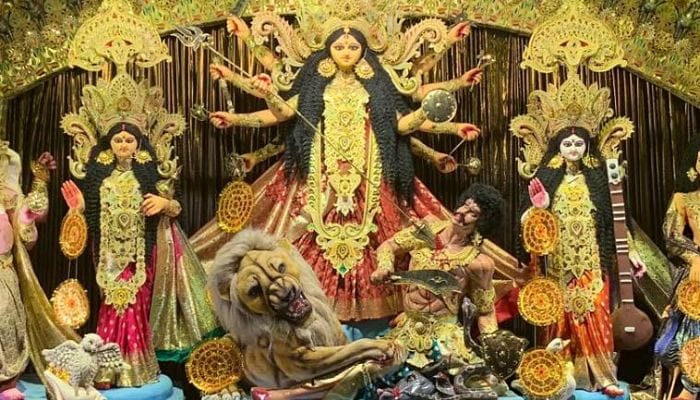
Thus, her manifest form was born/emerged from the gods to end the torture of Asura Mahishasura. She was endowed with different weapons, ornaments, valuable clothing, and gold jewelry with precious stones, and a lion as her mount before going to war.
References from the colonial era
Some of the earliest European accounts refer to a deity known as Deumus, Demus, or Deumo. Western sailors (Portuguese) first came face to face with the murti of Deumus in Calicut, on the Malabar coast, and concluded that it was the deity of Calicut. Deumus is sometimes interpreted as an aspect of Durga in Hindu mythology and sometimes as a deva. It is said that the ruler of Calicut (Zamorin) had a murti of Deumus in his temple inside his royal palace.
Attributes and iconography
Durga has been a warrior goddess and is depicted to express her martial skills. Her iconography typically resonates with these attributes, where she rides a lion or a tiger, has between eight and eighteen hands, each with a weapon to destroy and create. She is often shown in the midst of her war with Mahishasura, the buffalo demon, at the moment when she victoriously kills the demonic force.
In Hindu art, this calm attribute of Durga’s face is traditionally derived from the belief that she is protective and violent, not out of hatred, selfishness, or pleasure in violence, but because she acts out of necessity, out of love for good, for the liberation of those who depend on her, and marks the beginning of the soul’s journey toward creative freedom.
Durga traditionally wields the weapons of various male gods in Hindu mythology, which are given to her to fight the forces of evil because they feel she is the shakti (energy, power). These include the chakra, conch shell, bow, arrow, sword, javelin, shield, and rope. These weapons are considered symbolic by Shakta Hindus, representing self-discipline, selfless service to others, self-examination, prayer, devotion, remembrance of mantras, joy, and meditation.
The iconography of Durga has been flexible in Hindu traditions, where, for example, some intellectuals place a pen or other writing implements in her hand, as they consider her stylus to be her weapon. Archaeological discoveries suggest that these iconographic features of Durga became common throughout India around the 4th century AD, according to David Kinsley, a professor of religious studies specializing in Hindu goddesses.
In some temples, she appears as part of the Mahavidyas or Saptamatrkas. Her icons in major Hindu temples, such as in Varanasi, include relief works depicting scenes from the Devi Mahatmya.
Durga appears in Hindu mythology in numerous forms and names, but ultimately all of these are different aspects and manifestations of one goddess. While anthropomorphic icons of her, such as those showing her riding a lion and holding weapons, are common, Hindu traditions use aniconic forms and geometric designs (yantra) to remember and venerate what she symbolizes.
Worship and festivals
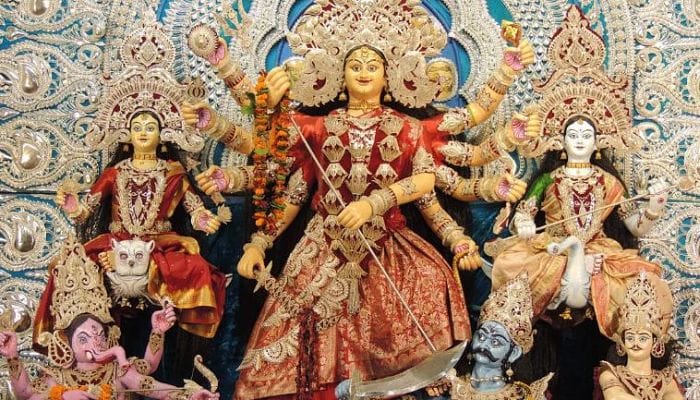
Durga is worshipped in Hindu temples in India and Nepal by Shakta Hindus. Her temples, cults, and festivals are particularly popular in the east and northeast of the Indian subcontinent during Durga Puja, Dashain, and Navaratri.
Durga Puja
The four-day Durga Puja is an important annual festival in Bengal, Odisha, Assam, Jharkhand, and Bihar. It is scheduled according to the Hindu lunisolar calendar in the month of Ashvin, and is usually celebrated in September or October. Since it is celebrated during Sharad (literally, the season of weeds), it is called Sharadiya Durga Puja or Akal-Bodhan to differentiate it from the one originally celebrated in spring.
Communities celebrate the festival by making special images of Durga out of clay, reciting the text of Devi Mahatmya, praying, and enjoying themselves for nine days, after which it is taken out in procession with singing and dancing and immersed in water. The Durga Puja is an occasion of great private and public festivities in the eastern and northeastern states of India.
This festival is an ancient tradition of Hinduism, although it is unclear how and in which century the festival began. Surviving manuscripts from the 14th century provide guidelines for the Durga puja, while historical records suggest that royalty and wealthy families sponsored the main public festivities of the Durga puja since at least the 16th century. The 11th- or 12th-century Jain text Yasatilaka by Somadeva mentions a festival and annual dates dedicated to a warrior goddess, celebrated by the king and his armed forces, and the description reflects the attributes of a Durga puja.
Dashain
In Nepal, the festival dedicated to Durga is called Dashain (sometimes spelled Dasain), which literally means “the ten.” Dashain is Nepal’s longest national holiday and is a public holiday in Sikkim and Bhutan. During Dashain, Durga is worshipped in ten forms (Shailaputri, Brahmacharini, Chandraghanta, Kushmanda, Skandamata, Katyayani, Kalaratri, Mahagauri, Mahakali, and Durga) with one form for each day in Nepal.
The festival includes animal sacrifice in some communities, as well as the purchase of new clothes and the giving of gifts. Traditionally, the festival is celebrated for 15 days, with the first nine days spent by devotees remembering Durga and her ideas, the tenth day marking Durga’s victory over Mahisura, and the last five days celebrating the victory of good over evil.
During the first nine days, nine aspects of Durga known as Navadurga are meditated on one by one during the nine-day festival by devotees of Shakti. Durga Puja also includes the worship of Shiva, who is the consort of Durga, as well as Lakshmi, Saraswati, Ganesha, and Kartikeya, who are considered to be the children of Durga. Some Shaktas worship the symbolism of Durga and her presence as Mother Nature.
In southern India, especially in Andhra Pradesh, Dussera Navaratri is also celebrated, and the goddess is dressed each day as a different Devi, all considered equivalent but another aspect of Durga.
Other countries
In Bangladesh, the four-day Sharadiya Durga Puja is the most important religious festival for Hindus and is celebrated throughout the country, with Vijayadashami being a national holiday. In Sri Lanka, Durga in the form of Vaishnavi, with the iconographic symbolism of Vishnu, is celebrated. This tradition has been continued by the Sri Lankan diaspora.
In Buddhism
According to Hajime Nakamura, throughout their history, some Buddhist traditions adopted Vedic and Hindu ideas and symbols. For example, the fierce meditative Buddhist deity Vajrayana Yamantaka, also known as Vajrabhairava, developed from the pre-Buddhist god of death, Yama. The tantric traditions of Buddhism included Durga and developed the idea further. In Japanese Buddhism, she appears as Butsu-mo (sometimes called Koti-sri). In Tibet, the goddess Palden Lhamo resembles the protective, fierce, and fierce Durga.
In Jainism
The mata Sacciya found in the main medieval temples of the Jain era reflects Durga, and has been identified by Jain scholars as the same or sharing a common older lineage. In the Ellora Caves, Jain temples depict Durga with her lion mount. However, she is not shown killing the buffalo demon in the Jain cave, but is presented as a peaceful deity.
In Sikhism
Durga is exalted as divine in the Dasam Granth, a sacred text of Sikhism traditionally attributed to Guru Gobind Singh. According to Eleanor Nesbitt, this view has been questioned by Sikhs who consider Sikhism to be monotheistic, arguing that a female form of the supreme and reverence for the goddess is “unmistakably Hindu in character.”
Outside the Indian subcontinent
The goddess Durga in Southeast Asia, from left to right: 7th/8th century Cambodia, 10th/11th century Vietnam, 8th/9th century Indonesia. Archaeological excavations in Indonesia, especially on the island of Java, have yielded numerous statues of Durga.
Of the numerous stone statues of Hindu deities from the early to mid-Middle Ages discovered on the Indonesian islands, at least 135 are of Durga. In some parts of Java, she is known as Loro Jonggrang (literally, “slender maiden”).
In Cambodia, during the era of Hindu kings, Durga was popular and numerous sculptures of her have been found. However, most differ from the Indian representation in one detail. The Cambodian iconography of Durga shows her standing on top of a severed buffalo head. Statues of Durga have been discovered in stone temples and archaeological sites in Vietnam, probably related to the Champa or Champa dynasty.
Influence
Durga is one of the main goddesses of Hinduism and the inspiration for Durga Puja, a major annual festival, particularly in the eastern and northeastern states of India. Every village, town, and city has its own goddess (if not a form of Laxmi). Durga is celebrated throughout northern India, commonly with the phrase “Jay Mata Di.” She is worshipped as Kamakshi in Tamil Nadu. Large cities such as Mumbai (named after Mumba Devi, a name for Durga) and Kolkata (from Kalika, one of Durga’s main forms) are named after her.
One of the devotees of her form as Kali was Sri Ramakrishna, who was the guru of Swami Vivekananda. He is the founder of the Ramakrishna Mission. Durga as mother goddess is the inspiration behind the song Vande Mataram, written by Bankim Chandra Chatterjee during the Indian independence movement, later becoming the official national anthem of India.
Durga is present in Indian nationalism, where Bharat Mata, or Mother India, is seen as a form of Durga. This is completely secular and in line with the ancient ideology of Durga as Mother and protector of Indians. She is present in pop culture and in successful Bollywood films such as Jai Santoshi Maa. The Indian army uses phrases such as “Durga Mata ki Jai” and “Kaali Mata ki Jai!” It is said that every woman who takes up a cause to fight for goodness and justice has the spirit of Durga in her.
